
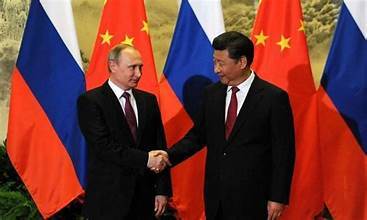
The summit between Chinese President Xi Jinping and Russian President Vladimir Putin in Beijing in May 2026 was not merely a bilateral meeting between two major powers. Rather, it appeared to signal the emergence of a new phase in the restructuring of the international order. The timing alone carried profound strategic implications: the summit came only days after U.S. President Donald Trump concluded his visit to Beijing, making China appear as the geopolitical center around which the world’s major power dynamics now revolve.
In reality, what unfolded in Beijing goes far beyond the traditional framework of Sino-Russian relations. It reflects the accelerating transformation of the global balance of power toward a multipolar order in which Western dominance is gradually eroding in favor of rising geopolitical and economic blocs—most notably the emerging Eurasian bloc.
From a “No-Limits Partnership” to the Architecture of an Alternative World Order
Since China and Russia declared their “no-limits partnership” in 2022, relations between the two countries have steadily deepened. Yet the 2026 summit demonstrated that the relationship has evolved beyond political and economic cooperation into an effort to construct a strategic structure parallel to the U.S.-led international order.
The summit’s rhetoric went well beyond bilateral coordination. Both sides openly criticized “unipolar hegemony,” condemned Western military policies and U.S. missile defense systems, and emphasized the necessity of building a “multipolar world.”
More importantly, this convergence is no longer based solely on pragmatic interests. Beijing and Moscow increasingly perceive that they are both facing comprehensive Western containment. China confronts mounting pressure in the South China Sea and around Taiwan, while Russia remains locked in a prolonged war of attrition with the West in Ukraine. Consequently, both powers now view strategic coordination as a matter of geopolitical survival rather than diplomatic convenience.
Iran: The Geographical Core of the Eurasian Project
If China represents the economic engine of this axis and Russia its military backbone, then Iran constitutes its most critical geopolitical node. Iran occupies a strategic crossroads connecting the Arabian Gulf, Central Asia, the Caucasus, the Red Sea, and the Indian Ocean, making it indispensable to any project aimed at reshaping global trade and energy routes.
For this reason, Tehran is no longer perceived by Beijing and Moscow merely as a regional Middle Eastern actor. Instead, it has become part of the geopolitical infrastructure of the broader Eurasian project. Strategic studies increasingly point to Iran as the key link connecting China’s Belt and Road Initiative with the Russian-Iranian International North–South Transport Corridor.
Stretching approximately 7,200 kilometers, the North–South Corridor is designed to connect Russia to the Indian Ocean through Iran, with projected annual cargo flows estimated between 14 and 24 million tons upon completion. In this context, weakening or isolating Iran would not simply affect a regional power—it would undermine one of the central pillars of Eurasian connectivity.
China: The Economic Power Redrawing the Global Map
China approaches this emerging bloc with a fundamentally different strategic logic from Russia. Beijing is not seeking direct military confrontation with the West; rather, it aims to reshape the global order from within through trade, infrastructure, technology, and financial integration.
The Belt and Road Initiative has evolved from a development project into a geopolitical instrument for redesigning global economic geography. Chinese strategists increasingly recognize that control over trade corridors and supply chains may prove more decisive in the twenty-first century than traditional military dominance.
This explains Beijing’s push to establish parallel financial and technological systems independent of Western control, including the expansion of the digital yuan, alternative payment mechanisms to SWIFT, and massive investments in artificial intelligence, semiconductors, and transcontinental digital infrastructure.
China is also the world’s largest energy importer, with a significant share of its oil supplies originating from the Gulf region. As a result, the stability of the Middle East, the Red Sea, and the Gulf has become directly tied to China’s national security calculations.
In many ways, China functions as the “strategic brain” of the emerging Eurasian axis—seeking to leverage geopolitical stability to expand its global economic influence without becoming directly entangled in large-scale military conflicts.
Russia: Strategic Exhaustion of the West
Russia, by contrast, operates according to a more confrontational logic. Moscow views the war in Ukraine not as a regional conflict, but as a historic struggle over the future shape of the international order. Consequently, Russia seeks to widen the arenas of strategic pressure on the United States and its allies, thereby dispersing and exhausting Western power across multiple fronts.
From Moscow’s perspective, the Middle East serves as an ideal arena for strategic attrition. Every escalation in the Gulf or the Red Sea compels Washington to redistribute military resources away from Eastern Europe. Russia also understands that preserving Iran’s strategic resilience creates a permanent challenge to American influence in the region.
Yet this relationship also exposes Russia’s growing dependence on China. Bilateral trade between the two countries reached approximately $228 billion in 2025, while Russian oil exports to China surged dramatically during the first half of 2026.
At the same time, disputes surrounding projects such as the “Power of Siberia 2” pipeline reveal the limits of the partnership. China remains cautious about making major economic concessions to Moscow, reflecting a widening asymmetry in favor of Beijing.
An Alliance of Necessity, Not of Trust
Despite the growing alignment among China, Russia, and Iran, this emerging bloc does not resemble traditional alliances such as NATO or the Warsaw Pact. It lacks a unified command structure or formal mutual defense commitments. Instead, it is held together by overlapping strategic interests and a shared perception of threat.
China seeks to avoid direct military entanglements, Russia fears becoming a junior partner to Beijing, and Iran remains wary that it could eventually become a bargaining chip in a future grand bargain between Washington and either Moscow or Beijing.
This makes the emerging Eurasian axis less an ideological alliance and more a flexible geopolitical arrangement shaped by necessity rather than complete strategic trust.
The Middle East and the Red Sea at the Heart of Global Competition
One of the most significant implications of the 2026 summit is the extent to which the Middle East and the Red Sea have become central theaters in the emerging global struggle for influence.
Competition among major powers is no longer confined to armies and military bases. It increasingly revolves around trade corridors, maritime chokepoints, supply chains, artificial intelligence, semiconductors, and technological dominance.
Accordingly, the integration of China’s Belt and Road Initiative with Russian-Iranian transport corridors reflects more than economic cooperation; it represents an attempt to redesign global trade routes beyond the traditional maritime system dominated by the United States.
Similarly, Chinese, Russian, and Iranian activities in Sudan, Libya, Ethiopia, and the Horn of Africa indicate that the Red Sea and the Suez Canal have become key arenas in the broader geopolitical contest between East and West.
Can the Eurasian Axis Succeed?
The answer remains uncertain. Western pressure is clearly pushing China, Russia, and Iran toward greater strategic coordination. Yet the emerging axis also contains deep internal contradictions related to asymmetries of power, divergent strategic priorities, and competing national interests.
Nevertheless, the most important reality revealed by the Beijing summit is that the world has undeniably entered a major transitional phase in which the United States is no longer the sole power capable of shaping the international order on its own.
What is emerging today is not merely a temporary political alignment, but an ambitious attempt to construct a “Greater Eurasia” stretching from Beijing to Moscow and Tehran—one aimed at redistributing global power and reshaping the geography of trade, energy, and technology beyond the framework of traditional Western dominance.
Most read