
Why Do Young People Cry Because of Football?

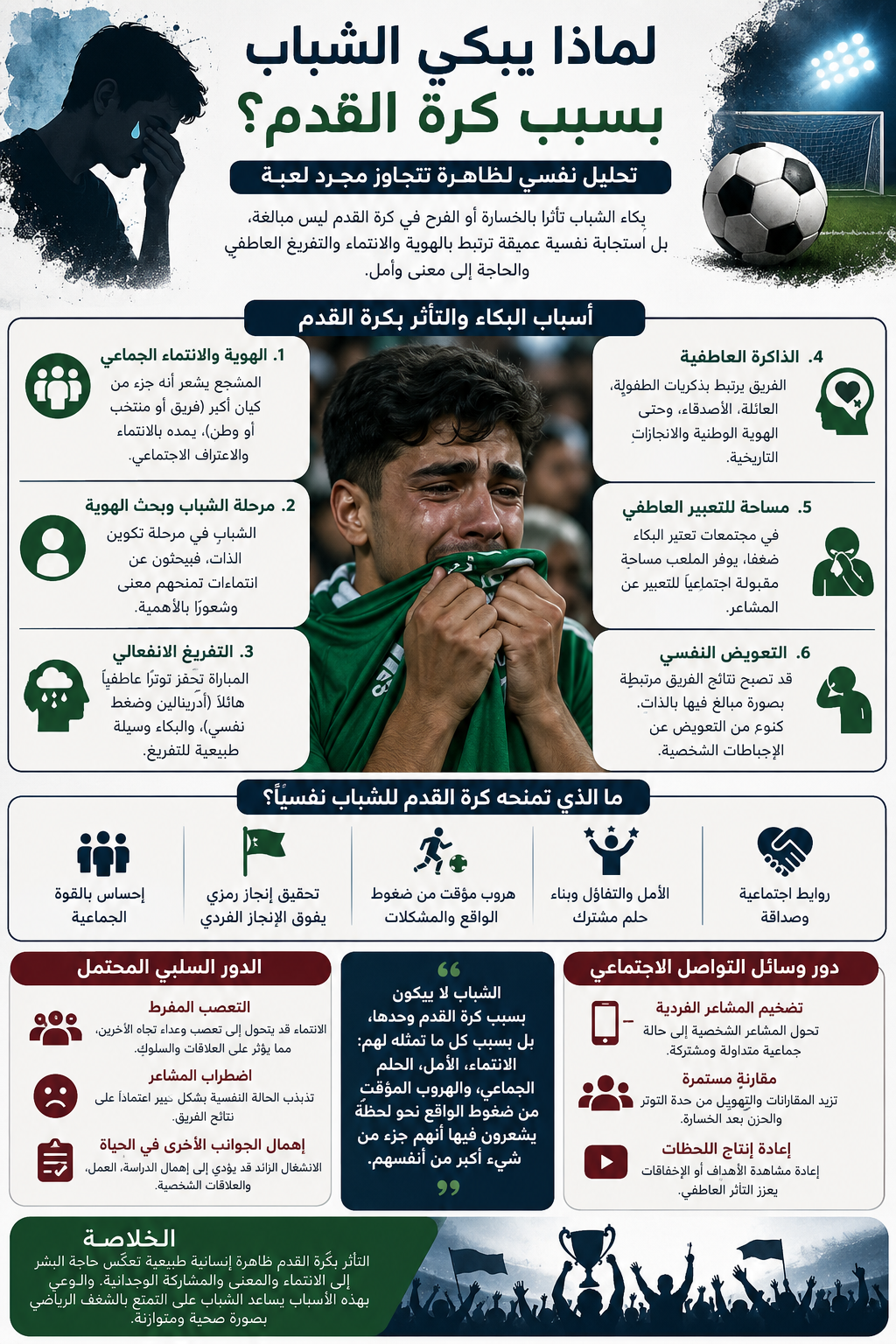
A Psychological Reading of the Relationship Between Identity, Belonging, and Sporting Emotion
For some people, young fans crying over the defeat of a football team or the victory of a national side may seem exaggerated. In reality, however, it is a complex psychological and social phenomenon connected to deep human needs such as belonging, identity, emotional release, and the projection of the self onto a collective group. The issue is not merely football as a game, but rather what it symbolically represents within the consciousness of individuals and societies.
In social psychology, sport is considered one of the strongest instruments of “collective identity.” A supporter does not see himself merely as a spectator following a team; rather, he feels part of a larger entity that provides meaning, belonging, and social recognition. Consequently, victory becomes a personal triumph, while defeat is experienced as a psychological shock that affects self-image and collective affiliation.
This phenomenon becomes particularly pronounced among young people because youth is psychologically associated with the search for identity, belonging, and self-affirmation. In societies that sometimes suffer from economic, political, or social pressures, football turns into an alternative space for expressing repressed emotions and achieving a sense of collective strength and symbolic success.
For this reason, crying in football is not always simply an expression of sadness. It may instead result from an enormous emotional release after the accumulation of tension, anticipation, and psychological pressure. The supporter experiences the match almost as a psychological battle, during which adrenaline levels and nervous tension rise in ways similar to what occurs in real-life critical situations.
Football is also deeply connected to emotional memory. Many young people associate their teams with childhood memories, family ties, friendships, or even national identity. Therefore, their emotional reaction is not tied solely to the result of a match, but to an entire system of meanings, memories, and affiliations.
From another perspective, football provides a rare social space—particularly for men—to express emotions openly in societies that often associate masculinity with emotional restraint and toughness. In everyday life, crying may be perceived as a sign of weakness, but within the sporting sphere it becomes socially acceptable, and is sometimes even understood as an expression of loyalty, belonging, and passion.
Social media also plays a major role in amplifying this phenomenon. It transforms individual emotions into a shared and widely circulated collective experience, increasing the intensity of psychological and emotional interaction. The supporter no longer experiences the match alone, but rather within a vast “digital crowd” that reproduces emotions collectively and instantaneously.
In some cases, however, excessive attachment to sport may evolve into a form of “psychological compensation” for personal frustrations or the absence of individual achievement. As a result, the team’s outcomes become disproportionately tied to the individual’s emotional state and self-esteem. This is where forms of fanaticism or excessive emotional breakdown after defeats may emerge.
Nevertheless, emotional attachment to football remains, in most cases, a natural human phenomenon reflecting people’s need for belonging, meaning, and emotional participation. Stadiums are not merely arenas for athletic competition; they are psychological and social spaces where identity, emotion, and collective memory intersect.
In general, young people may not cry because of football alone, but because of everything it represents to them: belonging, hope, the collective dream, and a temporary escape from the pressures of reality toward a moment in which they feel part of something greater than themselves.
Most read