
Africa has become one of the most significant arenas of international competition in the twenty-first century, not only because of its vast natural resources, but also because of its growing geopolitical and economic importance within the emerging international order. At the center of this transformation stands China, which has emerged as the most rapidly expanding external actor on the continent through a comprehensive strategy combining economics, politics, and security. This strategy has gradually reshaped the traditional balance of influence long dominated by Western powers.
China’s orientation toward Africa must be understood within the broader context of its dramatic transformation since the 1990s. Over the past decades, China evolved from a developing and relatively closed economy into a global economic power competing with the United States for international leadership. The rapid expansion of Chinese industry and the continuous rise in production and consumption compelled Beijing to search for new sources of energy, raw materials, and external markets. In this context, Africa emerged as a strategic sphere capable of satisfying China’s growing needs, whether through oil and gas supplies, mineral resources, or expanding consumer markets and investment opportunities.
However, the Chinese presence in Africa has never been merely a conventional economic expansion. Rather, it forms part of a broader Chinese project aimed at reshaping the international order and reducing Western dominance. Beijing recognized that expanding its influence in Africa would provide it with significant political weight within international institutions, particularly through the diplomatic support of African states in the United Nations. It also serves China’s long-standing objective of consolidating the “One China” policy and diplomatically isolating Taiwan. Consequently, Sino-African relations acquired a profound political dimension that extends beyond trade and investment toward the construction of long-term strategic partnerships based on the rhetoric of South-South cooperation and resistance to Western conditionality.
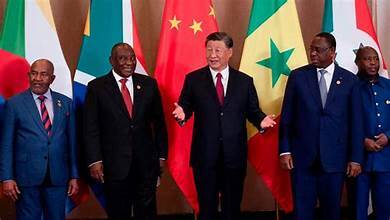
China’s approach in Africa has differed markedly from the traditional Western model. Unlike Western powers, Beijing has generally refrained from linking aid and investment to political conditions such as democratization or human rights reforms. Instead, China has presented itself as a development partner focused on infrastructure, trade, and investment. This approach earned Beijing broad acceptance among many African governments, which often viewed Western policies as extensions of old colonial practices. Through this model, China succeeded in becoming Africa’s leading trading partner, surpassing both the United States and France, while simultaneously expanding its investments in energy, ports, roads, telecommunications, and railway infrastructure.
At the heart of China’s African strategy lies the issue of energy and resource security. As the “factory of the world,” China requires stable flows of oil and strategic minerals to sustain its economic growth. Accordingly, Beijing intensified its energy investments in countries such as Angola, Sudan, Nigeria, and Algeria, while also securing access to strategic minerals including cobalt, manganese, copper, and uranium. This expansion significantly altered the global map of resource trade, as China became the primary importer of several African minerals, while European and American influence in this sector steadily declined.
Yet China’s economic expansion has increasingly intersected with security and military dimensions. As Chinese interests in Africa grew, Beijing gradually developed a security presence aimed at protecting its investments, securing maritime trade routes, and safeguarding energy supply lines. This shift became evident through China’s growing participation in United Nations peacekeeping missions, its anti-piracy operations off the Somali coast, and ultimately the establishment of its first overseas military base in Djibouti in 2016. These developments reflect China’s transition from a policy of “peaceful rise” toward a more pragmatic strategy that combines soft and hard power to protect strategic interests abroad.
In response, China’s rise in Africa generated increasing concern among the United States and Western powers, which viewed Beijing’s expanding presence as a direct challenge to their traditional influence on the continent. Washington came to recognize that Africa was no longer a peripheral arena in world politics, but rather an integral component of the global struggle for influence. This realization contributed to the creation of the United States Africa Command (AFRICOM) and the expansion of American military and security programs across the Sahel and the Horn of Africa. Through these measures, the United States sought to restore the balance of influence and contain China’s growing presence, while simultaneously strengthening its own economic and political partnerships with African governments.
Despite China’s success in presenting itself as an alternative development partner, its experience in Africa has not been free from criticism. Concerns have emerged regarding the flooding of African markets with inexpensive Chinese goods, which undermined local industries in several countries. Chinese companies have also been criticized for relying heavily on Chinese labor rather than employing local African workers. Furthermore, the growing Chinese military presence has raised fears that Africa could increasingly become a theater for geopolitical rivalry among major powers, with potentially destabilizing consequences for regional security and political stability.
Ultimately, China’s strategy in Africa reflects a profound transformation in the structure of the contemporary international system. Africa has become one of the principal arenas through which global power is being redistributed. China’s objectives extend beyond securing resources and markets; Beijing also seeks to promote a multipolar international order capable of limiting Western dominance and granting rising powers greater influence in global affairs. Nevertheless, the future of China’s presence in Africa will depend largely on the ability of African states themselves to exploit international competition in support of their own development agendas, rather than allowing the continent to once again become merely a battleground for great-power rivalry and geopolitical confrontation.
Most read