
The mineral wealth of the Democratic Republic of the Congo is no longer merely a local economic resource; it has become a central element in the global geopolitical struggle over energy, technology, and strategic supply chains. The African state, which possesses some of the world’s largest reserves of cobalt, copper, and critical minerals, now stands at the heart of international competition, particularly as the world accelerates toward a green economy, electric vehicles, and advanced technologies.
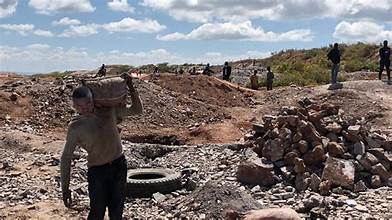
Within this context, the Congolese government announced an unprecedented step: the creation of a new paramilitary unit tasked with protecting mining sites and mineral transport routes, backed by support and funding from the United States and the United Arab Emirates. This move reflects a growing recognition that control over strategic minerals is no longer simply an economic issue, but has become deeply tied to national security and global competition over influence and resources.
From Private Security to the Militarization of Mineral Wealth
In the past, mining companies primarily relied on private security firms to protect their sites and infrastructure, as occurred in 2020 when Frontier Services Group Congo signed an agreement with the Chinese mining company Sicomines to provide security services for its operations. However, the current shift signals a transition toward a more centralized and militarized model of managing the mining sector.
The Congolese government plans to deploy approximately 20,000 personnel by 2028 across key mining regions under the supervision of the General Inspectorate of Mines. The stated objectives include reducing smuggling, replacing corrupt security forces, improving transparency and mineral traceability, and limiting the influence of armed groups operating in eastern Congo.
Yet the fundamental question remains: can security measures alone resolve a deeply rooted crisis linked to governance failures, corruption, and weak state institutions?
Congo’s Minerals at the Center of Global Competition
The Democratic Republic of the Congo occupies a uniquely strategic position in the global economy. It produces nearly three-quarters of the world’s cobalt supply, in addition to substantial reserves of gold, copper, tin, tungsten, and tantalum. These minerals are essential for batteries, electric vehicles, renewable energy systems, and advanced technologies.
As a result, the struggle over Congo is no longer simply an African domestic issue. It has evolved into part of the broader geopolitical competition among the United States, China, and the European Union to secure future supply chains.
Chinese companies currently dominate large parts of Congo’s mining sector, particularly cobalt production, while Washington and Brussels are attempting to reduce dependence on Chinese-controlled supply chains through new partnerships with Kinshasa focused on infrastructure, transport corridors, and electric battery manufacturing.
From this perspective, the proposed “mining guard” can be understood not merely as a domestic security initiative, but as part of a broader effort to reshape the balance of power within the strategic minerals sector.
The Real Dilemma: A Governance Crisis, Not Merely a Security Problem
Although improving security in mining areas is important, the core of the crisis in Congo runs much deeper than armed groups or smuggling networks.
The study indicates that legal frameworks regulating mining already exist, particularly after the 2018 Mining Code reforms, which expanded state participation and strengthened environmental and social obligations. However, the real challenge lies in weak enforcement, limited transparency, fragile oversight institutions, and persistent corruption and informal economic activity.
In many cases, state security forces themselves have been implicated in illegal mining operations, informal taxation, and abuses against local communities. This raises fears that the new force could ultimately reproduce existing problems rather than solve them.
The Green Economy and the Dark Side of Critical Minerals
The Congolese case exposes a striking contradiction within the global transition toward “clean energy.” While industrialized nations present electric vehicles and renewable energy projects as environmental solutions for the future, many of these industries rely on minerals extracted from regions marked by poverty, conflict, corruption, and weak governance.
This raises an important ethical and political question: can a “green” global economy truly be built upon opaque supply chains and unstable extraction zones?
For this reason, multinational corporations now face increasing pressure to prove that the minerals used in their products come from responsible and traceable sources that meet environmental and human-rights standards, particularly under frameworks promoted by the Organisation for Economic Co-operation and Development.
Between Sovereignty and International Trust
The Congolese initiative reflects a broader transformation in how strategic resources are governed. Access to minerals is no longer determined solely by geology or production capacity; it increasingly depends on trust.
Major powers and multinational corporations are no longer seeking minerals alone. They are searching for stable, transparent, and traceable environments capable of guaranteeing uninterrupted supply chains free from chaos and illicit trade.
Consequently, Congo’s future position within global supply chains will depend not only on the quantity of minerals it possesses, but also on its ability to build a governance system capable of managing this wealth transparently and responsibly.
Conclusion
The creation of a specialized force to protect mines in the Democratic Republic of the Congo reflects a growing awareness that critical minerals have become part of national security calculations and global geopolitical competition. However, militarizing the mining sector, while potentially necessary from a security perspective, will not by itself resolve the roots of the crisis.
Congo is not facing merely a security challenge; it is confronting a crisis of governance, institutions, accountability, and public trust. Unless corruption, weak oversight, community rights, and transparency in contracts and financial flows are properly addressed, any new security force risks becoming just another instrument within an already dysfunctional system.
In a world rapidly moving toward a green economy and intensifying competition over critical minerals, Congo’s real battle is not simply about who controls the mines, but about who possesses the ability to manage this wealth in a legitimate, sustainable, and durable manner.
Most read