Why Is the Trump Administration Betting on Damascus?

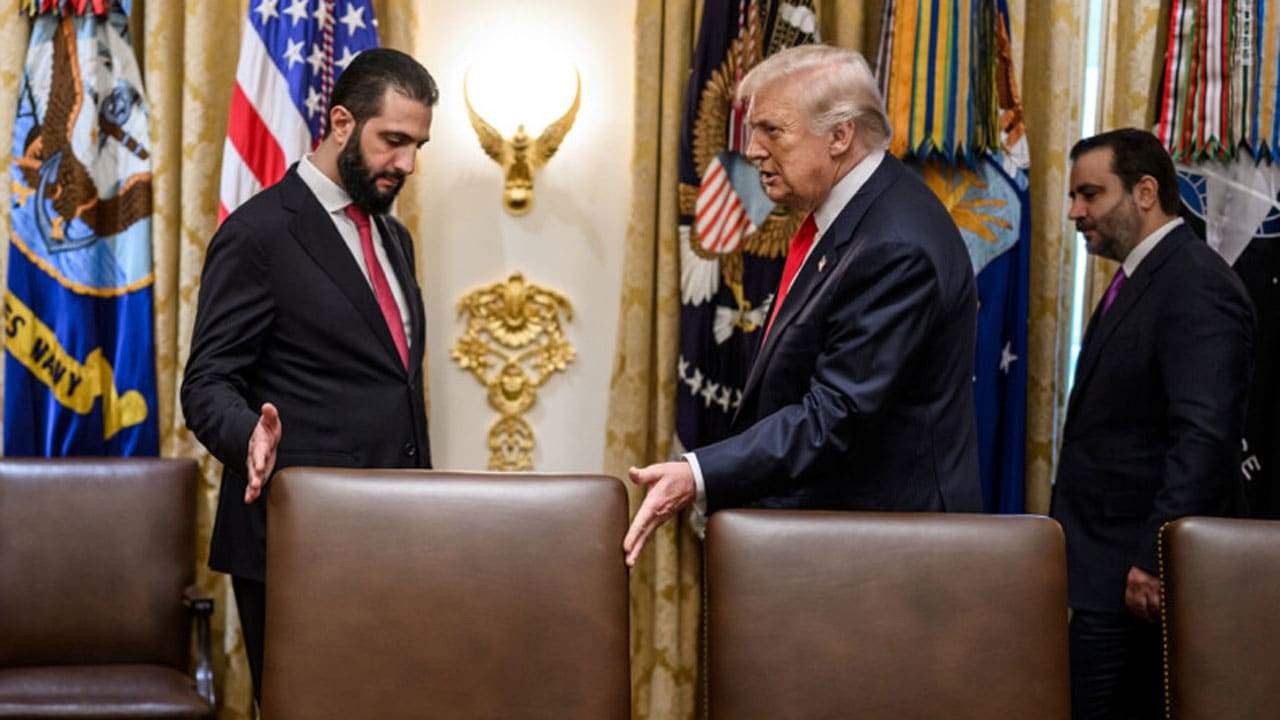
The praise that U.S. President Donald Trump has directed toward his Syrian counterpart, Ahmad al-Sharaa, is far more than diplomatic courtesy. It reflects a broader shift in Washington's perception of Syria and its potential role within a rapidly evolving regional order. When senior American officials link Syria's stability to "shaping the future of the Middle East," they are signaling more than recognition of a new political leadership. They are expressing an intention to reposition Syria's geography in service of a wider strategic agenda centered on containing Iran, safeguarding Israel's security, combating transnational militant organizations, securing regional trade and energy corridors, and reducing the cost of direct U.S. military engagement.
Since Ahmad al-Sharaa assumed power in Damascus in December 2024, Syria's new leadership has faced a dual challenge: rebuilding state authority at home while restoring legitimacy and international engagement abroad. For its part, the Trump administration appears prepared to approach the new government through a pragmatic rather than ideological lens. The central question in Washington is not where the new leadership came from, but what strategic functions it is capable of performing.
This explains the renewed American interest in Damascus. Syria occupies a unique geopolitical position, linking Iraq, Lebanon, Türkiye, Jordan, the Eastern Mediterranean, and Israel. For decades, it also served as the critical land bridge connecting Iran to Lebanon. Transforming Syria from an arena of regional competition into a functioning centralized state capable of controlling its territory could significantly alter the strategic balance across the Levant.
Strategic Objectives Remain Constant; Only the Tools Have Changed
Despite changes in U.S. administrations, Washington's core objectives in the Middle East have remained remarkably consistent: protecting Israel's security, preserving the stability of global energy and trade flows, preventing transnational terrorist threats, and ensuring that no regional rival dominates critical strategic corridors.
What has changed under Trump is not these objectives but the instruments used to achieve them.
Rather than relying on large-scale military deployments and prolonged interventions, the Trump administration has consistently favored burden-sharing, encouraging regional actors to assume greater responsibility for their own security while employing sanctions, diplomatic recognition, economic incentives, and political leverage as instruments of influence.
Within this framework, reducing America's military footprint does not necessarily imply declining influence. Instead, it reflects an effort to preserve strategic leverage at lower cost. A stable Syrian state therefore becomes considerably more valuable to Washington than a fragmented Syria requiring permanent military and intelligence engagement.
The United States does not necessarily need Syria to become a close political ally. It needs Syria to become sufficiently stable to prevent renewed chaos, suppress militant organizations, contain Iranian influence, secure Israel's northern frontier, and reduce the need for direct American intervention.
Syria and the Geography of Strategic Corridors
Syria's importance in U.S. energy calculations has little to do with its own hydrocarbon production. Instead, it derives from its location within the broader network connecting the Gulf, Iraq, the Eastern Mediterranean, and European markets.
Although the United States has become one of the world's leading energy producers, energy security remains a central pillar of its global strategy. Today's American approach is less about importing Middle Eastern oil than about maintaining stable international energy markets, protecting maritime trade routes, and preventing geopolitical rivals from disrupting critical supply chains.
From this perspective, Syria occupies an important position within what may be described as the "geography of strategic corridors." A stable Syria could facilitate future transportation, logistics, and energy connectivity linking the Gulf with the Eastern Mediterranean, whereas continued instability would leave these emerging networks vulnerable to regional competition and armed conflict.
Washington's interest in Syria therefore extends well beyond the country's own borders. A functioning Syrian state has the potential to become an anchor of stability within a much broader regional architecture.
Cutting the Iranian Land Corridor
Perhaps the strongest explanation for Washington's opening toward Damascus lies in the Iranian question.
For years, Syria constituted the central segment of the land corridor connecting Iran through Iraq to Syria and Lebanon. This corridor was strategically significant not merely because of geography but because it enabled the transfer of weapons, logistical support, and military expertise to Tehran's regional allies, particularly Hezbollah.
Should Syria's new leadership successfully close this route and prevent the re-establishment of Iranian military infrastructure, it would perform one of the most valuable strategic functions sought by both Washington and Israel.
Significantly, this objective also aligns with the priorities of Damascus. Syria's new leadership does not regard Iranian influence as an asset to preserve but rather as part of the legacy of the previous political order and an obstacle to rebuilding sovereign state institutions.
Consequently, Ahmad al-Sharaa can frame efforts to dismantle Iranian influence not simply as a concession to American interests but as an essential step toward restoring Syrian sovereignty. This overlap between domestic priorities and international expectations strengthens Syria's negotiating position by allowing it to pursue its own state-building agenda while simultaneously addressing Western strategic concerns.
Israel and the Golan: The Most Delicate Test
While limiting Iranian influence offers a broad area of convergence between Damascus and Washington, relations with Israel remain considerably more sensitive.
The United States seeks a quiet Syrian-Israeli frontier free from independent armed groups capable of launching attacks across the border, thereby minimizing the risk of another regional escalation.
Achieving this objective, however, does not necessarily require Syria to move rapidly toward political normalization with Israel.
A more realistic formula would separate security arrangements from diplomatic normalization. Damascus could maintain calm along the Golan Heights, prevent unauthorized armed activity, and reinforce the state's monopoly over force while postponing broader political questions concerning sovereignty and normalization.
Such an approach would satisfy Washington's minimum security requirements while allowing Syria's leadership to avoid domestic political costs associated with overt concessions on issues carrying profound symbolic importance.
The challenge, however, lies in maintaining this delicate balance. Excessive security concessions could undermine the government's domestic legitimacy, whereas renewed confrontation with Israel could derail Syria's fragile state-building process.
Counterterrorism Without American Occupation
Counterterrorism represents another major area where Syrian and American interests intersect.
The Trump administration has consistently rejected prolonged nation-building missions and large-scale military occupations. Instead, it prefers local governments to assume primary responsibility for combating militant organizations while the United States provides intelligence, technological support, and, when necessary, limited precision strikes.
Within this framework, the Syrian government can present itself as the authority capable of eliminating the remnants of ISIS, dismantling unauthorized armed groups, and rebuilding unified national security institutions.
These objectives are not exclusively American priorities. They also represent essential conditions for the survival and consolidation of Syria's new political order.
As a result, Damascus can transform what Washington views as counterterrorism requirements into components of its own national state-building project, while seeking international recognition, sanctions relief, investment, and reconstruction assistance in return.
The Implicit Bargain Between Washington and Damascus
The emerging relationship between the Trump administration and Syria's new leadership can be understood as an implicit exchange of strategic functions and political benefits.
Washington seeks a centralized Syrian state capable of controlling its borders, restricting Iranian influence, suppressing extremist organizations, monopolizing the use of force, and maintaining stability along Israel's frontier.
In return, Damascus seeks diplomatic recognition, sanctions relief, economic investment, reconstruction support, and reduced international resistance to the restoration of government authority across Syrian territory.
This is not an alliance built on shared ideology or long-term trust. Rather, it is a strategic bargain based on mutual interests.
The United States seeks low-cost regional stability without extensive military commitments. Syria seeks legitimacy, financial resources, and international engagement necessary for rebuilding the state.
The real political skill for Damascus lies in presenting policies that primarily serve Syrian national interests—such as securing borders, dismantling militias, reducing foreign influence, and combating terrorism—as measures that simultaneously contribute to broader regional stability.
Between a Functional State and an Independent State
This emerging framework nevertheless carries significant risks.
Washington may increasingly evaluate Syria according to the strategic functions it performs: limiting Iranian influence, protecting Israel's security, combating terrorism, and preserving regional stability. Such an approach risks reducing Syria to a functional state whose value is measured primarily by its utility to external powers.
For Ahmad al-Sharaa, therefore, the fundamental challenge is how to benefit from cooperation with Washington without becoming dependent upon it.
Rejecting American expectations outright would likely prolong Syria's diplomatic isolation and economic hardship. Yet accepting them unconditionally could undermine Syrian sovereignty and weaken domestic legitimacy.
The real strategic question is not whether Syria should cooperate with the United States, but how far that cooperation should extend.
Success will ultimately depend upon Damascus's ability to transform international expectations into policies that strengthen Syrian institutions and national sovereignty rather than substitute for them.
Why Is Washington Betting on al-Sharaa?
Ultimately, the Trump administration is not investing in Ahmad al-Sharaa because he represents a new ideological partner. Rather, it sees the centralized authority he leads as an opportunity to reshape one of the Middle East's most strategically important arenas while minimizing American costs.
If Damascus succeeds in severing Iran's land corridor, securing its borders, suppressing militant organizations, consolidating state authority, and preventing Syria from once again becoming an arena of regional proxy conflict, it will deliver substantial strategic benefits to Washington without requiring a large American military presence.
At the same time, Syria hopes to leverage Washington's strategic interests into diplomatic legitimacy, sanctions relief, foreign investment, reconstruction assistance, and greater freedom to rebuild the state.
The relationship emerging between Trump and al-Sharaa is therefore neither an alliance of shared values nor a partnership built on trust. It is a convergence of interests.
Washington views Syria as a geopolitical gateway through which it can help manage the Middle East more efficiently and at lower cost. Damascus views the United States as an essential channel through which it can escape isolation and accelerate national reconstruction.
The ultimate test for Syria's new leadership will be whether it can reverse the equation: not allowing Syria to become merely another instrument in the restructuring of the Middle East, but instead using the strategic importance that others attach to Syrian stability to rebuild a sovereign, unified, and independent Syrian state.
Most read