The Turkmens: A Historical and Anthropological Reading of the Formation of Identity

Turkmen identity is considered one of the most complex and culturally rich national identities in both the Asian and Middle Eastern spheres. It was shaped over centuries through the interaction of geography, migration, warfare, and religious and political transformations. The Turkmens are not merely an ethnic group belonging to the broader Turkic peoples; rather, they represent an extended civilizational experience that has managed to preserve a significant degree of cultural distinctiveness despite geographical dispersion and the profound transformations that have affected their regions since the medieval era up to the modern age. This long historical trajectory has profoundly influenced the structure of Turkmen identity, which has continuously oscillated between nomadism and settlement, tribal affiliation and imperial integration, as well as between preserving collective memory and adapting to new societies.
The earliest roots of the Turkmens can be traced back to the Oghuz Turkic tribes that inhabited the steppes of Central Asia since ancient times. The harsh geographical environment of these open grasslands played a decisive role in shaping the Turkmen character. A lifestyle based on migration, pastoralism, and constant mobility gave rise to a society centered on horsemanship, tribal power, and a strong sense of independence. In their early history, the Turkmens referred to themselves as the “Oghuz,” before the term “Turkmen” began to gain broader usage around the tenth century, particularly after the Oghuz tribes embraced Islam. Historical sources indicate that one of the earliest explicit references to the term “Turkmen” appeared in Ahsan al-Taqasim by the Arab geographer al-Maqdisi al-Bashari, while describing certain cities beyond the Oxus River. The term later appeared in Tarikh Sistan and Zayn al-Akhbar, where it became closely associated with the Seljuks and the Ghuzz tribes that emerged as a rising political and military force.
The transformation from “Oghuz” to “Turkmen” was not merely a linguistic shift in nomenclature; it reflected a profound civilizational transformation in the identity of these communities. Some historians linked the term to the phrase “Turk Iman” (“Turkish faith”), referring to the Turkic tribes that embraced Islam and distinguished themselves from other non-Muslim Turkic groups. From that point onward, Turkmen identity began to take shape as a dual identity combining Turkic ethnic roots with Islamic belonging, granting it a unique historical position within the Islamic world. Islam, for the Turkmens, was not merely a religion; it became a civilizational framework that reintegrated them into the Islamic sphere and provided them with political, cultural, and military legitimacy, especially after their incorporation into Islamic armies and participation in major conquests.
Large-scale Turkmen migrations also played a central role in reshaping their collective identity. Beginning in the fourth century AH, Turkmen tribes started moving westward due to environmental pressures, tribal conflicts, and political transformations in Central Asia. As they migrated toward Khurasan, Persia, Iraq, the Levant, and Anatolia, they carried not only their language and customs but also their distinctive social organization based on tribal structures, military alliances, and a spirit of perpetual movement. Consequently, Turkmen identity became associated with the idea of a “mobile identity,” one defined less by fixed territorial borders than by memory, language, and tribal affiliation.
With the rise of the Seljuks, the Turkmens entered a new phase in their political and civilizational history. Turkmen tribes evolved from nomadic pastoral communities into a military and imperial power that ruled vast parts of the Islamic world. Historical studies indicate that the Seljuks themselves represented one of the most prominent Turkmen branches that spread across Khurasan, Iraq, and Anatolia. This transformation shifted Turkmen identity from a narrow tribal framework into a broader conception tied to the state, empire, and political leadership of the Islamic world. Moreover, many major Islamic dynasties, including the Seljuks, Ottomans, Aq Qoyunlu, Qara Qoyunlu, and Afsharids, trace their origins to Oghuz Turkmen tribes such as the Kayi, Afshar, and Bayandur.
This imperial expansion deepened the Turkmens’ perception of themselves as more than marginal tribal groups; they came to see themselves as a people who contributed to shaping the political and military history of the Islamic world. This historical consciousness remained an important component of Turkmen national awareness into the modern era, particularly in regions where Turkmens continue to exist as minorities striving to preserve their political and cultural presence.
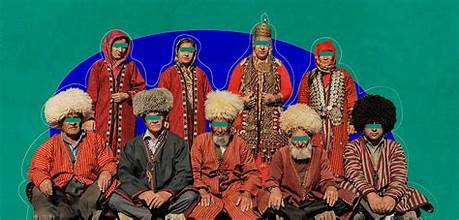
From an anthropological perspective, Turkmen society was traditionally rooted in a tribal structure that constituted the foundation of social and political life. The tribe was not merely a kinship group but a socio-cultural and economic institution that preserved language, customs, and collective memory while organizing relationships among individuals and communities. Major tribes such as the Teke, Yomut, Kayi, and Afshar played a central role in maintaining the continuity of Turkmen identity across centuries, to the extent that their names evolved into cultural symbols transcending social classification and becoming part of Turkmen historical and national consciousness.
The geographical environment of the steppes and deserts also profoundly shaped Turkmen culture. A lifestyle centered on migration and pastoralism created a unique relationship between the Turkmens and nature, reflected in their traditional way of life and housing. The circular Turkmen tent, or yurt, became a symbol of traditional Turkmen life. It was not merely a portable dwelling but a social space reflecting family organization, intergenerational relations, and the honored status of guests within society.
At the heart of Turkmen culture stood the horse as an exceptional symbolic element. For the Turkmens, horses were not simply tools of war or transportation; they symbolized honor, strength, and social prestige. The Turkmens became renowned for the Akhal-Teke horse breed, considered one of the oldest and most beautiful horse breeds in the world, celebrated for its endurance and elegance. Over time, the Akhal-Teke became a national symbol in Turkmenistan, embodying the historical continuity of Turkmen culture.
Political transformation was inseparable from cultural transformation. Turkmens who settled in Iraq, the Levant, Persia, and Anatolia were influenced by the great Islamic civilizations they encountered, yet they simultaneously preserved core elements of their original culture. As a result, Turkmen culture emerged as a complex synthesis of nomadic Turkic heritage and Islamic, Persian, and Arab influences. The Turkmen language, belonging to the Oghuz branch of Turkic languages, remained one of the central pillars of identity despite dialectical variations across Central Asia, Iraq, Syria, and Iran. Linguistically, it is closely related to Turkish, Azerbaijani, Qashqai, and Gagauz, reflecting the broad cultural extension of Oghuz peoples.
The persistence of the Turkmen language demonstrates the depth of Turkmen cultural consciousness. Language was not merely a means of communication but a vehicle for preserving collective memory and reproducing identity across generations. In Turkmenistan, Turkmen became the official language of the modern state, whereas in Iraq and Syria it continued to be used within homes and local communities as a means of preserving cultural specificity in the face of linguistic dominance by other groups. This divergence contributed to the emergence of two overlapping Turkmen identities: the “Eastern Turkmens” of Central Asia, Iran, and Afghanistan, and the “Western Turkmens” of Iraq, Syria, Lebanon, and Palestine, who were more heavily influenced by Turkish and Ottoman culture.
Folk literature also played a vital role in shaping Turkmen consciousness. Turkmen culture long relied on oral narratives, folk songs, and heroic poetry as instruments for preserving history and social values. Magtymguly Pyragy stands as one of the most prominent cultural figures in Turkmen history and is often referred to as the “Father of Turkmen Literature.” Through his poetry, he transformed the vernacular language into a medium of national and social expression and strengthened the sense of Turkmen unity despite tribal and geographical divisions.
Similarly, the bakhshi—wandering poets and singers—played an essential role in preserving cultural memory through heroic and romantic songs and narratives, making music and poetry central to the reproduction of Turkmen collective identity. Traditional instruments such as the dutar and tanbur accompanied songs dealing with themes of love, horsemanship, migration, nostalgia, and heroism, turning music into an archive of collective memory.
Turkmen women also occupied an important place in the cultural and social structure of society. Despite the conservative tribal character of Turkmen communities, women played a central role in preserving language, handicrafts, and folk traditions. They were responsible for transmitting stories, songs, carpet weaving, and textile arts, all of which formed the essence of Turkmen cultural memory. Moreover, the realities of nomadic life required women to participate in labor, mobility, and family management, granting them a more active social presence than in many sedentary agrarian societies.
Turkmen culture was also closely associated with traditional arts, particularly carpet weaving, which evolved into one of the most prominent symbols of Turkmen identity. Carpets were not merely handicrafts but expressions of tribal belonging, social status, and aesthetic worldview. Their geometric patterns and motifs carried symbolic meanings related to protection, fertility, strength, nature, and tribal affiliation, eventually making Turkmen carpets globally recognized symbols of Turkmen culture.
Religiously, the Turkmens gradually embraced Islam from the fourth century AH onward, while retaining certain pre-Islamic cultural elements, especially those linked to nature and spirituality. Consequently, Turkmen Islam became intertwined with Sufi and folk traditions. Sufi orders such as the Naqshbandiyya and Yasawiyya spread widely among Turkmen tribes, helping to soften tribal rigidity and connect Turkmen identity to a broader spiritual and civilizational Islamic framework. Shrines and saints also played an important role in social and religious life, giving Turkmen religiosity a flexible and tolerant character that combined religious devotion with cultural openness.
Demographically, the Turkmens are among the most geographically dispersed Turkic peoples due to centuries of migration and political transformation. Their principal demographic center today is Turkmenistan, which serves as the primary national homeland of the Turkmens, where they constitute the overwhelming majority of the population alongside Uzbek, Russian, and Kazakh minorities. The independence of Turkmenistan following the collapse of the Soviet Union in 1991 significantly reinforced Turkmen national identity, transforming it from a tribal and cultural identity into a modern national identity tied to the state.
Outside Turkmenistan, Turkmen communities are spread across the Middle East and Central Asia. In Iraq, the Turkmens constitute the third-largest ethnic component after Arabs and Kurds, concentrated in the historical region known as “Turkmeneli,” stretching from Tal Afar in the west through Mosul, Erbil, Kirkuk, Tuz Khurmatu, and Kifri to Mandali in the east. This geographical continuity contributed to the formation of a Turkmen political consciousness centered on defending cultural and historical existence amid ethnic and sectarian conflicts.
In Syria, Turkmens are concentrated in Aleppo, Latakia, Homs, Hama, and the Golan, with much of their presence tracing back to the Seljuk and Ottoman eras. In Iran, they are concentrated in the regions of Turkmen Sahra, Khorasan, and Golestan, while in Afghanistan they inhabit northern provinces bordering Turkmenistan and Uzbekistan.
The Palestinian Turkmen experience represents a unique model of dual identity combining national integration with the preservation of historical memory. Turkmens who entered Palestine with the armies of Saladin and settled in Haifa and the Marj Ibn Amer region gradually integrated into Palestinian society to the extent that younger generations largely lost the Turkish language. Nevertheless, they retained a distinct historical memory, while clan names and oral traditions continued to testify to their Turkmen roots.
More broadly, the Turkmen experience offers an important lens through which to understand how ethnic and national identities are formed within multiethnic environments. Historically, the Turkmens lived within diverse political and imperial spaces, giving their identity a flexible and pluralistic character. During the imperial era, Islamic and political belonging often took precedence over ethnic affiliation. However, with the rise of the modern nation-state, Turkmen identity gradually evolved into an ethnic identity seeking to preserve its cultural and political existence within multiethnic states.
In this sense, the Turkmens can be viewed as an example of what identity studies describe as “border identities”—communities that inhabit multiple cultural and political spaces and must continually renegotiate their relationship with the state and society. In Iraq, Turkmen identity became closely tied to the defense of language, political representation, and historical presence, while in Palestine, Turkmens integrated into Palestinian national identity while maintaining a symbolic memory linked to their historical origins. In Turkmenistan, meanwhile, Turkmen identity evolved into an official national project upon which the modern state bases its legitimacy.
The Turkmen experience also reveals the complex relationship between the “politics of recognition” and the “politics of integration.” In many states, Turkmens sought to preserve their cultural distinctiveness through language, education, and social institutions, while simultaneously integrating into the broader national societies in which they lived. This duality gave Turkmen identity a flexible and multilayered character, allowing individuals to identify simultaneously as Turkmen and Iraqi, Syrian, or Palestinian without perceiving contradiction among these affiliations.
Ultimately, the Turkmen experience demonstrates that identity is not a fixed ethnic essence but a dynamic historical process shaped through interactions among geography, religion, politics, migration, and memory. The Turkmens are not merely remnants of ancient tribes that once crossed the steppes of Central Asia; they are a people who transformed migration into memory, tribe into culture, and mobility into an enduring identity that has survived centuries of profound transformation. Today, Turkmen identity remains a living example of the ability of historical communities to preserve their cultural and symbolic continuity despite geographical dispersion and the deep political transformations of the modern world.
Most read