Arab–Chinese Relations: Strategic Partnership Transformations and the Reshaping of International Balances

Introduction
The international system has undergone profound structural transformations since the end of the Cold War, reshaping global balances of power, influence, and interstate relations. The collapse of the Soviet Union led to the emergence of a unipolar order dominated by the United States. However, the last three decades have gradually revealed a relative decline in America’s ability to monopolize global leadership, coinciding with the rise of new international powers, most notably China, which has transformed from a limited regional Asian actor into a global power possessing expanding economic, political, technological, and strategic capabilities.
At the center of this global transformation, the Arab region has emerged as one of the most significant geopolitical arenas where the interests of major powers intersect. This importance stems from the region’s strategic location, vast energy resources, and critical maritime routes that directly affect the global economy and international energy security. Within this context, Arab–Chinese relations have gained unprecedented momentum, evolving from traditional trade and cultural ties into a multidimensional strategic partnership shaped by economic interests and geopolitical ambitions.
China’s presence in the Arab world is no longer merely an extension of its need for oil and gas. Rather, it has become part of a comprehensive strategic vision through which Beijing seeks to redefine its position within the international system by building a global network of influence based on economics, technology, infrastructure, and soft diplomacy. Simultaneously, Arab states increasingly view China as a partner capable of providing economic, developmental, and political alternatives amid ongoing global transformations and declining confidence in traditional Western alliances.
Consequently, Arab–Chinese relations can no longer be understood solely through an economic lens. They are now deeply connected to the reshaping of international and regional balances and to the future of an emerging multipolar world order.
Historical Roots of Arab–Chinese Relations
Arab–Chinese relations possess deep historical roots stretching back centuries. The ancient Silk Road constituted the first civilizational and commercial framework linking Arab and Chinese societies. Arab merchants played a pivotal role in transferring goods, cultures, and knowledge between East and West, while Chinese coastal cities such as Canton became major centers of trade and cultural exchange with the Islamic world.
These interactions extended beyond commerce to include cultural, intellectual, and religious exchange. Arab and Muslim merchants contributed to the spread of Islam in parts of China, leading to the emergence of Chinese Muslim communities that preserved their cultural and religious identity for centuries.
Unlike many Western powers, China did not possess a colonial legacy in the Arab world. This historical distinction contributed to the development of relations based on mutual respect rather than historical grievances.
During the modern era, bilateral relations gradually developed, particularly after both Arab states and China achieved independence. China viewed Arab causes—especially the Palestinian issue—as an arena to reinforce its anti-colonial discourse and support for national liberation movements.
Nevertheless, throughout the Cold War, relations remained relatively limited due to China’s domestic priorities and the global polarization between the Eastern and Western blocs. China’s role in the region was therefore confined largely to trade, cultural exchange, and symbolic political support.
The end of the Cold War and China’s rapid economic rise fundamentally transformed Beijing’s perception of the Arab world, particularly as China’s need for energy, markets, and strategic trade routes intensified.
Transformation of China’s Strategy Toward the Arab World
The post-Cold War era represented a turning point in Chinese foreign policy. As China adopted an economic model based on industrialization, openness, and export-oriented growth, securing energy supplies and external markets became central components of Chinese national security.
Within this framework, Beijing increasingly viewed the Arab world as strategically vital for several reasons:
- The region possesses the world’s largest oil and gas reserves.
- It occupies a decisive geographical position controlling international maritime routes.
- Arab markets are increasingly important for Chinese exports and investments.
- The region is central to the Belt and Road Initiative.
- Relative American retrenchment has created opportunities for expanding Chinese influence.
Consequently, China moved from a policy of passive neutrality toward a more active strategy emphasizing economic and diplomatic expansion while carefully avoiding direct military entanglement in regional conflicts.
China’s approach toward the Arab world is characterized by several key features:
- Prioritizing economic development over ideology.
- Respecting sovereignty and non-interference.
- Building bilateral partnerships rather than pursuing a unified regional approach.
- Maintaining balanced relations with competing regional actors.
- Expanding influence through economic diplomacy and soft power.
This strategy reflects Beijing’s understanding of the complexity and volatility of the Middle Eastern environment, as well as its desire to protect economic interests without assuming the burdens of traditional military hegemony.
The Geopolitical Dimension of Arab–Chinese Relations
Arab–Chinese relations are no longer driven solely by economics and energy considerations. They have become part of the broader geopolitical competition between China and the United States.
For Beijing, the Middle East represents a strategically essential arena within its broader effort to reshape the international order. China understands that no aspiring global power can ignore the Arab region due to its geographical location and decisive influence on global energy security.
China therefore seeks to consolidate its presence through several instruments:
Political Diplomacy
China’s political role became more visible following its mediation of the Saudi–Iranian rapprochement in 2023. This development signaled Beijing’s transition from the role of “economic partner” to that of “geopolitical actor.”
Economic and Investment Expansion
China has become the largest trading partner for many Arab countries while significantly expanding investments in ports, telecommunications, infrastructure, artificial intelligence, and energy.
Energy Security
Oil and gas remain the central drivers of Chinese policy toward the Arab world. China increasingly depends on Gulf energy supplies to sustain its economic growth.
Competition with the United States
China’s regional expansion coincides with perceptions of relative American decline in the Middle East. Nevertheless, Beijing does not currently seek to replace the United States as the region’s hegemonic power. Instead, it favors gradual influence built on economics and diplomacy.
The Belt and Road Initiative and the Reshaping of Global Economic Geography
The Belt and Road Initiative constitutes the cornerstone of China’s global strategy in the twenty-first century.
Launched by President Xi Jinping in 2013, the initiative aims not only to improve trade networks and infrastructure but also to reshape global economic geography in ways that strengthen Chinese influence.
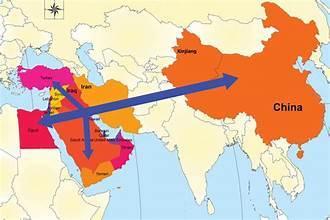
Within this framework, the Arab world occupies a pivotal position through both maritime and land corridors.
The strategic importance of the Arab region includes:
- The Suez Canal as a critical artery of global trade.
- Gulf ports as major logistical hubs.
- Iraq as a bridge between Asia and Europe.
- North Africa as a gateway to Africa.
China has therefore expanded investments in ports, industrial zones, railways, and renewable energy projects across the Arab world.
However, the initiative has also faced Western criticism accusing China of employing “debt diplomacy” to expand political influence.
Despite these criticisms, many Arab states view the initiative as an opportunity to diversify international partnerships and secure much-needed infrastructure financing and technological cooperation.
Arab–Chinese Relations and Regional Security
China’s growing presence in the Arab world increasingly influences regional security dynamics.
Although Beijing continues to emphasize “non-interference,” its expanding strategic interests have pushed it toward greater engagement in regional affairs, particularly those linked to energy security and political stability.
China’s approach to regional security differs significantly from traditional Western models. Beijing emphasizes:
- Economic development as a pathway to stability.
- Diplomatic and political solutions to crises.
- Respect for sovereignty.
- Opposition to foreign military intervention.
This discourse has granted China a degree of acceptance among Arab states exhausted by decades of Western military interventions.
At the same time, China’s expansion raises important questions regarding future regional balances, particularly given Beijing’s simultaneous relations with competing actors such as Iran, Saudi Arabia, Israel, and Turkey.
Challenges Facing the Arab–Chinese Partnership
Despite rapid expansion, the Arab–Chinese partnership faces multiple challenges:
U.S.–China Competition
The strategic rivalry between Washington and Beijing represents one of the most significant obstacles facing Arab–Chinese relations.
Regional Instability
The Arab region continues to experience civil wars, sectarian tensions, and terrorism, posing risks to Chinese investments and interests.
Regional Contradictions
China seeks balanced relations with all regional actors, yet ongoing rivalries may place Beijing before difficult political choices.
Western Criticism
China faces accusations of using economics as a tool of political influence and criticism regarding transparency and human rights.
Future Prospects
Current trends indicate that Arab–Chinese relations are likely to expand further in the coming decades due to:
- China’s continued rise as a global power.
- Asia’s growing centrality in the world economy.
- Arab demand for technology and investment.
- The transition toward a multipolar international order.
- The growing strategic importance of energy and trade corridors.
Nevertheless, the success of this partnership will depend on both sides’ ability to manage international rivalries and regional transformations.
China’s political role in the Middle East is likely to increase gradually, especially if the United States continues reducing its direct regional engagement.
Simultaneously, Arab states may seek to exploit great-power competition to maximize economic and strategic gains without fully aligning with any single global bloc.
Conclusion
Arab–Chinese relations reflect profound transformations in the contemporary international order. China is no longer merely an economic power searching for energy and markets; it has become a global actor seeking to reshape balances of power and influence worldwide.
Likewise, the Arab world is no longer simply a traditional sphere of Western influence but increasingly a major arena of international competition.
The Arab–Chinese partnership therefore represents one of the clearest manifestations of the transition toward a multipolar world based on the redistribution of economic and geopolitical power.
Yet the success of this partnership will depend on both sides’ ability to establish balanced relations that preserve Arab strategic autonomy while advancing mutual interests.
In light of ongoing global transformations, Arab–Chinese relations are likely to become one of the defining axes of twenty-first-century international politics.
Most read