The Case For A Managed U.S. Exit From NATO

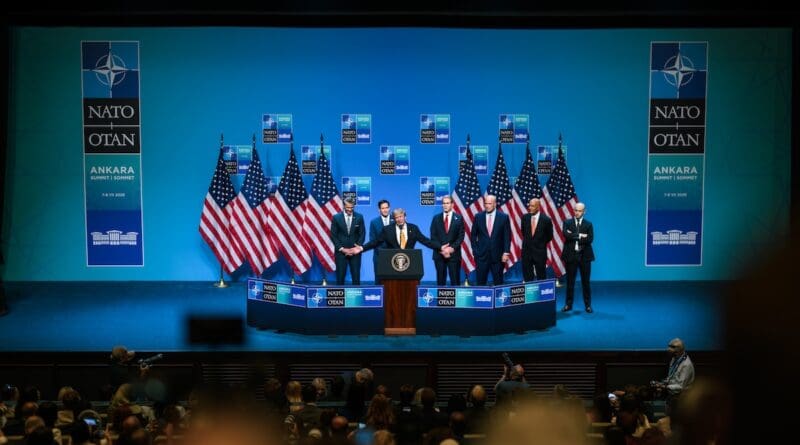
At the NATO summit in Türkiye, President Donald Trump added a new arrow of accusation to his quiver. For years now, he has rightfully complained and badgered his European allies to spend more on defense. This was because, since its inception in 1949, NATO, like many security alliances, has had a free-rider problem. Even during the Cold War, the potential enemy, the Soviet Union, posed a greater threat to Western Europe than to the faraway United States, given the United States’ inherent geographic security. Yet, as the leader of the alliance, the United States deliberately protected Western European countries so they could recover from the physical and economic damage caused by World War II. However, free riding has continued long after European countries became wealthy. Barack Obama got the allied nations to pledge to spend 2% of their GDP on defense, and Trump, more recently, got them to pledge to raise that to 5% of GDP. In the long term, whether all alliance members will follow through on such pledges and sustain that level of spending has always been an alliance issue. However, Trump has now pushed his complaint further.
While in Türkiye, Trump criticized the NATO allies by asserting, “We help them, but I’m not sure they’d be there for us.” He was referring to the Europeans declining to participate in the recent U.S.-Israeli attack on Iran. To be fair, however, Trump didn’t notify any European ally in advance that he was going to attack Iran and certainly didn’t consult with them—probably to his detriment—about whether it was a good idea.
More broadly, the NATO Treaty is a defensive alliance that is supposed to be confined to the defense of members’ territories, not to unprovoked offensive aggression against non-European countries that are not attacking NATO. But Trump does have a point that the wealthy allies are not doing enough to defend NATO territory compared to the almost $1 trillion dollar U.S. defense budget.
Yet jawboning the allies, who may or may not fulfill their pledges to hike defense spending, probably won’t work. Given that the United States provides the nuclear and conventional-force umbrellas to protect its rich allies, those countries have no incentive to do more for their own defense. In fact, over the decades, Europeans have funneled those saved resources into their companies, which compete overseas with American firms.
In addition, if Europeans spend more on defense, it doesn’t necessarily mean the United States will cut back its mammoth defense budget. Instead, Trump has outrageously proposed ballooning it by more than 50 percent. In light of this reality, his browbeating of allies on defense spending may seem to relieve allies’ snookering of the United States, but it doesn’t help the United States address its gaping budget deficits and spiraling national debt.
A better alternative would be for Trump to announce a gradual U.S. withdrawal from NATO over a two-year period. The European Union now has a GDP about 8.5 times that of its principal rival—a Russia that has been severely weakened by the bloody, drawn-out quagmire against the surprisingly resilient Ukraine. There has never been a better time to pull the plug on a Cold-War-era alliance. Thus, the Europeans are capable of defending themselves; even now, they together spend a lot on defense, but the expenditures lack coordination, resulting in both duplication and gaps in some military capabilities.
However, given existing bureaucratic and interest-group politics, to realize the benefits of finally turning European defense over to Europeans, the Trump administration would need to stand up to its own Military-Industrial-Congressional-Media Complex. That complex would vehemently oppose the redirection of savings into deficit reduction instead of finding new enemies to fight and buying expensive weapon systems that are now likely outdated in the new age of less expensive drone warfare.
Trump seemed to become enamored with military action after the quick and successful kidnapping of Venezuelan President Nicholas Maduro. Still, perhaps, deep down, he has learned his lesson in his failed attack on Iran that war does not always go your way and has high costs in money, lives, and reputation. Any such future caution might bring savings in national defense.
Most read