
After five months of war, the US-Iran confrontation has reached a strategic turning point. The question is no longer whether the United States can inflict further damage on Iran’s military capabilities. The air campaign has already demonstrated its ability to destroy missile bases, command centers, production facilities, and naval infrastructure, while significantly degrading parts of Iran’s conventional military power.
The more difficult question now is how Washington can translate that military superiority into a political outcome that ends the war on acceptable terms without sliding into a ground campaign or an open-ended regional conflict.
This dilemma helps explain both the growing US military buildup in the region and the discussion of broader offensive options, even as diplomatic channels and mediation efforts remain in play. The United States possesses overwhelming military superiority, but it faces an adversary whose strategy has been built for decades around the assumption that it cannot prevail in a conventional war.
Iran’s answer has therefore been to disperse its capabilities, fortify critical assets underground, rely on asymmetric warfare, and expand the geographical and economic costs of any conflict. The war is thus entering a phase in which continued American military superiority may be virtually assured, while achieving a decisive political outcome becomes increasingly difficult.
From Destroying Capabilities to Changing Behavior One of the clearest lessons of the war so far is that the ability to destroy an adversary’s military assets does not necessarily translate into an ability to alter its political calculations. The US-Israeli campaign has targeted a broad range of Iranian military infrastructure.
Yet Tehran has demonstrated a notable capacity to absorb attacks and restore parts of its operational network. Satellite imagery cited in Western media reports has shown tunnel entrances being reopened and roads and bridges repaired within weeks of being struck. This does not mean the attacks have been ineffective. Iran has sustained substantial military and economic losses.
The strategic distinction, however, lies between inflicting damage and permanently disabling capability. Iran designed much of its defense architecture around the principle of surviving the first strike. It dispersed launchers and stockpiles, constructed hardened facilities inside mountains and underground, and retained an industrial base capable of replacing at least some of what is destroyed. This creates a growing problem for US military planners.
The easiest and most visible targets are struck first. What remains tends to be more deeply buried, more dispersed, and more difficult to reach. As a result, progressively greater force may be required to produce increasingly marginal strategic gains. In other words, the air campaign is beginning to confront the law of diminishing returns: the United States can continue striking Iran, but each additional strike may not bring Washington proportionately closer to achieving its political objectives.
Iran Is Fighting for Survival, Not Victory Iran’s definition of success is fundamentally different from that of the United States. Tehran does not need to defeat the United States militarily. Given the enormous disparity in conventional capabilities, such an objective would be unrealistic. What Iran needs is to prevent Washington from converting its military superiority into an unequivocal political victory. From this perspective, the survival of the regime, the preservation of a residual missile and naval capability, and the continued ability to threaten US and regional interests can themselves constitute a form of strategic success.
This is a familiar dynamic in asymmetric warfare: the stronger side must accomplish specific objectives in order to claim victory, while the weaker side may only need to deny its adversary those objectives. That makes time a central element of Iran’s strategy. Tehran is betting that a prolonged war will increase the financial and political costs for Washington, strain American public support, magnify the impact of higher energy prices, and create divisions within the coalition opposing Iran. Yet this strategy carries substantial risks because time does not work exclusively in Tehran’s favor.
Attrition Is a Double-Edged Sword Iran entered this war already burdened by prolonged sanctions, inflation, economic pressures, and infrastructure problems. As military strikes continue, revenues decline, and economic activity is disrupted, pressure is mounting on the state’s ability to finance the war while maintaining essential services and domestic stability. This exposes a central Iranian paradox: Tehran wants the war to last long enough to exhaust its adversaries, but not so long that prolonged conflict exhausts Iran itself. The longer the confrontation continues, the more important internal political cohesion becomes. Long wars test not only military capabilities but also alter balances of power within ruling elites.
Hard-line factions may regard any retreat under military pressure as a threat to the regime’s survival and prestige. More pragmatic elements, however, may increasingly see the continuation of the war as a threat to the state itself if it leads to deeper economic exhaustion, international isolation, and declining governmental capacity. The conflict therefore becomes a race between two forms of attrition: will American political will erode before Iran’s internal capacity to endure the war begins to fracture?
Hormuz
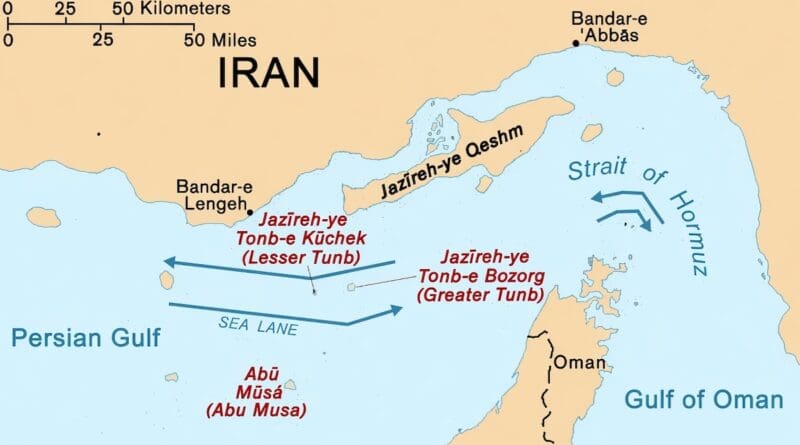
Using Geography to Offset Military Weakness One of the defining features of Iran’s strategy is that it relies not only on military capabilities, but also on geography. The Strait of Hormuz is the clearest example. The narrow waterway, through which a significant share of global oil and gas trade passes, gives Iran strategic leverage that cannot be measured simply by the size of its navy or the number of missiles in its arsenal.
The greater the pressure on Iran’s military capabilities, the more valuable this geographical asset becomes. If Tehran cannot match US air power, it can attempt to transfer the cost of war to the global economy by threatening maritime traffic and energy exports. Oil prices rising above $100 a barrel would therefore be more than an incidental economic consequence of the conflict; they could become an integral component of Iran’s pressure strategy.
Energy markets connect the battlefield directly to domestic politics in importing countries through inflation, fuel prices, transportation costs, and industrial production. In this way, part of the cost of war is transferred from the military theater to consumers and economies around the world. Yet weaponizing Hormuz also carries a strategic danger. When Iran disrupts shipping, it does not punish the United States alone. It affects the interests of China, India, Europe, and Asian economies heavily dependent on Gulf energy supplies. The longer such disruption continues, the greater the likelihood that countries seeking to remain outside the conflict will begin exerting pressure on Tehran. Iran’s strongest geographical card could therefore become one of the factors that expands the coalition aligned against it.
From Hormuz to Bab el-Mandeb: Expanding the Geography of Cost The renewed involvement of the Houthis adds another dangerous dimension. If Hormuz is a critical artery of global energy, Bab el-Mandeb and the Red Sea form one of the principal arteries of trade between Asia and Europe through the Suez Canal.
Threatening both corridors simultaneously means the war is no longer affecting energy markets alone; it is beginning to challenge global trade routes and supply chains. This can be understood as part of an Iranian strategy to expand the geography of cost: the greater the military pressure inside Iran, the wider the pressure points activated beyond its borders.
But this strategy has limits. Targeting US forces is politically different from threatening international commercial shipping. Raising the cost for Washington is not the same as imposing economic losses on China, India, the European Union, and other major trading powers. Tehran therefore faces a delicate strategic balance: it needs to widen the conflict enough to increase the cost of pressure against it, but not so far that major powers begin to regard Iran itself as a direct threat to their vital interests.
ashington’s Dilemma: What Comes After the Bombing? For the United States, the central problem is that the air campaign may already have accomplished the relatively easier part of the military mission. Many known targets have been destroyed. What remains is harder to eliminate: deeply buried facilities, dispersed stockpiles, underground networks, and capabilities that can eventually be rebuilt.
The question, therefore, becomes: what comes next? Washington could broaden its target list to include additional industrial facilities, power stations, bridges, ports, and dual-use infrastructure. But such an approach would increase the risk of civilian casualties and wider economic devastation without guaranteeing a change in the Iranian leadership’s calculations.
It could even produce the opposite effect by reinforcing the regime’s narrative that Iran is fighting an existential war, allowing the authorities to mobilize society and tighten domestic control. The alternative is to move from destroying capabilities to physically seizing or directly penetrating territory. At that point, however, the nature of the war changes fundamentally.
The Challenge of Deeply Buried Facilities Iran’s hardened underground infrastructure illustrates the limitations of air power. If strategically important equipment, including components linked to nuclear or missile programs, has indeed been moved into deep tunnel networks, destroying it completely may require capabilities beyond conventional aerial bombardment. At this stage, options involving special operations forces, limited airborne raids, temporary seizure of strategic sites, or even the capture of Iranian islands near major shipping routes begin to enter strategic calculations. Militarily, these options may appear limited compared with a full-scale invasion.
Politically and strategically, however, they carry considerable risks. The moment US troops enter Iranian territory, the definition of the war changes. It is no longer primarily an air and naval campaign whose tempo can be controlled with relative flexibility. Forces on the ground must be protected, supplied, reinforced, and potentially evacuated. Heavy casualties could compel further operations. Captured American personnel could trigger a major political crisis. Iranian retaliation against countries hosting US aircraft and forces could widen the conflict across the Gulf. A mission designed to remain “limited” could therefore generate a chain of military commitments that were never part of the original plan.
Iran’s Islands: A Middle Ground Between Air War and Invasion? This explains why Iranian islands in the Gulf may emerge as a potential intermediate option between continued aerial bombardment and a deep ground incursion. Some of these islands have strategic significance because of their proximity to the Strait of Hormuz, shipping routes, and energy infrastructure. Temporarily seizing selected positions could theoretically strengthen Washington’s ability to secure navigation and pressure Tehran without occupying densely populated Iranian cities. Yet this option is not as low-risk as it may appear.
Seizing Iranian territory, even a sparsely populated island, would allow Tehran to redefine the conflict in nationalist terms as a war to defend Iran’s territorial integrity. Rather than weakening the regime, such a move could broaden domestic mobilization behind it. It would also revive one of the most difficult questions the United States has confronted in previous wars: once territory is seized, what happens next? Who administers it? When do US forces withdraw? And what concessions would Washington demand in exchange for leaving?
Trump Between the Need for Victory and the Fear of an Endless War The dilemma is further complicated for President Donald Trump by domestic US politics. Every prolonged war eventually requires a clear definition of victory. The more a war’s objectives expand during the fighting, the harder it becomes to declare those objectives achieved. If the initial goal was to destroy specific military capabilities, success can be measured with relative clarity. But if the objective evolves into forcing Iran to alter its regional behavior, dismantling the capabilities of the Islamic Revolutionary Guard Corps, preventing the rebuilding of missile or nuclear programs, and perhaps reshaping the regime itself, then the conflict moves from defined military objectives toward an open-ended political project. At that point, the experiences of Iraq and Afghanistan inevitably return to the American strategic debate.
The central problem in those wars was not Washington’s inability to defeat its adversaries militarily. It was the difficulty of transforming rapid military superiority into a stable and sustainable political order. Iran would be considerably more complex: a geographically large country with a substantial population, a powerful national identity, deeply entrenched military and security institutions, and an established capacity to mobilize regional networks. Any large-scale ground invasion would therefore entail risks and costs that Washington is unlikely to accept except under extraordinary circumstances.
Three Strategic Paths for Washington Against this backdrop, US options can broadly be divided into three paths. The first is to intensify air and naval pressure, expand the target list, and tighten economic isolation in the hope that accumulating losses eventually alter Iran’s calculations. This remains the least dangerous option for US forces, but it faces the fundamental problem that Tehran has so far demonstrated a considerable ability to adapt to precisely this form of pressure.
The second is to move toward limited special operations, the seizure of strategic positions or islands, or direct action against facilities that cannot be destroyed from the air. Such operations could produce greater tactical gains but would sharply increase the danger of gradual escalation into a ground war. The third is to use military superiority as leverage for a political settlement—to shift the central question from “How much more can be destroyed?” to “What agreement can convert military gains into a sustainable strategic outcome?” This option requires its own difficult strategic concession: acknowledging that diplomacy rarely delivers everything that military force has failed to achieve.
The Greater Danger: A War Searching for an Ending The most likely outcome in the near term is neither complete Iranian surrender nor a full-scale US invasion. A more plausible scenario is a combination of expanded air strikes, maritime pressure, limited operations, and potentially greater Israeli participation, punctuated by temporary ceasefires and diplomatic initiatives that collapse and later re-emerge.
The danger is that this pattern evolves into a prolonged war of attrition that neither side can decisively win, yet neither can easily abandon. Iran is betting on survival and on raising the cost of war. The United States is betting that cumulative pressure will eventually force Tehran to accept more favorable terms. Between those competing calculations, the conflict could expand geographically—from Iran itself to the Gulf, the Strait of Hormuz, Yemen, and the Red Sea—and economically, from the battlefield to global energy prices, trade routes, and supply chains. Washington’s fundamental strategic dilemma, therefore, is not a shortage of military power.
It is the absence of any guaranteed relationship between using more force and achieving a better political outcome. Military power can destroy bases, bridges, ports, and industrial facilities. What it cannot do on its own is determine the shape of the day after.
As the air campaign approaches the limits of what it can achieve, every subsequent option becomes more dangerous: special forces operations, the seizure of islands, tighter blockades, broader target sets, or a wider regional confrontation. At that point, the question that will ultimately determine the course of the war is not whether Trump can order a “massive attack,” but whether Washington knows precisely what it wants to happen after the final strike.
The most dangerous wars are not always those in which a country lacks the ability to escalate. Sometimes, they are the wars in which it possesses overwhelming capacity to escalate but lacks a clear vision of the point at which military superiority becomes political victory
Most read