
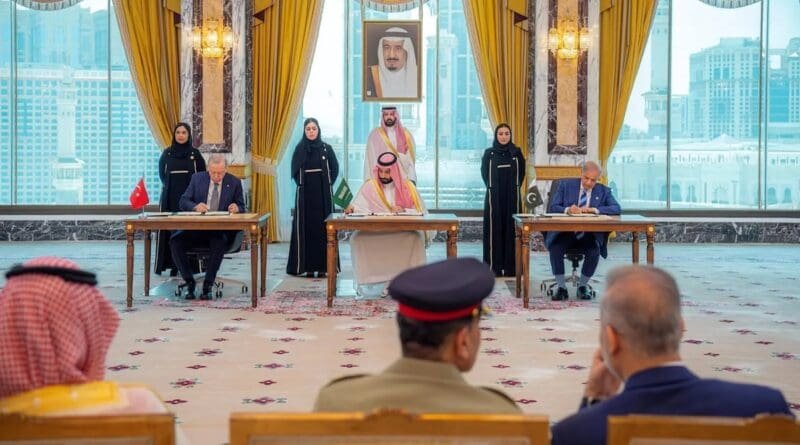
The joint defence agreement signed by Türkiye, Saudi Arabia, and Pakistan in Mecca on 7 August 2026 should no longer be viewed merely as another military cooperation agreement among three states. It can instead be understood as one of the indicators of a gradual transformation taking place in the regional and international security order.
The agreement stipulates that an armed attack against any one of the three countries will be considered an attack against all of them. It also establishes mechanisms for political and military coordination, joint exercises, cooperation in defence industries and emerging technologies, unmanned systems, and cybersecurity. Taken together, these provisions point beyond conventional defence cooperation toward the development of a more autonomous collective deterrence capability, less dependent on external security guarantees.
Although Ankara and Islamabad have emphasized the defensive nature of the agreement and stated that it is not directed against any particular country, its political significance lies not only in its declared intentions but also in the context in which it has emerged. Regional powers are increasingly confronting the possibility that traditional security guarantees may become less reliable. As a result, they are seeking to develop capabilities that would allow them to produce a greater share of their own security.
It is from this perspective that the significance of the Mecca Pact for the Balkans becomes much clearer.
From a Defence Agreement to a Project of Strategic Autonomy
The political weight of the Mecca Pact lies primarily in its principle of mutual defence. Yet interpreting it as the nucleus of a military alliance comparable to NATO would be premature.
The institutional and operational gap between the Pact and the North Atlantic Alliance remains substantial. There is, at this stage, no unified command structure or common institutional framework capable of turning it into a fully integrated military alliance.
A more accurate interpretation is to see it as an emerging coalition built around complementary capabilities.
Saudi Arabia brings financial capital, energy resources, and a strategic geographical position along some of the world's most important energy corridors. Türkiye contributes an increasingly sophisticated defence-industrial base, substantial military capabilities, and extensive experience within NATO. Pakistan contributes a large military and human-resource base, extensive military experience, and a declared nuclear capability.
This is where the distinctive character of the arrangement lies. The Pact does not bring together states with identical sources of power; rather, it brings together states whose capabilities can complement one another.
If these countries succeed in translating this theoretical complementarity into sustained mechanisms for technology transfer, joint production, interoperability, and military coordination, a new regional security and defence ecosystem could gradually emerge beyond the agreement itself.
Yet this possibility faces a fundamental problem: complementary capabilities do not necessarily mean convergent interests.
Pakistan continues to view India as its principal security threat. Türkiye must manage a complex web of relations and tensions involving NATO, Greece, Cyprus, Israel, and Iran. Saudi Arabia, meanwhile, places Gulf security, Iran, and the protection of energy corridors among its central strategic priorities.
The three countries may therefore possess the ability to cooperate without necessarily sharing the same threat perception.
For this reason, the real significance of the Mecca Pact should not be measured by whether it eventually becomes an “Islamic NATO,” but by whether it succeeds in transforming dispersed capabilities into a sustainable deterrence capability.
Türkiye: From Strategic Depth to Networks of Power
At the centre of this transformation stands Türkiye, whose position connects the Middle Eastern and European strategic environments.
A deeper understanding of Türkiye's role requires revisiting the concept of “strategic depth” developed by Ahmet Davutoğlu in his 2001 book Strategic Depth: Turkey's International Position.
The concept rests on the premise that a state's power is determined not only by its territory or its economic and military capabilities, but also by its historical, geographical, cultural, and civilizational depth.
From this perspective, Türkiye occupies an exceptional position at the intersection of Europe and Asia, the Balkans and the Middle East, and the Black Sea and the Mediterranean. It also possesses extensive historical, social, and cultural ties with regions that were once part of the Ottoman sphere.
This does not mean that contemporary Turkish foreign policy is simply a continuation of Davutoğlu's doctrine, nor that every Turkish move can be explained through it. Yet there is an important continuity in Ankara's conception of Türkiye as a power whose strategic movement should not be confined to a single geographical space.
This is where it becomes possible to speak of a transition from “strategic depth” to “strategic networking.”
If Davutoğlu viewed geography, history, and civilizational heritage as sources of power, contemporary Türkiye has increasingly sought to translate these resources into tangible networks of influence: political agreements, investments, economic partnerships, defence exports, military cooperation, infrastructure projects, diplomatic engagement, and interconnected strategic relationships extending from the Caucasus and Central Asia to Africa, the Middle East, and the Balkans.
From this perspective, the Mecca Pact can be placed within a broader network of relationships that Ankara is seeking to develop—not as an isolated initiative, but as another platform for expanding Türkiye's strategic room for manoeuvre.
Why Does the Mecca Pact Matter to the Balkans?
The geographical and political shift from Mecca to the Balkans may initially appear surprising. It becomes much more comprehensible, however, when Türkiye is viewed as a power operating across interconnected strategic spaces.
For Ankara, the Balkans are not merely a neighbouring region with historical and cultural significance. They are also a geopolitical corridor linking the Eastern Mediterranean with Central Europe.
This is why Albania and Kosovo occupy an important position within this broader geography. Albania's access to the Adriatic and Kosovo's location at the heart of the Western Balkans give both countries significance within wider regional strategic corridors.
But this reality does not mean that Turkish and Albanian interests are identical.
Türkiye seeks to expand its room for manoeuvre, strengthen its markets and diplomatic presence, enhance its military and defence-industrial footprint, and develop strategic corridors. Albania and Kosovo have different priorities, including the consolidation of sovereignty, regional stability, the development of defence capabilities, and the preservation of their Euro-Atlantic trajectory.
These interests may overlap in many areas, but they are not the same.
Therefore, the most rational principle for Tirana and Pristina should be: partnership with Türkiye, not dependence on Türkiye.
Historical Friendship Is Not a Security Doctrine
Türkiye possesses an important political and historical capital in its relations with Albania and Kosovo. Ankara has supported Kosovo politically, while military and defence cooperation with both sides has expanded over time.
Yet transforming these relationships into the sole foundation of a security doctrine would be a strategic mistake.
States do not build their security on historical sentiment or cultural affinity. They build it on calculations of interests, capabilities, and alliances.
This distinction becomes particularly important if the Mecca Pact evolves into a broader structure. The greater Türkiye's regional weight becomes, the greater the opportunities for cooperation with Ankara—but also the greater the possibility that certain Turkish priorities could at times diverge from those of the European Union, NATO, or the United States.
For this reason, Euro-Atlantic integration should remain the central strategic foundation of Albania's and Kosovo's foreign and security policies. Türkiye should be treated as an important strategic partner within that framework, not as a substitute for it.
Kosovo Needs a Security Network, Not a Single “Protector”
For Kosovo, the issue is even more sensitive.
The Republic of Kosovo occupies a space where the interests of the United States, the European Union, NATO, and regional powers intersect.
Within this configuration, Türkiye can play an important role, particularly because it is a NATO member while also maintaining extensive relations with the Muslim world. Yet Ankara's dual position should be treated as a strategic opportunity rather than a basis for one-sided dependence.
Kosovo does not need a single “protector.” It needs a network of strategic partners.
That means simultaneously deepening relations with Washington, London, Berlin, Brussels, Ankara, Paris, Rome, and other European and NATO capitals.
The alternative to dependence on a single power is not distancing oneself from that power; it is diversifying the sources of strength and support.
Within this framework, Turkish–Kosovan relations should increasingly focus on practical areas such as defence industries, intelligence, technology, cybersecurity, unmanned aerial systems, air defence, and military training.
Albania and the Adriatic: Turning Geography into Power
For Albania, the central challenge is not simply its relationship with Türkiye, but its ability to transform its geographical position into strategic capability.
Ports, energy corridors, maritime infrastructure, airspace, and connections with Italy and Croatia—as well as links to Kosovo and North Macedonia—should not be viewed merely as economic assets. They constitute elements of geopolitical infrastructure.
Strengthening maritime and air capabilities, intelligence, surveillance and reconnaissance, unmanned systems, electronic warfare, and cybersecurity should therefore not be understood simply as defence spending. It is an investment in Albania's strategic position.
Türkiye can become an important partner in this process, particularly in defence industries and technology. But the objective should be to build Albanian capabilities, rather than transferring security dependence from one power to another.
From Security Consumer to Security Producer
Perhaps the most important lesson that Albania and Kosovo can draw from the Mecca Pact is this.
The agreement is based on combining financial resources, technology, and military power within a common framework. Albania and Kosovo should similarly begin thinking about building an interconnected Albanian security and defence ecosystem rather than treating security as a service provided by larger powers.
This does not mean creating an alternative to NATO or establishing a parallel structure to the Euro-Atlantic security system. It means developing indigenous capabilities within that framework.
Such cooperation could encompass defence industries, the production and maintenance of unmanned systems, cybersecurity, intelligence and strategic analysis, secure communications, civil protection, border and maritime surveillance, technological research and development, joint training, and the alignment of capabilities with NATO standards.
Türkiye can be an important partner in this process, but the relationship should be structured around a three-way framework: Albanian–Turkish–Euro-Atlantic, rather than one actor replacing another.
Serbia and Russia: The Dimension That Cannot Be Ignored
Any assessment of Türkiye's growing role in the Balkans would be incomplete without considering Serbia.
Belgrade is closely monitoring the expansion of Turkish influence in the region, while maintaining significant economic and defence relations with Ankara.
This creates a strategic paradox: Türkiye can simultaneously be a partner of Serbia and a strategic partner of Kosovo.
The paradox reveals a fundamental reality of international relations: there are no absolute friendships; there are interests that can be negotiated and recalibrated.
Tirana and Pristina should therefore avoid viewing Türkiye as a “natural ally” under every circumstance. It is more sustainable to regard Ankara as a major partner with its own interests, with whom stable cooperation can be built wherever interests converge.
The Mecca Pact and the Possibility of a New Regional Order
The significance of the Mecca Pact becomes greater if the possibility of its expansion is taken seriously.
The agreement has reportedly been described by Pakistan as open to other countries in the region, while the possibility of Egypt joining has also been raised. Should such a process acquire a broader institutional form, a new security configuration could potentially emerge geographically stretching from the Gulf to the Mediterranean.
In such a scenario, Türkiye would occupy an increasingly complex strategic position: an Atlantic power on Europe's southeastern flank while simultaneously becoming a potential centre of a regional security architecture outside Europe.
That would inevitably increase Ankara's strategic weight—and the greater Türkiye's weight becomes, the more important the Balkans are likely to become within its calculations.
For Albania and Kosovo, the implication is clear: they should stop viewing the Balkans as a peripheral space and begin treating it as a strategic node within a broader system extending from the Adriatic to the Eastern Mediterranean.
Toward an Albanian Security Doctrine in Europe
These developments reveal a broader challenge that extends beyond Türkiye and the Mecca Pact.
If regional powers are increasingly building their own capabilities, while the United States encourages its allies to assume a greater share of the defence burden, Europe itself will face growing pressure to develop greater strategic capabilities.
Albania and Kosovo cannot simply wait for the new security environment to take shape around them.
They need a coherent Albanian security vision within the Euro-Atlantic framework—one that is not directed against Türkiye, Russia, Serbia, or any other actor, but instead reflects national interests and the requirements of European and Euro-Atlantic integration.
The strategic formula can be expressed clearly:
European Union + NATO + partnership with the United States + strategic relations with Türkiye + deeper Albania–Kosovo cooperation.
This formula would provide the Albanian space with greater strategic flexibility without sacrificing its overall orientation.
Conclusion: Partnership, Not Dependence
The Mecca Pact may ultimately prove limited in its ability to evolve into a classical military alliance. Its actual effectiveness will depend on whether it can overcome gaps in command, coordination, and operational integration when confronted with a real crisis.
But reducing its significance to the question of whether it will become an “Islamic NATO” would miss its broader geopolitical meaning.
The message conveyed by the Pact is much wider.
Regional powers are seeking greater autonomous deterrence capabilities. Middle powers are searching for greater strategic space. Alliances are becoming more flexible, and states are preparing for an international environment in which no external security guarantee can be taken for granted.
In such a world, Türkiye is likely to become a more consequential power.
But Albania and Kosovo should neither perceive the rise of Turkish power primarily as a threat nor regard it as a substitute for the Euro-Atlantic security architecture.
The more rational approach is to transform Turkish power into a lever for strengthening indigenous capabilities.
Ultimately, the issue is not whether Albania and Kosovo should choose between Türkiye and the West. The real question is whether they can develop sufficient strategic capacity to become valuable partners to both without becoming instruments of either.
This is the deeper strategic challenge facing the two Albanian republics in the emerging geopolitical era.
And it is precisely here that the central lesson of the Mecca Pact lies:
States that fail to produce their own strategic capabilities will ultimately find themselves incorporated into the strategic calculations of others.
Most read