
The proximity of war in Sudan can no longer be measured by the distance separating cities from the front lines. In El Obeid, the capital of North Kordofan, residents need only hear a sound in the sky, followed by ground-based air defenses and an explosion somewhere in the city, to realize that the war has come closer than the map suggests. In recent months, the city has become one of the areas most exposed to drone attacks, while ground fighting has moved to within less than 40 kilometers of it. On August 12, eight drones targeted the city in a single day, killing two people and injuring others, according to eyewitnesses and medical sources cited by Reuters.
But the significance of El Obeid lies not simply in the fact that it has come under attack. The city illustrates the transformation that has taken place in Sudan’s war more than three years after it began. A conflict that initially centered on competing ground forces and military formations is gradually becoming a war capable of reaching cities, infrastructure, and essential services without requiring physical control of the territory or direct proximity to the battlefield.
A fundamental rule of war has therefore changed:
Moving away from the front no longer necessarily means moving away from the war.
From the Front Line to the National Space
The pattern of attacks during 2026 reveals the scale of this transformation. North Kordofan recorded at least 141 drone attacks between the beginning of the year and July 8, most of them in El Obeid. The strikes did not target military positions alone. Schools, markets, fuel stations, water points, and the city’s main power station were also hit.
In a city approaching half a million residents, including roughly 100,000 displaced people, every strike against critical infrastructure becomes more than a security incident. It becomes a direct assault on the city’s ability to function and survive.
This is one of the most dangerous consequences of drone warfare in Sudan: the transformation of civilian infrastructure into an indirect extension of the battlefield.
A power station is not merely a military target if disabling it shuts down water pumps. A hospital does not have to be hit directly to be affected by war. Destroying a fuel depot does not merely disrupt energy supplies; it affects transportation, generators, humanitarian operations, and basic services.
The true cost of a strike can therefore no longer be measured solely by the number of people killed or injured at the point of impact. A single attack can trigger a chain of consequences that extends far beyond the location and moment of the explosion.
Port Sudan: The End of the “Safe City” Illusion
Perhaps the clearest indication of this transformation was the arrival of drones in Port Sudan.
For thousands of Sudanese, Port Sudan was not merely a city far from the fighting. It had become a major refuge after the government and state institutions relocated there, effectively turning it into an alternative administrative capital. Its geographical distance from the main battlefields, combined with the presence of government institutions, created the expectation that the city would enjoy greater protection.
The attacks of May 2025 shattered that assumption.
Between May 4 and 9, Port Sudan came under a series of drone attacks targeting military and civilian facilities, including the city’s airport, a fuel depot, and air and naval bases. On May 6, strikes hit a fuel depot and the main power station, triggering a major fire and causing a complete blackout across the city.
The crisis did not stop at electricity.
Power outages disrupted water-pumping and desalination facilities, while fuel shortages soon emerged and long queues formed at petrol stations. The attacks also affected humanitarian operations and United Nations humanitarian air services, while forcing hundreds of families to leave the city.
The strategic lesson is clear:
The target may be a single facility, but the strike can disable an entire network of functions on which a city depends.
The strategic impact of drones therefore cannot be assessed merely in terms of accuracy or the number of direct casualties. Their deeper effect lies in their ability to generate cascading disruptions across urban life.
When Distance Loses Its Protective Value
The experience of Port Sudan also reveals a profound psychological transformation.
Mohamed Abdel-Moneim, who was displaced from Khartoum Bahri to Gezira and then to Port Sudan, no longer found displacement to be a reliable means of escaping the war. Each time he moved farther from the front, the war appeared somewhere else.
After drones reached Port Sudan, his options narrowed further. Even cities without ground fighting could no longer be regarded as genuinely safe. Distance from artillery was no longer sufficient to place civilians outside the range of the conflict.
This may be one of the most consequential strategic effects of long-range drone warfare in Sudan: the traditional relationship between distance and safety has been weakened.
In conventional warfare, civilians can, at least in theory, escape by moving away from the battlefield. But when warring parties possess long-range unmanned systems, the map itself loses part of its ability to distinguish safe areas from dangerous ones.
El Obeid: A Model of a War That Pursues Civilians
If Port Sudan represents the collapse of the safe-city concept, El Obeid represents a more advanced stage of this transformation.
Between June 6 and 28 alone, the UN Human Rights Office documented 45 civilian deaths and 41 injuries in 15 drone strikes in and around El Obeid. The attacks came after months of shortages of water, food, and healthcare, adding another layer of danger to an already fragile civilian environment.
Even obtaining water became hazardous.
According to the material, some women and girls began avoiding trips to collect water during the daytime for fear of drone attacks, while going out at night exposed them to other risks, including harassment and sexual violence.
At this point, drones move beyond their direct military role and begin to reshape civilian behavior. They do not merely kill. They alter patterns of movement, fear, displacement, and access to basic services.
This is what makes modern aerial warfare particularly disruptive: an unmanned weapon can maintain a persistent threat even when there is no direct fighting in the streets.
From Manned Aviation to Unmanned Warfare
Sudan did not arrive at this stage overnight.
At the beginning of the war, conventional airpower gave the Sudanese Armed Forces a significant advantage, with fighter aircraft, attack planes, helicopters, and air bases. Drones were initially used mainly for reconnaissance, monitoring troop movements, and supporting ground operations.
That equation began to change in late 2023. Drone warfare became more prominent in 2024 and evolved into a central component of military operations during 2025 and 2026, including attacks on military bases, fuel depots, power stations, and targets far from direct fighting.
The military logic is straightforward: when one side lacks conventional airpower comparable to that of its opponent, drones can provide a lower-cost and more flexible alternative.
That appears to have occurred in Sudan. According to the military expert cited in the report, drones allowed the Rapid Support Forces to develop an unmanned aerial capability that they did not possess at the beginning of the war, while the Sudanese Armed Forces simultaneously expanded their own drone arsenal.
Air superiority, therefore, is no longer necessarily the exclusive domain of the side possessing conventional combat aircraft.
A War Fueled by Multiple Sources of Technology
The types of drones reportedly used in Sudan reveal another dimension of the transformation: the war has become part of a broader ecosystem of unmanned military technology.
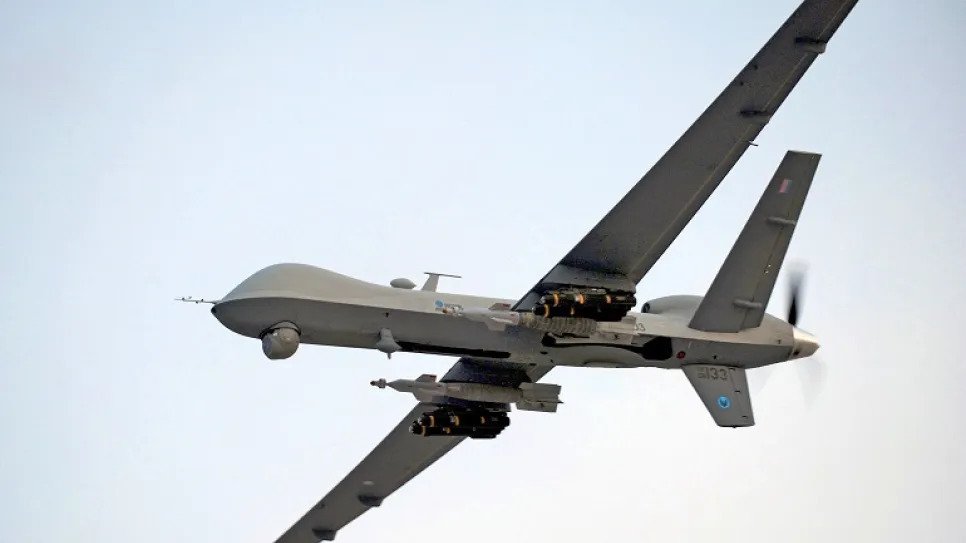
The report identifies Iranian-made Mohajer-6 drones and Turkish Bayraktar TB2 and Bayraktar Akıncı systems among those operated by the army, while the Rapid Support Forces have reportedly used Chinese CH-95 drones and other long-range systems.
The arsenal ranges from small commercial drones used for close-range reconnaissance to tactical fixed-wing systems, armed drones capable of carrying munitions, and loitering or suicide drones in which the aircraft itself becomes the weapon.
This diversity matters politically as much as it does militarily.
As access to advanced military technology becomes cheaper and more widespread, the ability to sustain warfare increases. At the same time, conventional airpower becomes less decisive as the sole source of aerial superiority.
The diversity of suppliers also illustrates how Sudan’s war is increasingly connected to a wider regional and international environment in which technology, weapons, and external interests intersect with the domestic conflict.
The “Safe Rear” Is No Longer a Distance
Perhaps the most important development in Sudan’s war is the redefinition of what constitutes a “safe rear.”
Long-range drones can rely on satellite-based navigation, inertial navigation systems, and pre-programmed routes, enabling them to reach distant targets without requiring continuous manual control throughout the flight.
This fundamentally changes military calculations.
In conventional warfare, distance offered cities and infrastructure a degree of natural protection from artillery, ground forces, and short-range weapons.
Today, distance alone is no longer an adequate measure of security.
A “safe rear” increasingly depends on an integrated system of early warning, radar coverage, air defenses, electronic warfare, the dispersal of critical infrastructure, and the ability to restore essential services rapidly after an attack.
A city without effective air defenses can therefore remain vulnerable even if it is hundreds of kilometers from the battlefield.
The Low Cost of the Weapon, the High Cost to Society
The danger posed by drones also lies in the imbalance between the cost of deploying them and the potential cost of the damage they inflict.
Even when some drones are relatively inexpensive compared with fighter aircraft, striking a single facility can impose enormous costs on society.
A single power station may supply a hospital, water pumps, and residential neighborhoods. A fuel depot does more than supply transportation; it powers generators and sustains essential services. A port is not simply a commercial facility; it is a channel through which food, medicine, and humanitarian assistance enter the country.
The question, therefore, is no longer simply whether a drone successfully hit its intended target.
The more important question is:
How much disruption did that strike cause across the civilian system?
Infrastructure can function as a force multiplier. A strike against a single node can transmit its effects across sectors and regions far from the point of impact, as demonstrated by attacks on the Merowe Dam and the power networks connected to it.
Merowe Dam: How One Strike Can Become a National Crisis
The Merowe Dam illustrates this dynamic with particular clarity.
Drone attacks on power facilities in Merowe in January 2025 caused widespread disruption to the electricity network across large areas controlled by the army. The consequences subsequently spread to other states, affecting hospitals, schools, and water facilities.
The strategic implication is profound:
A war no longer needs to strike every city individually.
It can target a single critical node in an interconnected network and allow the effects to travel hundreds of kilometers.
The economic and service geography of the state thus becomes part of the military geography of the conflict.
A patient whose hospital loses power may be far from the attack site. A family whose water pump stops working may never see the drone. A bakery unable to operate may have no direct connection to the military target.
Yet all become indirect casualties of the same strike.
The definition of a war victim therefore expands beyond those physically present at the point of impact.
A War That Comes From the Sky
Sudan’s experience shows that drones are no longer merely tools for improving reconnaissance or striking selected military targets.
They are becoming instruments for reshaping the war itself.
They expand the geographical range of attacks, reduce risks to those conducting them, enable strikes against distant targets, increase pressure on critical infrastructure, and create a persistent climate of uncertainty among civilians.
Nor does intercepting a drone necessarily eliminate the danger. Parts of the airframe, engine, fuel, warhead, or interception system can fall to the ground, while unexploded ordnance may remain hazardous in populated areas.
The danger of aerial warfare can therefore persist beyond the moment of impact.
Sudan Enters the Era of “War Without a Front”
The most dangerous aspect of this transformation is that Sudan is moving toward a model that could be described as “war without a front.”
The front is no longer a geographical line from which civilians can simply move away. It has become a network of potential targets extending from military bases to power stations, airports, fuel depots, markets, and ports.
This also changes the logic of displacement.
In conventional warfare, civilians flee a city where fighting is taking place and seek refuge in another city that appears safer.
In a war in which opposing sides possess long-range drones, however, there may be no place that can be considered completely safe.
This makes displacement more complicated and less effective, increases pressure on host cities, and creates successive layers of humanitarian vulnerability.
What Does This Mean for the Future of the War?
The most important conclusion is not that drones will end the war or necessarily give either side a decisive victory.
On the contrary, their proliferation may prolong the conflict by lowering the cost of conducting strikes and providing the warring parties with new military capabilities.
Their most significant impact may instead be to change the nature of the war and increase the cost of its continuation for society and the state.
As power stations, water facilities, fuel depots, airports, and ports become potential targets, the state’s ability to provide basic services becomes directly linked to its ability to protect critical infrastructure.
As the range of potential targets expands, the distinction between the military and civilian spheres becomes increasingly fragile.
Drones are therefore not simply changing how the war is fought. They are changing how cities collapse under the pressure of war.
Conclusion: Sudan After the Fall of Distance
The central question in Sudan is no longer simply: Where is the front line?
The more important question is:
How far can the war reach?
The experiences of El Obeid, Port Sudan, Merowe, and other locations demonstrate that the geographical reach of the conflict has expanded far beyond the ground front lines.
Drones have undermined one of the oldest assumptions of wartime survival: that moving away from the battlefield provides protection.
They have also redefined the meaning of strategic depth. A distant location can be exposed; civilian infrastructure can become part of military calculations; and a strike that appears geographically limited can trigger a crisis hundreds of kilometers away.
The transformation taking place in Sudan is therefore not simply about the introduction of drones into the battlefield. It is about the transition from controlling territory to possessing the ability to threaten the entire national space.
And that is the most dangerous implication of Sudan’s new aerial warfare:
**The war no longer needs to travel the entire road to reach the people.
Sometimes, it only needs to come from the sky.**
Most read