Religion and Politics in Armenia: A Struggle for Influence Between the State and the Church

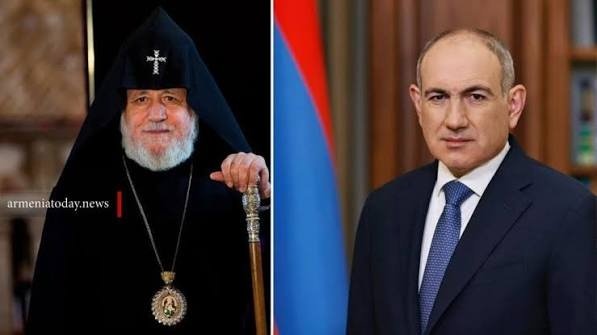
The relationship between the state and the Church in Armenia has entered a new phase of tension after the government of Prime Minister Nikol Pashinyan explicitly included changing the leadership of the Armenian Apostolic Church in its government programme for 2026–2031. The move has brought back to the forefront a broader question concerning the limits of state intervention in the affairs of a religious institution that enjoys a degree of autonomy under the Armenian Constitution and law.
The dispute between Pashinyan and Karekin II does not appear to be merely a personal conflict between a head of government and a religious leader. In recent years, it has evolved into a political and institutional confrontation involving questions of Church governance, its autonomy, and its relationship with the state, alongside competing accusations over the politicization of the religious institution and the use of religious influence in public life.
The Church leadership, for its part, argues that the government is exceeding the limits of its authority and seeking to interfere in an institution that is supposed to enjoy autonomy. The government, meanwhile, says its objective is not to directly appoint a new Catholicos, but rather to reactivate Church institutions that it believes have remained dysfunctional for many years.
The core of the crisis, therefore, is not simply about who will lead the Church. The more important question is: Who has the authority to determine the future of an autonomous religious institution when the state believes that the way it is being governed has become a political or institutional problem?
From a Political Dispute to Government Policy
Relations between Pashinyan and Karekin II have become increasingly tense in recent years, with both sides at times calling for the other to leave office. The dispute acquired a new institutional dimension, however, when the ruling Civil Contract party, led by Pashinyan, included in its 2026 election programme the idea of reforming the Church and removing what it described as the Church’s “de facto head,” referring to Karekin II.
Following the party’s victory in the parliamentary elections on June 7, in which it secured 64 of the National Assembly’s 105 seats, the issue moved from the level of an electoral platform to that of government policy. On August 20, the Pashinyan government approved its programme for 2026–2031, which included a section entitled “Spiritual Security” and identified replacing Catholicos of All Armenians Karekin II as a strategic objective.
The National Assembly subsequently approved the programme on August 25, with all 64 Civil Contract lawmakers voting in favor, 27 voting against, while the remaining lawmakers either did not vote or were absent.
The dispute over Church leadership had thus become part of an official government policy rather than simply a confrontation between two institutions or individuals.
The Armenian government, for its part, has sought to frame the crisis from a different perspective. Government spokesperson Melanya Harutyunyan stressed that the state neither can nor wants to appoint a Catholicos, noting that the selection of the head of the Church falls under the authority of the National Ecclesiastical Assembly. The government argues, however, that the problem lies precisely in the fact that this assembly has not convened for many years.
According to the government’s account, the National Ecclesiastical Assembly has not met since 1999, despite the Church’s internal rules requiring it to convene at least once every seven years. The Church’s Representative Assembly, which is supposed to meet every two years, has also not convened since 2017. The government further argues that this situation has weakened the Church’s internal governance mechanisms and that some of its bodies have been operating for years with expired mandates.
From this perspective, the government portrays its intervention as an attempt to restore Church institutions to functioning order rather than as an effort to seize the Church’s right to choose its own leadership. This framing makes the dispute appear more like a disagreement over how to restore the autonomy of an institution whose own internal mechanisms, according to the government, have become ineffective.
At the same time, however, it raises a highly sensitive question: If the state believes that the internal institutions of the Church have become dysfunctional, does that give it the right to intervene in restructuring its leadership?
The Church: Autonomy Is Not Subject to Parliament
The Armenian Apostolic Church categorically rejects this reasoning. The Church’s Supreme Spiritual Council has argued that the government lacks the constitutional authority to include “Church reform” in its government programme or the power to impose proposals or demands on clergy.
The Council has also rejected the National Assembly as an appropriate forum for discussing the internal affairs of the Church, stressing that reforming a religious institution cannot be achieved through external pressure or threats.
The Church bases its position on Armenia’s own legal framework. The Constitution provides for the autonomy of religious organizations, while the law on religion establishes a separation between Church and state and prohibits state bodies from interfering in the activities and internal affairs of religious organizations as long as they operate within the law.
The Armenian Apostolic Church also benefits from a special law adopted in 2007 that recognizes it as an independent and self-governing church within its hierarchical structure.
Consequently, the Church leadership argues that the dispute goes beyond disagreement over Karekin II and concerns a fundamental question about the limits of state authority.
The Constitutional and International Dimension
The sensitivity of the issue is heightened by Armenia’s international obligations concerning freedom of religion or belief. The international principles cited in connection with the dispute indicate that states are expected to leave questions concerning leadership selection, internal rules, organizational structures, and procedures for appointing religious officials to religious communities themselves.
Accordingly, the real test is not simply whether the government has political or administrative grounds for intervention, but whether the means it employs are consistent with the principle of institutional autonomy enjoyed by religious communities.
This is where a grey area emerges in the crisis.
The state may have legitimate concerns regarding the administration of a religious institution, but the legitimacy of those concerns does not necessarily mean that restructuring its leadership from outside the institution is legitimate.
Conversely, religious autonomy does not necessarily mean exemption from legal accountability when the issue concerns compliance with court orders or conduct criminalized under the law.
The interaction between religious autonomy and the rule of law is therefore one of the most complex dimensions of the crisis.
The Judicial Case: A New Layer of the Conflict
The confrontation has not been confined to political statements. Karekin II and six senior bishops are facing criminal proceedings stemming from a dispute involving Bishop Gevorg Saroyan.
The Church had removed Saroyan from his position and subsequently stripped him of his ecclesiastical rank after he supported calls for changes in the Church’s leadership. In January 2026, a court issued an order requiring his reinstatement, while the Church leadership rejected the decision, maintaining that its decisions were based on its ecclesiastical laws and canonical rules.
Following the failure to implement the court order, the authorities launched a criminal investigation. Charges were subsequently brought against six bishops and Karekin II. If convicted, the defendants could face penalties of up to two years in prison.
The case places the crisis on a different level. The question is no longer limited to the autonomy of the Church, but also concerns the relationship between decisions made by a religious institution and judgments issued by the civil judiciary.
The course of the proceedings has added another layer of complexity. The case moved between different courts after the initial judge withdrew from the proceedings. It was subsequently transferred to a court in Yerevan, which asked the Court of Cassation to determine jurisdiction. On September 7, the Court of Cassation returned the case to the First Instance Court of the Armavir Region.
This procedural trajectory has not remained merely a legal matter. It has become part of the wider political and media debate surrounding the case.
The government maintains that resorting to the judiciary became necessary because a court order had not been implemented. Its critics, however, argue that using judicial proceedings against the Church leadership contributes to expanding state intervention in ecclesiastical affairs.
The heart of the dispute here, therefore, rests on two competing interpretations of the rule of law.
From the government’s perspective, a religious institution cannot refuse to implement a court judgment. From the perspective of its critics, turning an internal ecclesiastical dispute into a criminal case could weaken the Church’s institutional autonomy.
A Religious Institution with Political and Historical Weight
The Armenian Apostolic Church occupies an exceptional position within Armenian society, making the struggle over its leadership extend beyond the boundaries of a religious institution.
It is not merely a small religious community whose activities can easily be separated from the public sphere. Rather, it is a historic institution deeply embedded in Armenian identity.
For this reason, any attempt to redefine its relationship with the state inevitably carries broader political and social implications.
From the government’s perspective, reforming the religious institution may form part of a broader effort to reorganize the public sphere and prevent the Church from being used as a political instrument.
From the Church’s perspective, however, such a justification could become a gateway for subjecting an autonomous institution to executive authority.
The crisis therefore intersects with a broader question confronting many modern states: How can religion and politics be separated when the religious institution itself forms part of a country’s history and national identity?
“Spiritual Security” or a Redesign of the Public Sphere?
The government’s choice of the term “Spiritual Security” in its programme is particularly noteworthy because it indicates that the crisis is not viewed in Yerevan merely as an administrative matter.
The government programme links Church reform to preventing what it describes as attempts by external forces to turn the Church into a platform for “hybrid warfare,” while also emphasizing financial transparency and ethical conduct among clergy.
This rhetoric reflects a view that religious institutions can become part of the security and political environment in a highly complex regional context.
Yet expanding the concept of security to encompass the religious sphere also carries political risks. “Spiritual security” could potentially become a justification for expanding the state’s role in civil society and religious institutions.
The success of the government’s policy will therefore depend not only on its declared objectives, but also on the limits of the tools it chooses to pursue them.
A Struggle Over the Future More Than the Past
Against this backdrop, it is difficult to reduce the current confrontation to the question of removing Karekin II.
The deeper issue appears to concern the redefinition of the relationship between the state and the Church in Armenia.
The government wants a more transparent Church, more effective internal institutions, and an institution that is less politicized. The Church, meanwhile, seeks to preserve its autonomy in selecting its leadership and managing its internal affairs.
Both sides use concepts that may appear, at first glance, to be broadly compatible, including autonomy, the rule of law, reform, and transparency.
The disagreement, however, concerns who has the authority to interpret these concepts and determine how they should be applied.
That is what makes the crisis more complicated than a personal dispute between Pashinyan and Karekin II.
Where Could the Conflict Go?
A settlement does not appear easy now that the dispute has evolved into government policy and a judicial case.
Nevertheless, there may be a middle path capable of preventing the crisis from becoming a zero-sum confrontation: separating the state’s right to enforce the law from the Church’s right to manage its internal affairs.
The state can demand financial transparency and compliance with the law, but that does not necessarily mean that it should become the decision-maker in selecting religious leadership.
Conversely, the Church can defend its autonomy, but autonomy cannot necessarily mean refusing to comply with judicial decisions issued under civil law.
The real question facing Armenia, therefore, may not be: Who will prevail, Pashinyan or Karekin?
Rather, it is how to build a stable institutional relationship between a relatively secular state and a historic religious institution in which Church autonomy does not become immunity, and state authority does not become tutelage.
The answer to this question will significantly shape the relationship between religion and politics in Armenia in the years ahead.
The current confrontation may end with a change in the person at the head of the Church, but its deeper impact could be much greater—particularly in redefining the boundaries between the state, society, and religion, and in determining whether the autonomy of religious institutions in Armenia is a firmly established constitutional principle or a space open to reinterpretation whenever the balance of political power changes.
Most read