The Three Nuclear Powers Summit: A Display of Influence and the Limits of Managing the International Order

Trump, Xi, and Putin Seek Political Gains in Shenzhen, but the World Can No Longer Be Managed from a Table of Great Powers
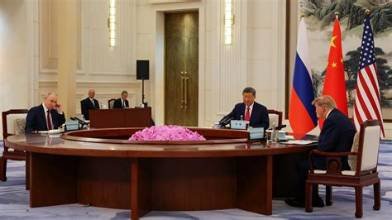
The trilateral summit bringing together US President Donald Trump, Chinese President Xi Jinping, and Russian President Vladimir Putin on the sidelines of the Asia-Pacific Economic Cooperation (APEC) summit in Shenzhen on November 19 was more than an extraordinary diplomatic encounter between three of the world's most prominent leaders. It reflected an attempt to reaffirm the central role of great powers in managing international affairs at a time when the global order is undergoing rapid transformation and mounting challenges are exposing the limits of traditional power and influence.
The summit's significance lay in the fact that it marked the first time the incumbent leaders of the world's three largest nuclear powers had held a direct trilateral meeting without the participation of other heads of state. Although the gathering produced no major strategic agreements or decisive understandings on pressing international issues, its political symbolism and the messages exchanged revealed the distinct calculations of each participant, as well as areas of overlapping interests that do not eliminate their underlying rivalries.
Each leader appeared to have secured gains consistent with his own political and strategic priorities, although the nature and extent of those gains differed considerably. For Moscow, participation offered an opportunity to break through some of its international isolation. For Beijing, it provided a platform to demonstrate its ability to manage diplomacy among the major powers. Trump, meanwhile, used the occasion to reaffirm his personal presence on the international stage and showcase his interest in reviving nuclear arms control efforts.
Putin and the Restoration of International Standing: A Symbolic Breakthrough Against Isolation
Russian President Vladimir Putin arguably gained the most in symbolic and political terms from the summit. Since Russia launched its full-scale invasion of Ukraine in February 2022, Moscow has faced mounting diplomatic isolation and international pressure, while its opportunities for engagement with Western-led multilateral frameworks have narrowed. Against this backdrop, Putin's appearance at a direct meeting with the US and Chinese presidents, in the first summit of its kind, offered an important opportunity to reassert Russia's position as a major player whose participation cannot be overlooked in discussions of global strategic affairs.
The significance of this appearance extended beyond the optics of the three leaders sharing the same table. It underscored Russia's continued recognition as a major nuclear power and Moscow's ability to maintain direct channels of communication with Washington and Beijing despite the ongoing war in Ukraine and Western sanctions.
Elizabeth Wishnick, an expert on Chinese-Russian relations at the US-based CNA research organization, described Putin as the meeting's biggest beneficiary. Sari Arho Havren, an associate fellow at the Royal United Services Institute (RUSI), similarly argued that the summit substantially reduced the appearance of Russia's isolation, with at least some potential implications for the diplomatic reality as well.
One of Moscow's most notable gains was the inclusion in the joint statement of language concerning the International Criminal Court (ICC). The three leaders emphasized the importance of state consent and respect for the immunities of state officials, while warning against the abuse of jurisdiction by the ICC and similar institutions. The wording carries particular significance for Putin, against whom the ICC issued an arrest warrant in March 2023 over alleged war crimes in Ukraine.
The statement also referred to increasing the production and supply of refined petroleum products for the benefit of all nations, a formulation that could serve the interests of Russia's energy sector, which continues to face Western restrictions and sanctions.
Nevertheless, it is important to distinguish diplomatic gains from substantive political achievements. The summit produced no settlement to the war in Ukraine, did not result in any easing of sanctions against Russia, and contained no practical commitments that would fundamentally alter Moscow's relationship with Western powers. Putin's gains therefore lay primarily in recovering some measure of diplomatic legitimacy and international visibility, rather than overcoming the underlying causes of Russia's isolation or the consequences of the war.
Xi Jinping and the Management of the Diplomatic Stage: China as a Center of Global Engagement
Unlike Moscow, Beijing had little need for a comparable diplomatic breakthrough. China faces no international isolation of the kind experienced by Russia and maintains an extensive network of economic and political relationships with major global actors. Yet the summit's importance for Xi Jinping lay in demonstrating China's capacity to host and manage a highly sensitive meeting between the world's three largest nuclear powers without overshadowing the broader Asian economic gathering on whose sidelines it took place.
Beijing succeeded in presenting the meeting as an example of its approach to diplomacy: managing competing interests, avoiding direct alignment with any single side, and preserving channels of communication among rival powers. Yun Sun, director of the China Program at the Washington-based Stimson Center, described the summit as a high-profile event that had been carefully choreographed and could be considered a diplomatic success for China. However, she noted that reaching agreement on a joint statement among all three parties came at the expense of addressing contentious issues in greater detail.
Xi Jinping appears to have used the meeting to reinforce China's image as a central actor in international affairs and a power capable of bringing competing parties together. It also allowed him to demonstrate a degree of flexibility in managing relations with the United States, particularly amid the trade and strategic tensions that have characterized bilateral ties in recent years.
Notably, Xi showed a willingness to discuss nuclear arms control, an issue of particular interest to Trump, while avoiding specific commitments. China, whose nuclear arsenal is estimated at approximately 620 warheads according to figures cited in the Stockholm International Peace Research Institute's 2026 report, still possesses a significantly smaller arsenal than those of the United States and Russia, each of which has more than 5,000 nuclear warheads.
For Beijing, entering comprehensive nuclear arms reduction negotiations at this stage could impose constraints that do not align with its understanding of national security requirements, particularly as it seeks to expand its nuclear capabilities and strengthen its strategic position. Consequently, the joint statement reiterated the familiar principle that a nuclear war cannot be won and must never be fought, while offering a general commitment to dialogue on reducing nuclear risks and preventing proliferation. It provided no specific mechanisms, timelines, or measurable obligations.
This illustrates a defining feature of Chinese diplomacy: expressing readiness to cooperate on major international issues while retaining broad room for maneuver and avoiding premature strategic concessions.
Trump and the Gains of Personal Diplomacy: Turning International Engagement into a Political and Media Achievement
US President Donald Trump entered the summit with relatively modest expectations, a factor that enabled him to present its outcome as a diplomatic success despite the absence of substantive agreements. According to several analysts, his primary objective was to demonstrate that his administration was seeking to reopen nuclear arms control discussions with the other two major nuclear powers and that he could restore direct diplomacy with leaders of countries that compete with the United States.
From this perspective, Trump achieved an important political and media objective simply by appearing alongside Xi and Putin and demonstrating that the major powers remained capable of discussing strategic issues despite their profound differences.
The personal dimension of the relationship between Trump and Xi also appeared to shape the summit's overall atmosphere. The Chinese president made a point of displaying warmth and hospitality toward his American counterpart. Trump described Xi's embrace as a "big win for us" and a sign of "great respect." These gestures highlight the importance of personal diplomacy in Trump's approach to international relations, in which direct interactions and ceremonial symbolism appear to carry considerable weight.
For Beijing, maintaining relatively stable relations with Trump is a strategic interest, particularly following years of trade and political tensions during both Trump's first administration and Joe Biden's presidency. A reduction in pressure from Washington would give China greater room to pursue its economic and strategic priorities.
The summit, however, failed to provide Trump with a clear way out of the war involving Iran, despite his stated intention to raise the issue before the meeting. The joint statement made no direct reference to the conflict, while both Putin and Xi refrained from publicly addressing it during the APEC gathering.
This position reflects the limits of convergence among Washington, Moscow, and Beijing. Neither China nor Russia appears willing to provide Trump with direct assistance in managing the conflict with Tehran, nor are they seeking to adopt a position that would encourage Iran to continue its military confrontation with the United States. Calling for peace and de-escalation remains the safest course for both countries, allowing them to avoid becoming entangled in a confrontation that does not necessarily serve their interests.
Great-Power Diplomacy and the Limits of Controlling International Crises
While the summit demonstrated the ability of major powers to communicate and coordinate broad positions on selected issues, it also exposed the limits of their capacity to control the course of international crises. The most sensitive issues, particularly the war in Ukraine and escalating tensions in the Middle East, remained outside the scope of any publicly announced practical understanding.
Concerns had intensified in Ukraine and Europe when Putin first proposed the trilateral summit, amid fears that it might become a framework for negotiating a settlement to the war without Ukraine or European participation. Yet such an outcome was never particularly realistic, given China's reluctance to take steps that could damage its economic relations with Europe, as well as Beijing's efforts to maintain its image as a power seeking to project neutrality.
China's decision to keep Ukraine off the summit's agenda was therefore more than a procedural detail. It reflected Beijing's calculation that becoming involved in a unilateral settlement could undermine its relations with Europe and weaken its diplomatic narrative of neutrality.
In this context, Elizabeth Wishnick pointed to Ukrainian drone and missile strikes on the Crimea Bridge shortly before the summit, arguing that they conveyed a clear message: world leaders cannot bring the war to an end without the participation of Ukraine and relevant European leaders.
The episode highlights a deeper transformation in the management of international conflicts. The political will of major powers is no longer sufficient, on its own, to impose settlements on parties directly involved in conflicts, particularly when those parties possess military capabilities and other instruments of influence that allow them to obstruct arrangements that disregard their interests.
Other regional developments further demonstrated the difficulty of separating diplomatic initiatives from events on the ground. On November 18, Iran launched drone and missile attacks against Bahrain and Kuwait, the first attacks of this kind in approximately two months, according to the report. Meanwhile, North Korean leader Kim Jong Un left the APEC gathering without meeting Trump, despite the US president's earlier remarks suggesting that such a meeting might take place. This was particularly notable given Pyongyang's role in supporting Russia's war effort in Ukraine through the provision of weapons and troops.
The summit thus failed to translate the combined weight of the three powers into an effective capacity to contain simultaneous crises or impose their priorities on other regional and international actors.
From a Unipolar World to a World the Great Powers Cannot Manage Alone
The summit's most important implications extend beyond its immediate outcomes to the broader transformation of the international system. On the one hand, it reaffirmed that the United States, China, and Russia continue to possess extraordinary instruments of influence, derived from their military and nuclear capabilities as well as their economic and political weight. On the other hand, it demonstrated that these instruments are no longer sufficient to guarantee control over international developments or impose lasting settlements on all relevant parties.
The war in Ukraine cannot be resolved through an understanding among Washington, Moscow, and Beijing that excludes Kyiv and Europe. Likewise, the conflict involving Iran cannot be settled through arrangements between the United States, Russia, and China without taking into account Tehran's calculations and the interests of regional states. The same applies to nuclear proliferation, regional security, and strategic competition, where the interests of multiple actors intersect and where states increasingly resist being treated merely as subjects of negotiations among the great powers.
Elizabeth Wishnick captured this reality when she observed that major powers retain considerable influence but cannot control events on the ground. The era in which leaders could simply sit around a table and decide the fate of the world is over, she argued, adding that resolving international problems now requires broader engagement with other states.
In this sense, the Shenzhen summit did not signal the return of a world order managed exclusively by the great powers. Rather, it highlighted the contradiction between their continued centrality and their diminishing ability to impose their will. The world still needs their cooperation, but it can no longer be managed through their agreements alone.
Ultimately, the Shenzhen summit was more a test of diplomacy than a milestone in international agreement-making. Putin gained an opportunity to ease his diplomatic isolation, Xi reinforced China's image as a power capable of managing international balances, and Trump secured a platform to reaffirm his personal presence and demonstrate his engagement with nuclear arms control. Yet these symbolic gains did not translate into solutions to the world's major crises. Perhaps the summit's deeper message is that the multiplication of centers of power does not necessarily produce a greater capacity to manage the world. Instead, it may reflect an increasingly complex international landscape in which instruments of influence—and the ability to obstruct political settlements—are distributed among a growing number of actors.
Most read