Lebanon’s Non-Aggression Framework with Israel: A Strategic Reset or the Prelude to a New Internal Crisis?

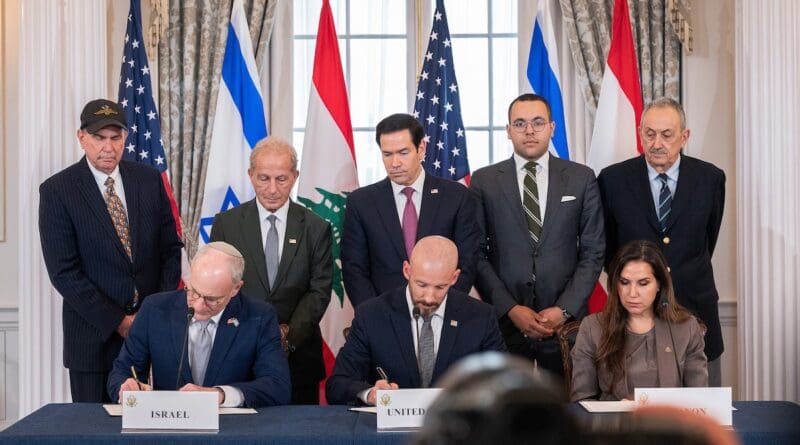
The framework agreement recently signed in Washington between Lebanon and Israel under US mediation represents one of the most consequential political developments in Lebanese-Israeli relations in decades. Although Lebanese officials have been careful to stress that the document does not constitute a peace treaty or normalization agreement, its political and security implications extend far beyond a simple ceasefire arrangement.
Rather than ending the broader Arab-Israeli conflict, the framework seeks to establish a new security architecture along the Lebanese-Israeli frontier while redefining the Lebanese state's monopoly over the use of force. This objective places Hezbollah's military future at the center of Lebanon's domestic political struggle and raises profound questions about whether the agreement can be implemented without triggering another period of internal instability.
A Non-Aggression Framework Rather Than Peace
Lebanese officials have deliberately characterized the agreement as a mechanism to terminate the state of hostilities rather than establish diplomatic relations with Israel.
This distinction carries significant political importance. Beirut continues to affirm its commitment to the 2002 Arab Peace Initiative, under which comprehensive normalization with Israel remains conditional upon the establishment of an independent Palestinian state based on the 1967 borders and a just resolution of the Palestinian refugee issue.
By emphasizing this position, Lebanese authorities seek to reassure domestic audiences that the framework does not represent a departure from long-standing Arab consensus, but rather a pragmatic security arrangement designed to prevent further military escalation after years of destructive confrontation.
Nevertheless, regardless of its legal terminology, the agreement represents the first structured roadmap for managing Lebanese-Israeli relations beyond periodic ceasefire understandings, making it strategically significant even without formal diplomatic recognition.
Rebuilding the Lebanese State's Monopoly on Force
The most transformative aspect of the agreement concerns the gradual restoration of Lebanese state authority across all national territory.
Under the framework, the Lebanese Armed Forces (LAF) are expected to progressively assume full security responsibility while non-state armed organizations are to be disarmed and their military infrastructure dismantled through a phased and internationally verified process.
This provision goes well beyond previous ceasefire arrangements. Instead of merely separating combatants, it directly addresses one of Lebanon's most sensitive political questions: whether the state alone should possess legitimate military authority.
Prime Minister Nawaf Salam has attempted to frame this commitment as entirely consistent with existing constitutional and international obligations, arguing that it merely reinforces principles already established by the Taif Agreement, UN Security Council Resolution 1701, and the November 2024 ceasefire arrangement.
From the government's perspective, therefore, the framework does not introduce a fundamentally new doctrine but seeks to operationalize commitments that Lebanon has repeatedly accepted over the past three decades.
Hezbollah Faces Its Greatest Strategic Challenge
For Hezbollah, however, the framework touches the very foundation of its military and political identity.
Since its emergence during the Israeli occupation of southern Lebanon, the organization has justified maintaining an independent military capability on the basis of resistance against Israeli aggression.
The new framework challenges that rationale directly by establishing a roadmap in which the Lebanese state gradually replaces Hezbollah as the country's sole security authority.
Not surprisingly, Hezbollah leaders have responded cautiously but critically.
While some officials refrained from issuing immediate definitive positions pending internal consultations, others warned that implementation would be impossible unless Lebanese authorities moved toward confrontation with the movement itself.
These statements reflect Hezbollah's central concern: disarmament is not viewed merely as a military adjustment but as a fundamental redistribution of political power inside Lebanon.
Domestic Politics: Consensus or Confrontation?
The agreement has immediately exposed deep divisions within Lebanon's already fragmented political landscape.
Supporters argue that the framework offers Lebanon a historic opportunity to escape decades of recurring wars and regional proxy conflicts. They view stronger state institutions and exclusive military authority as prerequisites for economic recovery, foreign investment, and political stability.
Opponents, however, perceive the agreement as a strategic concession made under conditions of military weakness.
Some critics openly acknowledge that Lebanon currently possesses little negotiating leverage after months of devastating conflict. From this perspective, the framework reflects necessity rather than strategic choice.
The government's challenge will therefore extend beyond negotiations with Israel; it must also maintain sufficient domestic consensus to prevent implementation from becoming a catalyst for renewed political polarization—or worse, violent confrontation.
The Regional Dimension
The agreement cannot be understood in isolation from broader regional transformations.
The Middle East is experiencing an unprecedented period of strategic realignment characterized by shifting alliances, renewed US diplomatic engagement, and growing efforts to contain regional conflicts through negotiated security arrangements.
Within this broader environment, Lebanon faces mounting pressure to redefine its security doctrine.
Several Lebanese political figures have already framed the debate in explicitly geopolitical terms, asking whether the country should continue functioning as an arena for regional competition or instead seize emerging diplomatic opportunities to restore state sovereignty.
Consequently, implementation of the framework may become closely linked to broader regional developments involving Iran, Syria, Israel, and the Gulf states.
A Phased Security Architecture
Unlike previous agreements, the framework introduces a gradual implementation model rather than demanding immediate nationwide changes.
The Lebanese Armed Forces will initially assume responsibility for two pilot security zones while Israeli forces progressively withdraw from designated areas. Additional zones will be incorporated only after successful implementation and mutual agreement.
To facilitate this transition, the agreement establishes a US-supported military coordination mechanism responsible for overseeing implementation, verification procedures, and security coordination.
This phased approach appears designed to reduce the risks associated with abrupt political or military shifts while allowing confidence-building measures to develop over time.
However, gradual implementation also creates multiple opportunities for political disputes, security incidents, or external interference capable of slowing—or even derailing—the entire process.
Israel's Strategic Objectives
From Israel's perspective, the framework seeks to institutionalize long-term security guarantees rather than merely secure another temporary ceasefire.
Israeli officials argue that military operations inside Lebanon have been conducted exclusively in response to attacks by Hezbollah and other armed groups.
Accordingly, Israeli leaders maintain that once these organizations are disarmed and security arrangements become fully operational, there will be no strategic justification for maintaining military deployments inside Lebanese territory.
At the same time, Israeli authorities have indicated that buffer zones and force deployments may remain in place until they are satisfied that threats from southern Lebanon have been effectively eliminated.
This condition illustrates one of the framework's principal challenges: implementation depends not only on Lebanese actions but also on Israel's confidence that new security arrangements are genuinely sustainable.
Can the Framework Be Implemented?
Although the agreement establishes an ambitious roadmap, its success ultimately depends less on the text itself than on political realities inside Lebanon.
Disarming Hezbollah is not simply a technical military exercise. It involves questions of constitutional legitimacy, sectarian balance, regional influence, deterrence against Israel, and the future distribution of political authority within the Lebanese system.
Any attempt to accelerate implementation without broad domestic consensus risks intensifying political polarization or even provoking internal unrest. Conversely, prolonged delays could undermine confidence in the framework and encourage renewed military escalation along the border.
Conclusion
The Washington framework represents far more than a ceasefire mechanism. It constitutes an attempt to redefine the foundations of Lebanon's post-war security order by transferring exclusive military authority back to the state while establishing a structured path toward ending decades of armed confrontation with Israel.
Whether this initiative ultimately becomes a historic turning point or another unrealized diplomatic document will depend on three interconnected variables: the Lebanese state's capacity to build domestic political consensus, Hezbollah's willingness to adapt to a changing regional environment, and sustained international commitment to supporting implementation.
For now, the agreement marks the beginning of a long and uncertain political process rather than its conclusion. It opens a new chapter in Lebanese-Israeli relations—but one whose outcome remains contingent on fragile domestic balances and an increasingly fluid regional landscape.
Most read


Read also