What The Astana Process Reveals About Conflict Governance

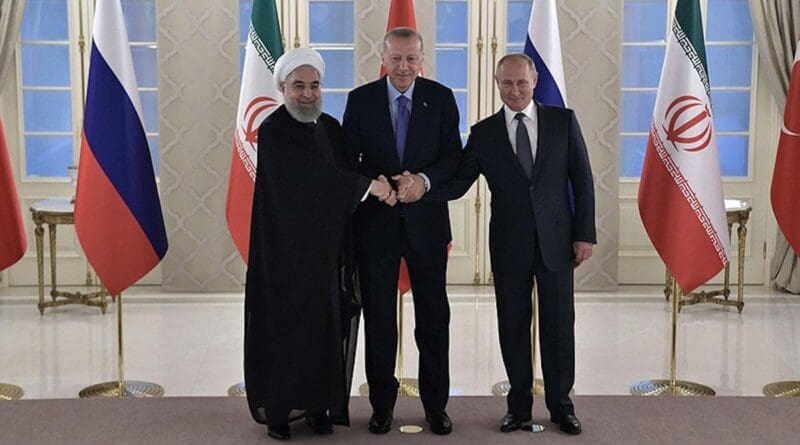
The Astana Process, launched in 2017 by Turkey, Russia, and Iran, challenged a long-standing assumption in conflict diplomacy: that institutions primarily exist to resolve wars. Instead, Astana evolved into a mechanism for governing rivalry within an ongoing conflict, creating procedures through which external powers could manage escalation without resolving the underlying political dispute.
The significance of Astana therefore lies less in whether it produced a political settlement than in how it structured interaction among actors with fundamentally incompatible objectives. By institutionalising diplomatic and military coordination without requiring strategic alignment, the process created a framework for managing instability while the conflict itself remained unresolved. Astana thus offers a useful example of a broader shift in contemporary conflict management, in which external actors increasingly seek to regulate conflict rather than resolve it.
From the outset, Turkey, Russia, and Iran entered the Astana framework with distinct and often contradictory strategic objectives. Russia sought to consolidate the survival of the Assad government and secure its battlefield gains. Iran aimed to preserve its regional influence and strategic access through Syria. Turkey, by contrast, sought to prevent the consolidation of Kurdish-led autonomous governance structures along its southern border while retaining influence over Syria’s political trajectory.
Despite these competing agendas, the three actors shared a narrow but important interest: preventing the Syrian conflict from escalating into uncontrolled and mutually costly confrontation. Astana provided a framework through which this limited convergence could be operationalised without requiring broader political agreement or strategic alignment.
This distinction is important. The process did not emerge because Turkey, Russia, and Iran agreed on what Syria’s political future should look like. It emerged because they needed a mechanism through which competing interests could be managed without allowing their rivalry to produce wider escalation.
One of the most important features of the Astana Process was the establishment of de-escalation arrangements. These did not aim to resolve the conflict, but to contain violence spatially and temporarily by designating areas for reduced fighting and creating mechanisms for monitoring ceasefires and regulating military activity.
Although many of these arrangements were fragile, selectively implemented, or eventually reversed, they demonstrated how the process could institutionalise limited forms of conflict management without resolving the political disputes underlying the war. Alongside these arrangements, Astana established regularised diplomatic and military coordination among the three guarantor states, including negotiation rounds, direct communication between military establishments, and issue-specific bargaining over territorial control, ceasefire enforcement, and operational deconfliction.
Together, these mechanisms created a more predictable environment in which rivalry could be managed without being eliminated. This is what makes Astana significant beyond the Syrian case: institutionalisation did not depend on political convergence. The actors could develop procedures for managing their interaction precisely because they did not agree on the conflict’s ultimate outcome.
The coordination achieved through Astana should not be mistaken for alignment or trust. The process did not resolve the underlying strategic divergences between Turkey, Russia, and Iran. Instead, it provided a framework through which those divergences could be contained and managed while the war continued.
Cooperation remained conditional and sensitive to developments on the ground. Competing priorities over northern Syria, the role of Kurdish forces, and the political future of the Assad government repeatedly exposed the limits of negotiated de-escalation. Military operations and shifting frontlines also disrupted agreed arrangements, demonstrating that institutionalised coordination remained vulnerable to changes in the balance of power.
Yet these limitations do not negate Astana’s significance. Its value lay precisely in allowing cooperation to persist despite disagreement. The process did not transform the interests of its participants; it helped organise their interaction around those differences.
Astana therefore functioned less as a pathway toward peace than as a governance mechanism for an unresolved war. It allowed external actors to structure their interaction in ways that reduced the risk of uncontrolled escalation while preserving fundamentally incompatible strategic objectives. Conflict was not transformed; the conditions under which competing interests interacted were.
This reflects a broader development in contemporary conflict management. In conflicts involving multiple external actors, comprehensive political settlements may be difficult to achieve even when the parties recognise the costs of uncontrolled escalation. Under these conditions, institutions can emerge to regulate the intensity, geography, and external spillover of conflict without resolving its underlying causes.
The Astana Process illustrates this dynamic clearly. Its significance does not lie in having overcome the strategic differences between Turkey, Russia, and Iran, but in demonstrating that institutionalisation can occur in their absence. The process created a structured mechanism for managing rivalry among actors whose objectives remained fundamentally incompatible.
This suggests that the success of conflict institutions should not be measured solely by whether they produce political settlements. In some cases, their more immediate function may be to prevent rivalry from escalating beyond manageable limits. Astana did not produce peace in Syria. It demonstrated how competing external powers could organise and contain their rivalry without achieving it.
The fall of Bashar al-Assad in December 2024 changed the political context in which the Astana Process operated, but it does not erase this broader lesson. The collapse of the Assad government ended the political framework around which much of the process had been organised, while Turkey, Russia, and Iran continued to confront overlapping but divergent interests in Syria. Astana is therefore best understood not as a model that produced a durable settlement, but as an example of how external powers can institutionalise mechanisms for managing rivalry even when the political conditions underlying those mechanisms eventually change.
Most read