The U.S.–Saudi Nuclear Deal: An Energy Partnership or the Beginning of a New Middle Eastern Balance of Power?

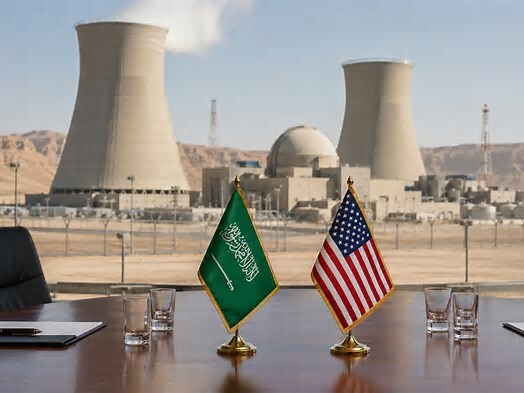
The significance of a U.S.–Saudi civil nuclear agreement extends far beyond the construction of reactors or the generation of electricity. At its core lies a much broader strategic equation in which energy intersects with security, technology with geopolitical influence, economic diversification with regional power balances, and uranium enrichment with the future credibility of U.S. nuclear nonproliferation policy.
Seen from this perspective, the agreement is more than a technical partnership between Washington and Riyadh. It reflects an evolution in the relationship between the two countries, potentially places Saudi Arabia in a more advanced position within the region’s nuclear technology landscape, and gives the United States an opportunity to anchor itself in a strategic Saudi industry for decades while limiting Chinese and Russian influence.
Yet behind these potential gains lies a more difficult question: will the introduction of advanced nuclear capabilities contribute to regional stability by creating a more balanced strategic order, or could it trigger a technological nuclear competition that gradually transforms the Middle East’s balance of power?
Beyond Energy: Saudi Arabia’s Search for Diversification and Power
For Saudi Arabia, the nuclear program is first rooted in clear economic and developmental objectives. The Kingdom has long sought to diversify its energy mix and reduce the domestic consumption of oil and gas for electricity generation, allowing more hydrocarbon resources to be exported or directed toward higher-value economic uses.
From this perspective, nuclear energy fits naturally within the broader transformation envisioned under Saudi Vision 2030. Energy is no longer merely a utility sector; it has become part of a larger strategy to build a more diversified economy, expand industrial capabilities, and develop a more sophisticated technological base.
Saudi ambitions, however, extend beyond simply purchasing ready-made reactors from foreign suppliers.
Riyadh’s insistence on maintaining a greater role within the nuclear fuel cycle—including the possibility of domestic uranium enrichment under agreed safeguards and arrangements—reflects an ambition to move from being merely a consumer of advanced technology to becoming a country that possesses the knowledge, infrastructure, and technical capabilities associated with it.
That distinction is strategically important.
A country that simply imports nuclear-generated electricity occupies a fundamentally different position from one that possesses a domestic nuclear industry, specialized human capital, supply chains, and fuel-cycle capabilities. Saudi Arabia’s nuclear ambitions therefore represent a long-term investment in technological power, not merely in electricity generation.
Enrichment at the Heart of the Equation
Uranium enrichment remains the most sensitive element of the nuclear equation because it lies at the intersection of legitimate civilian use and the strategic concerns associated with nuclear proliferation.
Enrichment technology does not in itself indicate a military nuclear program. It can legitimately be used to produce fuel for civilian reactors. Yet it is also one of the most sensitive capabilities in the nuclear fuel cycle because the knowledge and infrastructure associated with enrichment can, in theory, be developed to higher levels if political decisions and strategic circumstances change.
For this reason, U.S. nuclear cooperation policy has historically approached enrichment and reprocessing with considerable caution.
The contrast with the U.S.–UAE nuclear agreement is particularly important. Abu Dhabi accepted what became known as the “gold standard,” renouncing domestic uranium enrichment and spent-fuel reprocessing in exchange for access to American nuclear technology and cooperation.
If Riyadh secures substantially more flexible terms, the implications would extend well beyond Saudi Arabia.
It could establish a political and strategic precedent.
Other regional states could eventually ask a simple question: if one Middle Eastern country is permitted to retain more advanced fuel-cycle capabilities while benefiting from U.S. nuclear cooperation, why should others accept more restrictive conditions?
At that point, a bilateral agreement becomes a question about the future architecture of nuclear nonproliferation across the region.
Washington’s Calculation: Concession in Exchange for Containment
From Washington’s perspective, greater flexibility toward Saudi demands can be understood as part of a broader strategic trade-off.
The United States faces a straightforward dilemma. If it refuses to cooperate under terms Riyadh considers compatible with its ambitions, Saudi Arabia has potential alternatives—notably China and Russia, both of which have sought to expand their influence across the Middle East’s energy, infrastructure, and technology sectors.
Strict U.S. conditions, therefore, would not necessarily stop Saudi Arabia from pursuing nuclear energy. They could instead push the Kingdom toward a strategic competitor.
The central question for Washington consequently becomes less about whether Saudi Arabia will develop a civilian nuclear sector and more about who will build it, whose standards will govern it, and which external power will acquire decades of influence over one of the Kingdom’s most sensitive strategic industries.
Nuclear reactors are not short-term commercial transactions. They are multi-decade projects involving maintenance, fuel supplies, training, safety systems, security arrangements, and technological upgrades. The country that becomes the principal partner in a national nuclear program acquires a long-term strategic relationship with the recipient state.
For the United States, securing Saudi Arabia’s nuclear market could generate billions of dollars in potential contracts for American industry. More importantly, it could prevent China or Russia from establishing a dominant position in one of the most strategically sensitive sectors of the Arab world’s largest economy.
What may appear to be an American “concession” on enrichment can therefore also be interpreted as the strategic price of containment.
Nuclear Cooperation as an Anchor of Alliance
Saudi Arabia’s preference for American nuclear technology also carries a security dimension that may be as important as the economic one.
Nuclear facilities are inherently long-term strategic assets. They create dense networks involving technology providers, engineers, companies, regulators, security systems, and supply chains. The greater the American role in building such critical Saudi infrastructure, the higher the long-term cost of strategic disengagement between the two countries.
In this sense, nuclear cooperation could serve as a strategic anchor for the U.S.–Saudi relationship.
Riyadh would not simply acquire reactors or technical expertise. It would connect part of its future critical infrastructure to an American technological ecosystem that would be difficult to replace quickly.
Washington, in turn, would acquire deeper economic, technological, and security interests tied directly to Saudi stability and the protection of critical infrastructure.
Nuclear cooperation could therefore help redefine a relationship historically framed around “oil for security,” expanding it into a multidimensional partnership built around advanced technology, energy, investment, industrial development, and long-term strategic security.
Iran at the Center of the Strategic Equation
No analysis of Saudi Arabia’s nuclear ambitions can ignore Iran.
Riyadh views Iran’s nuclear capabilities as a central component of the regional balance of power, particularly given Tehran’s accumulated technical expertise and enrichment infrastructure.
A sophisticated Saudi civilian nuclear program, with its associated scientific, industrial, and technological base, would provide the Kingdom with a form of strategic hedging, even if the program remained entirely peaceful and under international safeguards.
Strategic capability does not always require possession of the weapon itself.
Knowledge, trained personnel, infrastructure, materials, supply chains, and experience in managing an advanced nuclear fuel cycle can reduce the technological distance between a purely civilian program and other potential options should the security environment fundamentally deteriorate.
This is why any Saudi acquisition of enrichment capabilities would inevitably be interpreted regionally not simply as an energy project, but as a change in the structure of latent power.
The Nonproliferation Dilemma
This creates one of the most sensitive contradictions in U.S. policy.
Washington seeks, on the one hand, to prevent Iran from acquiring a nuclear weapon. On the other, it may find itself accepting more advanced civilian nuclear capabilities for a regional ally in order to preserve the strategic partnership and prevent Riyadh from turning toward Beijing or Moscow.
That tension poses a challenge to the credibility of U.S. nonproliferation policy.
If Saudi Arabia receives terms significantly more flexible than the UAE’s “gold standard,” it may become increasingly difficult to persuade other countries that renouncing enrichment should remain the default condition for civilian nuclear cooperation.
The greater risk is not necessarily that Middle Eastern states would immediately begin building nuclear weapons.
Instead, the region could enter a competition for nuclear latency.
In such a competition, states do not necessarily seek a bomb. Rather, they seek the technology, expertise, infrastructure, and industrial capabilities that preserve the option of moving toward more advanced nuclear capabilities if future security conditions demand it.
Such a development could be more complex than a conventional arms race because it would unfold largely through legally permissible civilian programs while gradually altering the strategic calculations of regional powers.
Israel and the Question of Qualitative Superiority
Israel would be expected to watch such developments with considerable caution.
Israeli security doctrine has traditionally placed great emphasis on maintaining qualitative military and technological superiority. Any expansion of sensitive nuclear capabilities in the region therefore raises questions that go beyond present-day intentions and focus instead on long-term possibilities.
States change. Alliances shift. Governments rise and fall. Nuclear infrastructure and expertise, however, can endure for decades.
Israel’s strategic calculation is therefore unlikely to focus only on what Saudi Arabia intends to do today. It will also consider what capabilities the Kingdom might possess twenty or thirty years from now.
This long-term perspective is precisely what makes the spread of advanced nuclear technology so sensitive, even among countries that currently share stable relations or overlapping strategic interests.
Three Potential Strategic Transformations
The agreement could generate three major transformations in the regional order.
The first would be the re-anchoring of the U.S.–Saudi partnership on a new foundation that goes beyond the traditional oil-and-security bargain to encompass advanced technology, nuclear energy, industry, investment, and long-term strategic cooperation.
The second would involve a recalibration of the Saudi–Iranian balance of power. Even if Saudi Arabia’s program remained entirely civilian, the development of an advanced nuclear infrastructure would narrow aspects of the technological gap with Iran and provide Riyadh with additional strategic weight.
The third would be the potential spread of demand for advanced nuclear capabilities across the Middle East. If Saudi Arabia establishes a model in which a regional state can gain access to American nuclear technology while retaining broader rights within the fuel cycle, other governments may eventually seek comparable arrangements.
The region could then move from an order in which only a very small number of states possess sophisticated nuclear capabilities toward one in which several countries acquire what might be described as latent nuclear capacity.
An Energy Deal—or the Beginning of a New Regional Order?
Ultimately, the significance of a U.S.–Saudi nuclear agreement should not be measured solely by the number of reactors constructed or the value of contracts awarded to American companies.
Its deeper importance lies in the rules and precedents it may establish.
For Saudi Arabia, the agreement could advance economic diversification, build a sophisticated technological base, enhance regional status, and deepen its long-term security relationship with the United States.
For Washington, it offers substantial commercial opportunities, a means of limiting Chinese and Russian strategic penetration, and an opportunity to reinforce ties with a pivotal regional power.
Yet the potential strategic cost lies in weakening some of the constraints that have shaped nuclear nonproliferation policy for decades and encouraging other states to demand similar rights.
Herein lies the central paradox: an agreement designed to strengthen an alliance and reinforce stability in the short term could, if its safeguards and precedents are not carefully managed, accelerate the long-term emergence of a Middle East in which several powers possess the technological foundations for more advanced nuclear options.
The decisive question, therefore, is not simply whether Saudi Arabia will build nuclear reactors. It is what kind of regional order will emerge when advanced nuclear technology becomes an increasingly important instrument of power, status, and strategic leverage across the Middle East.
The deal may prove an economic victory for Saudi Arabia and a commercial and geopolitical gain for the United States. But it could also mark the beginning of a much deeper transformation: a shift from the region’s traditional competition for political and military influence toward a competition over the technologies that will determine who possesses the strategic options of the future.
Most read



Read also