Iraq Between Geopolitical Pressures and the Imperative of Balance: Can Baghdad Redefine Its Regional Role?

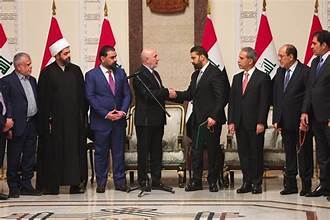
Iraq has never been an ordinary state in the strategic equations of the Middle East. Since the establishment of the modern Iraqi state, its geographic location, vast oil wealth, and complex social and political composition have made it a focal point of interaction, competition, and conflict among regional and international powers. Today, more than two decades after the U.S.-led invasion that reshaped Iraq’s political order, the country once again finds itself at a strategic crossroads, where American pressure, Iranian influence, Turkish ambitions, and rapidly evolving regional dynamics converge.
The arrival of Ali Al Zaydi as Prime Minister in May 2026 places these challenges under a new test. Al Zaydi inherits not only a set of complex economic and security issues but also a state attempting to redefine its regional role within a strategic environment undergoing unprecedented transformation.
Current developments in Iraq reveal a fundamental dilemma: the gap between the concept of a sovereign state and the actual balance of power on the ground. Iraq possesses constitutional institutions, a national army, and formal security agencies, yet it also hosts a broad network of armed actors whose sources of power remain relatively independent from state institutions.
Since the war against the Islamic State in 2014, the Popular Mobilization Forces (PMF) have emerged as one of the most influential actors in Iraq’s security landscape. Although formally integrated into state institutions, segments of the PMF continue to maintain close political, ideological, and military ties with Iran.
The core challenge is that these factions are no longer merely a security issue; they have become an integral component of the political balance underpinning Iraq’s governing system. Consequently, any attempt to reduce their influence or place them fully under state control represents not only a security challenge but also a potential restructuring of power relations within Iraq’s political order. As a result, Al Zaydi’s ability to establish the state’s monopoly over the use of force is likely to depend more on political consensus than on military or security capabilities.
Notably, since the assassination of Iranian Quds Force commander Qassem Soleimani and Popular Mobilization Forces deputy chief Abu Mahdi al-Muhandis in early 2020, Iraq has increasingly become one of the principal arenas of indirect confrontation between Washington and Tehran. What distinguishes the current phase, however, is that Iraq is no longer merely a battleground; it has become a strategic asset in the calculations of both sides. The United States views Iraq as a critical platform for containing the expansion of Iranian influence across the Arab Levant, while Iran regards the preservation of its influence in Iraq as a cornerstone of the regional deterrence architecture it has spent the past two decades constructing.
The significance of this dimension has grown further amid the current U.S.–Iran confrontation, which has reignited fundamental questions regarding the future of Iran-aligned armed groups and their role within the Iraqi state.
In this context, Baghdad faces a particularly complex equation. It requires continued security cooperation with the United States to combat terrorist threats and strengthen its military capabilities, yet it cannot ignore the depth of Iranian influence within its political and security institutions.
At the same time, while analyses often focus on the Iraqi-Iranian relationship, the Turkish dimension is becoming increasingly significant. Ankara views northern Iraq primarily through a security lens, considering the presence of the Kurdistan Workers’ Party (PKK) a direct threat to Turkish national security. Consequently, Turkish military operations inside Iraqi territory have continued for years despite repeated objections from Baghdad.
Recent developments, however—particularly the PKK’s announcement of its abandonment of armed struggle—may open the door to a new phase in Turkish-Iraqi relations, one that allows for a shift from a narrowly security-focused relationship toward a broader economic and strategic partnership. Such a transformation would be highly significant for Iraq, which seeks to diversify its regional partnerships and reduce dependence on any single geopolitical axis.
Although discussions of Kurdish independence have diminished compared to the period following the 2017 referendum, the Kurdish question remains one of the most important structural challenges facing the Iraqi state. Relations between Erbil and Baghdad continue to revolve around negotiations over oil revenues, budget allocations, the distribution of powers, and a range of disputed issues. Likewise, rivalry between the Kurdistan Democratic Party (KDP) and the Patriotic Union of Kurdistan (PUK) adds another layer of complexity to an already intricate political landscape.
In recent years, Baghdad has gradually strengthened its influence at the expense of the Kurdistan Region through judicial rulings, financial arrangements, and political agreements that have returned some authorities to the federal government. Yet this process does not necessarily signify the resolution of the Kurdish issue. Rather, it suggests a transition from open confrontation to ongoing negotiations over the nature of the relationship between the center and the region.
Despite the relative improvements witnessed in recent years, Iraq’s economy remains the weakest link in the country’s stability equation. The state remains overwhelmingly dependent on oil revenues to finance public expenditures, while rapid population growth continues to generate mounting pressure on labor markets and public services.
Furthermore, the expansion of public-sector employment over the past decade has reinforced an economic model driven more by government spending than by productivity, investment, and private-sector development. These vulnerabilities become even more pronounced amid fluctuations in global oil prices and regional instability affecting trade, energy flows, and investment patterns.
Consequently, Iraq’s future stability will depend not only on its ability to manage security and political balances but also on its success in building a more diversified and sustainable economic model.
More broadly, Iraq’s experience over the past two decades demonstrates that Baghdad’s ability to preserve relative stability has consistently depended on avoiding complete alignment with any regional or international bloc. Iraqi policymakers recognize that fully aligning with the United States would risk provoking domestic and regional confrontation with Iran-linked actors, while complete dependence on Tehran would jeopardize relations with the West and the Arab world and undermine economic opportunities.
For this reason, a strategy of strategic balancing appears to be the most realistic option available to Iraq’s current leadership. Such a strategy seeks to maintain security cooperation with Washington, preserve political and economic ties with Iran, and simultaneously deepen engagement with Turkey and the Arab Gulf states.
Yet the success of this approach will ultimately depend on Iraq’s ability to restore a greater degree of national decision-making autonomy and reduce the influence of non-state actors over its strategic choices.
Overall, Iraq stands today at a pivotal juncture that may prove to be one of the most consequential periods since the defeat of the Islamic State. The real challenge is no longer limited to confronting a specific security threat or managing a temporary political crisis. Rather, it lies in rebuilding the very concept of the state within a highly polarized regional environment.
Caught between American pressure, Iranian influence, Turkish ambitions, economic vulnerabilities, and internal divisions, Iraq faces a historic test: whether it can transform itself from an arena of regional competition into a regional actor possessing an independent will and a coherent strategic vision. The success or failure of this transformation will not only shape Iraq’s future but will also play a significant role in defining the emerging balance of power across the Middle East in the years ahead.
Most read


Read also