In the Second Week of the U.S.–Israeli–Iranian War: Escalating Military Confrontation and Regional Economic Repercussions

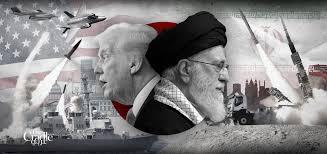
The U.S.–Israeli war against Iran has entered its second week amid unprecedented military escalation in the region, following a series of reciprocal strikes and an expansion of the conflict to several countries across the Middle East. With military operations continuing and no clear signs of de-escalation, concerns are growing that the confrontation could evolve into a broader regional war with global political and economic implications.
The conflict was sparked on February 28 when Israel announced that it had launched what it described as a “preemptive” attack against Iran. Shortly afterward, the United States declared the start of large-scale combat operations inside Iranian territory. U.S. President Donald Trump stated that the operations were intended to “neutralize the Iranian threat and defend the American people.”
Extensive Strikes and Targeting of Iranian Leadership
During the first days of the war, the United States and Israel carried out a series of air and missile strikes targeting sensitive military and security sites inside Iran as part of a broader strategy aimed at weakening the country’s military and security infrastructure.
Targets included military command complexes in Tehran, facilities belonging to the Islamic Revolutionary Guard Corps (IRGC), intelligence and security agencies, as well as the Basij paramilitary forces affiliated with the Revolutionary Guard.
The strikes particularly focused on command and control centers in an attempt to disrupt Iran’s chain of command and reduce Tehran’s ability to manage military operations and respond effectively to attacks.
Iranian Response and Expansion of the Conflict
Iran responded by launching ballistic missiles and drones toward Israel, resulting in casualties and material damage in several areas.
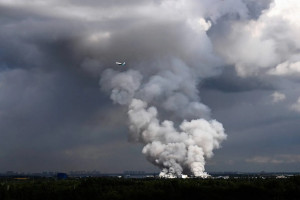
The confrontation quickly expanded beyond the two countries as Iran targeted energy facilities and vital infrastructure in several Gulf states using missiles and drones, while multiple countries reported intercepting aerial threats originating from Iranian territory.
Hezbollah also entered the conflict, announcing that it had targeted an Israeli military site south of Haifa with rockets and a swarm of drones, stating that the operation was carried out in retaliation for the assassination of Iran’s Supreme Leader Ali Khamenei.
In response, the Israeli military launched extensive strikes on Lebanon, announcing that it had targeted approximately 500 sites linked to the group.
Political Developments Inside Iran
Iran witnessed major political developments during the first week of the war, most notably the assassination of Supreme Leader Ali Khamenei and several senior officials as a result of Israeli strikes.
This was followed by the formation of a temporary leadership council to manage the country amid heightened political and security tensions.
In a televised address, Iranian President Masoud Pezeshkian said the war had been “imposed on Iran,” while offering an apology to regional countries for attacks carried out by Iranian forces.
He also stated that the temporary leadership council had instructed the armed forces not to target neighboring countries unless attacks against Iran were launched from their territories.
Human Losses and Security Consequences
The first week of military exchanges resulted in a significant number of casualties.
Heavy airstrikes inside Iran caused both human and material losses, while Iran’s retaliatory missile and drone attacks resulted in casualties in Israel and in some countries affected by the strikes or falling debris.
Strikes targeting Iran’s military and political leadership also led to major changes within the country’s command structure.
Global Economic Repercussions
Alongside the military escalation, economic consequences began to emerge by the end of the first week, particularly in energy markets and international transportation.
Air traffic across the region experienced major disruptions as several countries closed portions of their airspace due to rising security risks.
Oil prices also surged sharply, with U.S. West Texas Intermediate crude rising by more than 12 percent to approach $91 per barrel, while Brent crude settled near $93 per barrel.
This increase represents one of the largest weekly gains in the history of the oil market, driven by fears of disruptions to global energy supplies.
Disruption of Navigation in the Strait of Hormuz
Maritime navigation was also significantly affected, particularly in the Strait of Hormuz, one of the world’s most critical energy shipping routes.
Data from the Joint Maritime Information Center indicated a sharp decline in vessel traffic, with fewer than ten ships passing through the strait daily and only two commercial vessels confirmed to have transited within a 24-hour period.
Rising security risks forced dozens of fully loaded oil and gas tankers to halt operations within the Arabian Gulf, while international insurance companies began scaling back war-risk coverage for vessels operating in the region.
In response, the United States announced insurance guarantees and naval escort services for commercial ships, while the U.S. military is reportedly preparing a plan to ensure continued maritime transit through the strait.
Background of the Crisis
The military escalation followed the failure of a round of nuclear negotiations between Iran and Western countries in Geneva, amid growing tensions surrounding Iran’s nuclear program and the economic sanctions imposed on Tehran.
With the diplomatic track collapsing and threats escalating on both sides, the crisis quickly transformed into a direct military confrontation.
An Uncertain and Escalating Future
As the war enters its second week, indicators suggest that military operations are likely to continue, especially after Israel confirmed its intention to sustain strikes for several weeks.
U.S. President Donald Trump also stated that any agreement with Tehran would only be possible after “unconditional surrender.”
Amid the expanding scope of the conflict and its global economic consequences, the international community is closely watching developments in the coming days, with mounting fears that the confrontation could evolve into a wider regional war capable of reshaping the balance of power in the Middle East.
Most read



Read also