
African Cross-Border Displacement In The Shadow Of South Africa’s June 30 Mobilization

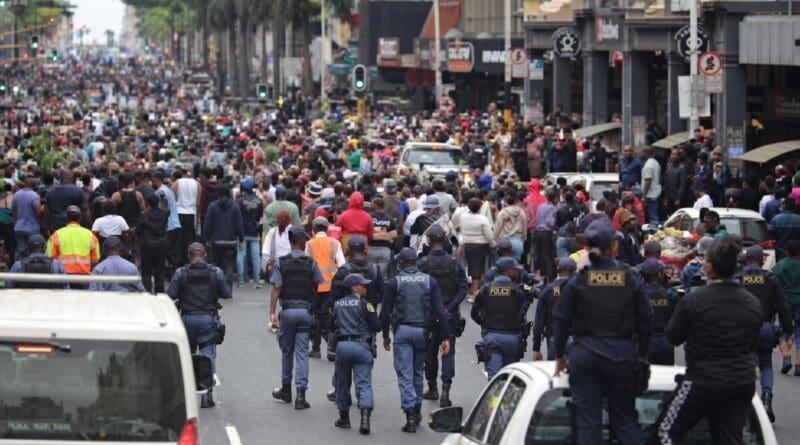
South Africa’s anti-immigration protests of June 2026 generated widespread commentary on vigilantism, constitutional order, and political opportunism. Yet much of that commentary remained narrowly domestic in focus. The people who fled, sought shelter, or queued for repatriation in the weeks before the June 30 deadline were not simply passive objects of South African politics. They were participants in a broader regional mobility system shaped by unequal development, administrative bottlenecks, and weak continental institutions. To analyse the crisis only through the lens of South African public order is to miss its wider structural significance.
Labour-Market Distress and the Misattribution of Causality
South Africa’s labour-market distress is real and politically combustible. The expanded jobless rate reached 43.7% in Q1 2026, with over 8.1 million people without work. That frustration is legitimate. But the existence of severe unemployment does not establish migrants as its principal cause. Wits University researchers calculated that even if every foreign national were removed, the unemployment rate would fall by only six percentage points, from 43.6% to 37.6%. Statistics South Africa data presented in Parliament showed that foreign-born persons were twice as likely to be employed as locally born citizens, with an absorption rate of 64% against 37.7%. Rather than interrogate why employers preferred foreign workers, the government’s response was stricter enforcement.
The timing of the 2026 surge compounds this picture. According to data from ACLED, nearly 100 demonstrations occurred on June 30 alone, bringing the June total to at least 150, exceeding the combined total of anti-migrant demonstrations over the entire preceding twelve months. Since 2022, at least 148 fatalities have been linked to attacks on migrants. This was not spontaneous public anger. Multiple analyses linked the wave directly to November’s local government elections. Anti-immigrant mobilisation functioned less as a social reaction and more as a political strategy of electoral redirection enabled in part by WhatsApp disinformation campaigns distributing pamphlets designed to resemble official government deportation notices. The scale of migration itself requires conceptual discipline. South Africa had approximately 2.4 million foreign-born residents in 2022, around 3.9% of the population, up from roughly 958,000 in 1996. Migration has grown; the country has not experienced a demographic takeover. Any argument that depends on vastly inflated unofficial population estimates should be rejected as methodologically unsound.
Emergency Repatriation as Evidence of Regional Institutional Fragility
What unfolded before June 30 was not orderly migration management. It was an emergency crisis response. Ghana began voluntary repatriations in late May, with over 800 nationals registered for evacuation. Nigeria repatriated an initial 262 passengers, with over 1,000 nationals registered for return. The repatriation of Nigerian nationals from South Africa prompts a question that deserves more than a passing note. Nigeria is, by nominal GDP, the largest economy in Africa, yet youth unemployment in Nigeria stood at 53% in 2025, according to the State of the Nigerian Youth Report. Malawi’s case showed the pressure most starkly: an estimated 10,000 Malawians queued at a temporary site near Durban, where processing delays triggered their own separate protests.
South Africa repatriated 2,745 foreigners in a single week of mid-June and processed 15,162 Malawians by June 25. By June 30, over 25,000 had been repatriated. Kenya and the DRC joined the queue of countries requesting voluntary returns. These are the administrative signatures of emergency evacuation, not regional governance. The African Union’s Free Movement of Persons Protocol, designed to create a legal basis for better-governed continental mobility, had been ratified by only four countries as of 2025, far short of the threshold for entry into force. The June 2026 crisis revealed a familiar contradiction: African labour markets are regionally integrated, but African mobility governance remains legally thin and politically under-implemented. Migrants continue to move through systems that oscillate between neglect, criminalisation, and emergency response.
Humanitarian Harm Beyond the Spectacle of Protest
The public focus on protest counts and police deployments risked obscuring cumulative harm that preceded the demonstrations. Mozambique reported five of its citizens killed before the end of May. By June 30, at least four people had died in the run-up to the protests. Bashiru Isak, a 40-year-old Ghanaian tailor and a father of three, was shot dead in his Khayelitsha shop on June 30, as confirmed by Ghana’s Ministry of Foreign Affairs. He was not undocumented. Reuters reported that many targeted individuals “possess legal documentation and have established lives in the country”.
Over 900 people were arrested on June 30, of whom only around 300 were undocumented migrants; the remainder were arrested for looting, violence, and incitement. As of 2026, over 40,000 foreign nationals have been arrested since January. Xenowatch’s records since 1994 document nearly 700 fatalities, 128,000 people displaced, and over 5,600 businesses looted in xenophobic attacks with a prosecution rate so low as to constitute effective impunity. June 2026 should be read not as an isolated flaring of anger, but as the latest episode in a cycle through which migrants become politically available scapegoats during moments of socioeconomic stress.
Origin-Country Pressures and the Production of Mobility
Migration into South Africa is not accidental. It is produced by persistent asymmetries in opportunity, security, and governance capacity across the region. Zimbabwe’s net migration rate was -60,528 in 2024, with 35,938 health workers receiving UK visas in a single year. For those without UK visa access, South Africa remains the default. Nigeria, Africa’s largest nominal economy, has 53% youth unemployment and 82.9 million people in poverty. A large GDP does not produce distributed opportunity when state delivery capacity is this constrained. South Africa, for all its dysfunction, offers returns to skilled and semi-skilled labour simply unavailable within Nigeria at comparable rates. Nigerian migration southward is not a geographic anomaly. It is the predictable product of distribution failure inside aggregate growth. South Africa’s own deportation record confirms the cycle. The Department of Home Affairs deported 57,784 people in 2025-26, a 46% increase over two years. Irregular arrivals did not decline correspondingly.
A Way Forward
The political timing of the crisis is difficult to ignore. Multiple June 2026 reports linked the rise of March & March and related formations to the approach of South Africa’s municipal elections later in the year. That does not mean every anti-immigrant participant was election-minded. It does mean, however, that political entrepreneurs had incentives to convert diffuse socioeconomic frustration into a concretely legible enemy. This is one reason the available evidence supports a sharper formulation than the draft initially offered: anti-immigrant mobilization was not merely a spontaneous social reaction but also a political technology of redirection. If that diagnosis is correct, then a regional response cannot rest on deportation surges and ad hoc evacuations alone. It requires at least three things.
- First, South Africa needs more credible regularization and documentation pathways so that administrative precarity does not feed vigilante enforcement.
- Second, regional institutions need to move beyond rhetorical commitment and build lawful mobility frameworks that reduce the space in which smuggling networks and political opportunists thrive.
- Third, an origin-country crisis must be treated as part of migration governance rather than as a separate issue. The June 2026 crisis showed that when regional governance is absent, mobility does not disappear; it returns in the form of coercion, panic, and diplomatic strain.
South Africa is, at this moment, a critical test case. It has one of the continent’s most progressive constitutional frameworks, a dense network of research institutions capable of evidence-based policy design, and, if it chooses to use it, genuine influence over regional norms through SADC and the AU. Whether it deploys those assets to construct a genuinely regional migration governance framework or continues to cycle through enforcement, crisis, and repatriation will determine not only the fate of the next wave of Malawians sheltering in Western Cape community halls but the trajectory of intra-African mobility governance for a generation.
Most read



Read also