
Peoples may differ in politics, language, and historical narratives, yet they often draw remarkably close to one another around the dining table. Food is never merely a daily necessity; it is memory, identity, and a distinct way of understanding life, generosity, and social relationships.
In Arab–Kurdish relations, cuisine appears to be one of the clearest spaces revealing the depth of cultural overlap and similarity between the two peoples. Many dishes, ingredients, and cooking methods are so closely intertwined that it becomes difficult at times to determine where one culinary tradition ends and the other begins.
This human dimension has been one of the central themes explored by the campaign “Integration… Arabs and Kurds… A Shared Destiny,” one of the projects launched by Istishraf International Network. Through a series of cultural and social initiatives, the campaign has sought to introduce Kurdish cuisine to Arab audiences not merely as a folkloric tradition, but as a space for familiarity, dialogue, and human connection.
Food, much like music, possesses a unique ability to break barriers between people. When someone tastes the cuisine of another culture, they move closer to that culture in subtle but meaningful ways, discovering its environment, history, and patterns of life almost unconsciously.
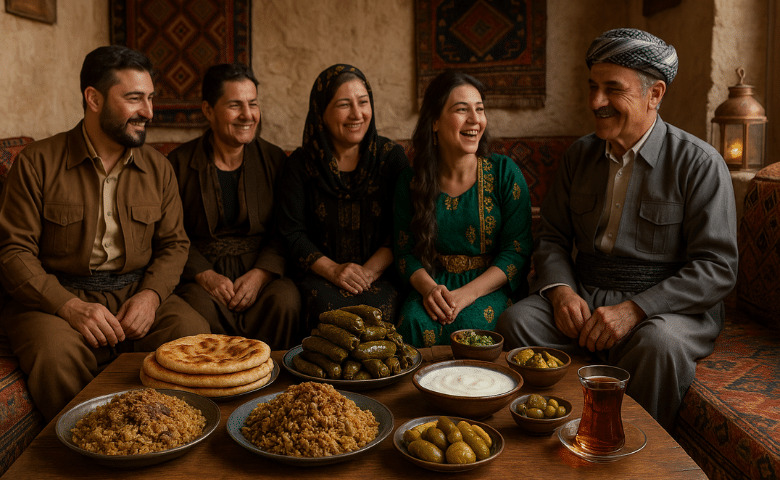
Anyone observing the Kurdish table will immediately recognize many elements familiar to Arab households: rice, bulgur, traditional bread, grilled meats, stews, stuffed vegetables, wild herbs, and even the communal style of serving meals that reflects the centrality of family and social sharing.
At the same time, Arab societies themselves absorbed reciprocal influences from Kurdish cuisine through centuries of geographic proximity, demographic interaction, and commercial exchange. This explains why many popular dishes across the Levant and Iraq appear to be the product of a long history of cultural interaction among neighboring peoples.
Perhaps what gives Eastern cuisine in general its distinctive character is that it is built not solely around food itself, but around the idea of gathering around food. In both Arab and Kurdish homes alike, the dining table becomes a space for storytelling, laughter, discussion, and family reunion. These simple details often reveal deeper social similarities between the two societies than dozens of political studies ever could.
The “Integration” campaign attempted to invest in precisely these human-centered spaces, recognizing that genuine rapprochement cannot emerge only through intellectual debates or political dialogue. It also requires rediscovering the shared human experiences that communities lived naturally for generations.
In recent years, content related to Kurdish cuisine has attracted growing interest among Arab audiences, particularly through social media platforms that have enabled people to explore other cultures in direct and accessible ways.
The image of a Kurdish woman baking bread in a clay oven, a family gathering around a festive meal, or a traditional dish served during weddings or religious celebrations—all of these scenes create a sense of emotional and human closeness because people naturally connect with details that resemble their own everyday lives.
It is also striking that many customs associated with food remain deeply similar among Arabs and Kurds alike. Generosity, insistence on feeding guests, and transforming meals into expressions of affection and respect are values still strongly rooted throughout Eastern societies in general.
In a region that has long suffered from division and tension, writing about food may appear simple or marginal. Yet in reality, it reveals something profoundly important: peoples who eat together and celebrate food in nearly the same way cannot be as distant from one another as political narratives sometimes suggest.
Perhaps for this reason, cuisine is not merely a world of flavors, but also a space of memory, familiarity, and mutual understanding. In an era increasingly marked by psychological and cultural barriers between peoples, the shared table may remain one of the simplest and most powerful ways to rediscover the humanity of the other.
Originally published in Sudan News
Most read