
At a moment when artificial intelligence applications have become capable of writing texts, analyzing data, and explaining complex scientific concepts within seconds, the real question is no longer whether technology can continue to evolve, but whether human beings themselves can preserve their role and meaning in this rapidly accelerating world.
The astonishment generated by advanced language models such as “ChatGPT” did not stem merely from their ability to provide correct answers, but from their capacity to explain ideas, interpret concepts, and simplify knowledge in ways that closely resemble human reasoning. It is precisely here that the most unsettling question emerges: if machines are now capable of thinking, explaining, and producing, what remains uniquely human?
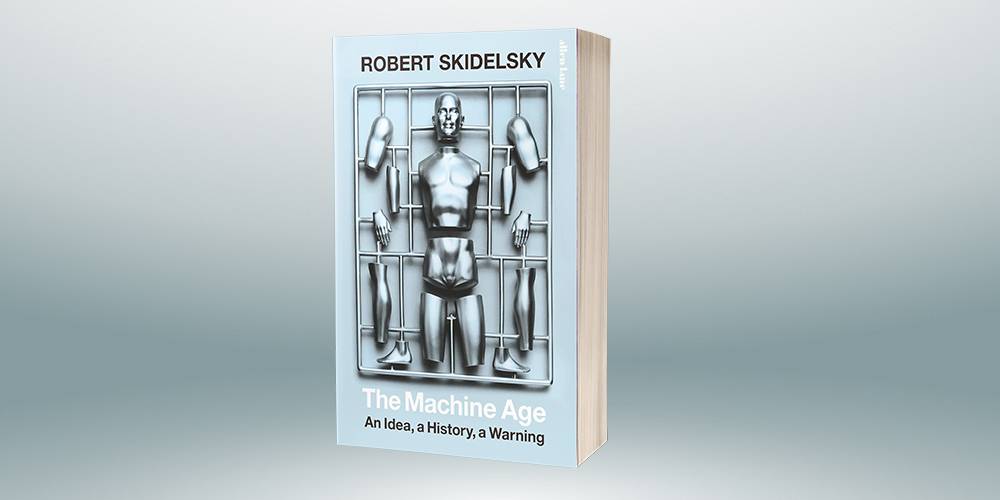
This question forms the central intellectual gateway of The Machine Age by Robert Skidelsky, published in 2023. Through this work, the author seeks to offer a critical reading of the complex relationship between technology, economics, politics, and the future of humanity.
Skidelsky does not treat technology merely as a set of tools designed to make life easier, but rather as a historical force reshaping society, the state, labor markets, and even the meaning of human existence itself. The book is built upon a central premise: humanity may have entered an era in which “progress” itself has become a source of threat—not because scientific advancement is inherently dangerous, but because the accelerating pace of technological transformation is weakening humanity’s ability to control its consequences.
One of the book’s most important themes concerns the future of labor. Skidelsky challenges the conventional optimism that assumes technological innovation will always create new jobs to replace those it destroys. While previous industrial revolutions indeed generated new forms of employment, the author argues that artificial intelligence differs fundamentally because it targets not only manual labor, but also cognitive, analytical, and creative professions—fields long believed to be exclusively human domains.
From this perspective, the book raises a profound philosophical and social dilemma: is human value fundamentally tied to work and productivity? And if machines become more efficient than humans in many professions, how will societies redefine “human worth” in the modern age?
Skidelsky criticizes the traditional economic view that reduces labor to a mere “cost of production,” warning that reducing people to numerical variables within economic equations gradually erodes the human dimension of society. Work, in the author’s view, is not simply a means of earning income; it is also a source of identity, dignity, and social belonging.
Yet the importance of the book extends far beyond economics. Skidelsky also questions whether modern democratic systems are truly capable of managing the deep technological transformations that lie ahead, especially amid the growing influence of global technology corporations and the increasing reliance of governments on digital systems for surveillance and social management.
The author appears deeply skeptical of the idea of a “technological utopia” long celebrated in Western thought. Rather than producing a freer and more prosperous world, he warns that technology could instead become a mechanism for reproducing domination and inequality, where a small elite monopolizes data, knowledge, and wealth while broader segments of society become increasingly vulnerable.
This concern is especially evident in his discussion of artificial intelligence, which he portrays as a double-edged sword. On one hand, AI has the potential to liberate humanity from repetitive and exhausting tasks. On the other, it may transform human beings into dependents of highly complex technological systems they neither fully understand nor control.
Despite the intellectual strength of the book, Skidelsky occasionally falls into excessive philosophical reflection and theoretical digression, making some sections appear more contemplative than practically analytical. Moreover, while the book excels at diagnosing the crisis and warning about its implications, it does not always provide clear solutions.
Nevertheless, the enduring value of The Machine Age lies in the fact that it approaches technology not as an isolated technical issue, but as a profound civilizational transformation redefining humanity’s relationship with work, the state, knowledge, and freedom. The book does not condemn technology itself; rather, it warns against surrendering humanity’s ability to guide and regulate it.
Ultimately, Skidelsky seems to pose an open-ended question to the modern world: are we witnessing the peak of human progress, or the beginning of an era in which humanity gradually loses control to the machine?
That is what makes The Machine Age more than simply a book about technology; it is an attempt to understand the future of humanity itself in the age of artificial intelligence.
Most read