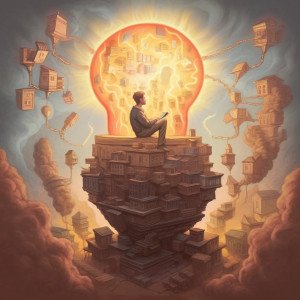


Modern humanity no longer experiences time in the way previous generations once did. The rhythm that was once slow and gradual—allowing room for contemplation, accumulation, and lived experience—has transformed into a rapid pace governed by screens, notifications, and the endless flow of information. We are not merely living in the age of technology, but in the age of speed itself: the speed of access, the speed of consumption, and even the speed of forgetting. At the heart of this transformation, not only have the tools of knowledge changed, but the very meaning of knowledge itself, along with humanity’s relationship to reading, thinking, memory, and even personal consciousness.
Knowledge, in its traditional form, was a long journey requiring patience, contemplation, and inward listening. Reading was never simply an act of acquiring information; it was an existential experience through which human beings engaged with texts and ideas. The reader once stood before a book as though standing before a mirror reflecting both the self and the surrounding world, granting the text its proper time and allowing meaning to form gradually within consciousness. Today, however, knowledge has become increasingly reduced to rapidly consumable “content,” passing before our eyes in seconds before disappearing amid an endless stream of data, images, and headlines.
This transformation is not merely about changing mediums from paper to screens; it reflects a deeper shift in the structure of the mind itself. The digital world has fundamentally altered our relationship with attention and concentration. Every new notification fragments consciousness, and every open window pushes the mind into a state of continuous distraction. Contemporary thinkers such as Nicholas Carr have argued that the internet does not merely change how we access information, but reshapes the human brain itself, making it more inclined toward rapid browsing and less capable of deep immersion in meaning.
In this context, slow reading today appears almost as an act of intellectual and cultural resistance. Slowness is no longer simply a different rhythm; it has become necessary for protecting consciousness from fragmentation and for restoring the capacity for critical thought and reflection. Attentive reading allows individuals to reconstruct meaning, connect ideas together, and transform knowledge from scattered data into a coherent intellectual and personal experience. It is not a rejection of technology, but an attempt to restore balance within a world moving faster than the human mind can comfortably absorb.
One of the most profound transformations imposed by the digital age has been the transition from a “culture of the book” to a “culture of the screen.” Printed books once provided readers with a complete sensory and temporal experience: a calm relationship with the text, margins for reflection, and a rhythm that allowed understanding to accumulate gradually. Screens, by contrast, have transformed reading into a fragmented and accelerated experience, where texts compete with images, videos, advertisements, and notifications. The reader no longer sinks into the text, but merely passes over it. Meaning becomes fragmented, while attention is divided among countless competing digital stimuli.
Yet this does not mean that technology is inherently evil or fundamentally opposed to knowledge. The digital world has granted humanity unprecedented access to books, references, and cultures. Today, anyone can reach global libraries, intellectual lectures, and cultural debates within seconds—resources once available only to academic elites. The problem, therefore, does not lie in technology itself, but in the nature of its use and in humanity’s ability to transform speed into a tool for understanding rather than allowing it to become a permanent condition of superficial consumption.
The impact of digital speed becomes even more visible in literature and culture. Great literature, by its very nature, requires time and calmness, allowing readers to immerse themselves in layers of meaning, character development, and human experience. Long novels and profound poetry cannot be reduced to quick quotations or superficial summaries. Nevertheless, today’s culture of speed pushes many readers toward short texts and rapid content, gradually undermining humanity’s capacity for intellectual patience and prolonged contemplation.
At the same time, literature remains one of the most powerful tools for resisting digital superficiality because it reconnects readers with the inner time of thought and reflection. Novels, poetry, and deep intellectual essays offer the mind an opportunity to slow down and rediscover itself away from the noise of digital overload. Literature thus becomes more than entertainment; it becomes a means of preserving cultural memory and protecting human consciousness from fragmentation.
The contemporary crisis of knowledge cannot be fully understood without examining the concept of the “attention economy.” In the digital world, companies no longer compete solely to sell products, but to capture human attention itself. Every platform and algorithm is designed to keep users continuously engaged and connected. Attention has therefore become an economic commodity, while speed has become a commercial necessity. Reflection and slowness, meanwhile, are increasingly treated as obstacles to digital circulation. The scholar Shoshana Zuboff described this reality through the concept of “surveillance capitalism,” in which data, behavior, and attention are transformed into resources for exploitation and control.
The ultimate consequence of this reality is the erosion of deep memory. A mind constantly dependent on search engines and digital storage gradually loses its ability to build stable cognitive connections. Information becomes fleeting, and memory turns into an external archive rather than an internally rooted experience. This helps explain why many people today feel that they possess vast amounts of information while lacking coherent understanding and deeper meaning.
Nevertheless, the future does not appear entirely condemned to digital superficiality. There is growing awareness of the importance of reclaiming slowness, contemplation, and focused reading as essential skills for preserving cultural and human depth. Perhaps the real challenge in the age of speed is not resisting technology itself, but learning how to live alongside it without losing our capacity for free thought, reflection, and inward awareness.
Ultimately, modern humanity’s struggle with speed is, at its core, a struggle over consciousness itself. The issue is no longer merely the quantity of information we consume, but our ability to transform that information into genuine knowledge and into understanding that gives meaning to human experience. In a world moving at the speed of light, slowness may paradoxically become the deepest form of wisdom.
Most read