
Forward Deterrence and Europe’s Emerging Nuclear Age

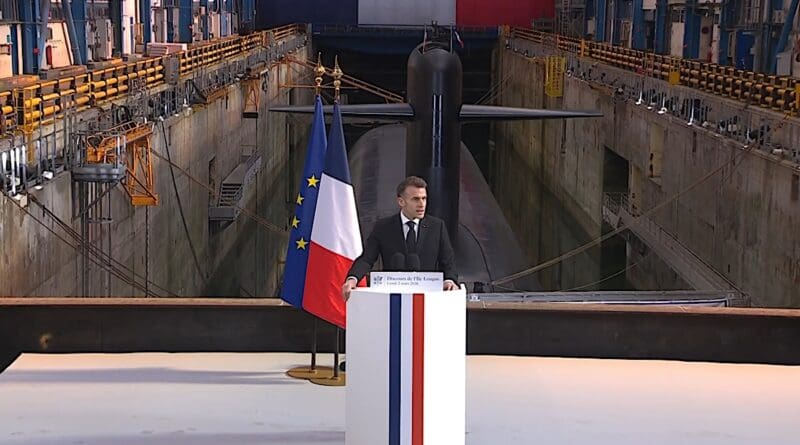
At a time marked by the return of major wars, intensifying competition among nuclear powers, and growing European uncertainty regarding the American security umbrella, French nuclear doctrine appears to be quietly evolving from a model of “closed national deterrence” toward a broader and more complex framework that can best be described as “forward deterrence.” The central question today is no longer merely how France protects itself, but how nuclear deterrence is being redefined as a pillar of European security in the post–Cold War era.
French President Emmanuel Macron’s 2026 speech at Île Longue carried implications that extended far beyond the military sphere. It revealed a gradual transformation in the philosophy of French deterrence without amounting to a complete doctrinal rupture. Paris remains committed to the core Gaullist principles: full independence of nuclear decision-making, the exclusive authority of the French president over nuclear use, and the rejection of NATO-style nuclear sharing. Yet the substance, language, and timing of the speech demonstrated that France has begun to view deterrence as an instrument for reshaping the European strategic space as a whole.
From National Deterrence to Implicit European Deterrence
Historically, French nuclear doctrine was built upon the principle of “deterring the strong by the weak,” a concept developed by General Pierre Gallois during the Cold War. The idea rested on the assumption that a limited but credible nuclear capability would be sufficient to deter a superpower from attacking France, since the costs of war would become unacceptable. This doctrine emerged from a profoundly sovereign conception of nuclear weapons as the ultimate guarantee of French strategic independence, free from reliance on NATO or the United States.
However, the contemporary strategic environment has pushed Paris toward expanding the meaning of “French vital interests.” The war in Ukraine, European anxiety regarding possible American retrenchment, and Russia’s renewed reliance on hard power to reshape the European order have all contributed to France’s gradual transition from national deterrence toward what might be termed “implicit European deterrence.”
This does not mean that France is extending a formal nuclear guarantee to Europe in the American sense. Rather, Paris seeks to create a form of “constructive strategic ambiguity,” whereby any large-scale aggression against Europe could be interpreted as a direct threat to French vital interests. This constitutes the real qualitative shift: not in changing the doctrine itself, but in expanding the political and psychological space within which the doctrine operates.
Forward Deterrence and the Reinvention of France’s European Role
The concept of forward deterrence reflects a French attempt to reposition itself within Europe’s evolving security architecture, particularly as confidence in the long-term reliability of American commitments begins to erode. Although Washington continues to affirm its commitment to NATO, its growing strategic focus on the Indo-Pacific and competition with China has pushed European capitals to reconsider the necessity of greater strategic autonomy.
Within this context, the French initiative appears less as a technical modernization of deterrence and more as a political project aimed at redefining Europe’s strategic center of gravity. Paris recognizes that its nuclear arsenal—alongside that of the United Kingdom—provides France with a unique strategic advantage inside Europe, particularly after Brexit.
This helps explain the emerging Franco-British nuclear rapprochement and the expanding Franco-German strategic dialogue. Together, they reflect efforts to construct a European deterrence pillar parallel to the American umbrella, though not explicitly intended to replace it. France does not seek disengagement from Washington; rather, it aims to ensure that Europe possesses a greater capacity to manage existential threats independently if necessary.
The Paradox of European Sovereignty
Yet this transformation is burdened by a deep structural contradiction. France seeks to “Europeanize” the strategic meaning of its nuclear force without “Europeanizing” the authority to use it. In other words, Paris wants Europeans to feel protected by French deterrence while denying them any direct role in nuclear decision-making.
Here lies the doctrine’s central paradox: extended deterrence inherently requires some degree of collective commitment, whereas French doctrine remains rooted in exclusive national sovereignty. France is therefore attempting to balance two conflicting objectives:
-
reassuring European allies;
-
while preserving absolute national control over nuclear decision-making.
This contradiction makes forward deterrence appear more like a political-psychological framework than a fully developed system of collective nuclear defense. For frontline states such as Poland and the Baltic countries, the American umbrella still appears more concrete and reliable than France’s deliberately cultivated ambiguity.
Is Europe Entering a “Third Nuclear Age”?
The study suggests that Paris increasingly views the international system as having entered a “third nuclear age,” characterized by the return of multipolar nuclear competition after decades dominated by nonproliferation and arms-control efforts. In this emerging era, nuclear weapons are no longer merely ultimate deterrent instruments; they are once again becoming central tools in the restructuring of geopolitical balances.
France recognizes that the war in Ukraine has reaffirmed a fundamental reality: nuclear powers remain capable of conducting large-scale conventional warfare under the protection of nuclear deterrence. Europe, therefore, is no longer living in a post-deterrence era but has re-entered a period defined by existential competition among major powers.
This explains why the modernization of France’s nuclear arsenal, the expansion of its stockpile, and the development of new hypersonic systems are not merely technical adjustments. They reflect a deeper strategic transformation in French thinking: a shift from symbolic minimum deterrence toward active deterrence capable of operating within a broader European theater.
What Is Washington Really Concerned About?
Although the United States has officially welcomed France’s growing strategic role, Washington’s real concern is not French nuclear capabilities themselves, but the possibility that they could eventually evolve into the foundation of a broader European strategic autonomy.
The United States wants Europeans to assume greater defense responsibilities, yet it remains uneasy about the prospect of an autonomous European security architecture that could reduce American influence over the continent. Consequently, French forward deterrence places Washington before a complicated equation:
-
a more strategically autonomous Europe would reduce America’s defense burden;
-
but it could also diminish American geopolitical leverage within Europe.
French doctrine therefore appears as an attempt to navigate a delicate balance: strengthening Europe’s strategic role without provoking the United States or undermining NATO cohesion.
Conclusion: Deterrence as a Declaration of Historical Transition
At its core, the French shift represents more than an adjustment in nuclear doctrine; it is an implicit declaration that the post–Cold War European order has come to an end. The assumption that European security would remain permanently guaranteed under the American umbrella is fading, just as the illusion that nuclear deterrence had lost its relevance in international politics has collapsed.
France is not merely redefining its nuclear posture; it is redefining the meaning of European security itself. The central question that will shape Europe’s future is no longer whether the continent needs nuclear deterrence, but whether Europe is politically and strategically prepared to bear the consequences of a new nuclear age—one in which power, deterrence, and strategic ambiguity once again become fundamental components of the emerging international order.
Most read


Read also