Upgrading Diplomatic Representation and Reshaping the Normalization Process Between Morocco and Israel

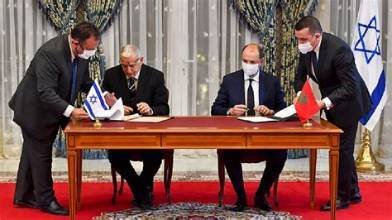
The agreement announced between Morocco and Israel to upgrade their mutual diplomatic representation to the level of embassies marks a new stage in the bilateral relationship that was restored in 2020. At the same time, however, the move goes beyond its immediate diplomatic and protocol-related dimension. It comes amid a highly complex regional environment and raises broader questions about the future of the Abraham Accords, the limits of Arab-Israeli cooperation, and the calculations shaping the continuation of this process despite the profound regional changes of recent years.
The announcement followed a trilateral meeting in New York between Israeli Foreign Minister Gideon Sa'ar and Moroccan Foreign Minister Nasser Bourita, under the auspices of U.S. Ambassador to the United Nations Mike Waltz. According to the Israeli announcement, the two sides agreed to transform their respective diplomatic missions into embassies and appoint ambassadors, in addition to expanding direct flights, finalizing agreements on investment protection and the avoidance of double taxation by the end of 2026, and arranging high-level visits between the two countries.
It is important, however, to approach the development with some precision. The announcement refers primarily to a political decision to upgrade diplomatic representation rather than to the completed establishment of embassies and the assumption of duties by ambassadors. Moreover, at the time of the initial announcement, the Israeli side was the principal source of the information, while no equivalent official Moroccan confirmation had yet been issued.
From Liaison Offices to Embassies: Moving from Normalization to Institutionalization
The restoration of Moroccan-Israeli relations in December 2020 was part of the wave known as the Abraham Accords, which that year also involved the United Arab Emirates, Bahrain, and Sudan under U.S. auspices. Morocco initially opted for liaison offices rather than establishing full diplomatic relations at the ambassadorial level.
The latest step can therefore be understood as a transition from limited and cautious normalization toward a more institutionalized relationship. Embassies do not merely represent a change in diplomatic terminology; they provide a more stable framework for managing political relations, expanding economic cooperation, organizing official communications, and developing sector-specific partnerships.
This shift is particularly significant because Moroccan-Israeli relations have already expanded in the years since the 2020 agreement to include political, economic, security, and tourism-related areas. The upgrade in diplomatic representation therefore represents an extension of an existing trajectory rather than the beginning of a new relationship.
From this perspective, the decision can be viewed as an attempt to transform the relationship from a format that could remain limited or politically reversible into a more firmly institutionalized bilateral relationship.
The American Dimension: Washington as an Actor in Expanding the Normalization Network
The latest announcement cannot be separated from the U.S. role. The meeting at which the decision was announced was held under the auspices of the U.S. ambassador to the United Nations, while the restoration of Moroccan-Israeli relations in 2020 itself took place within a U.S.-led diplomatic initiative.
This indicates Washington's continued interest in treating the Abraham Accords as a framework that can support the expansion of relations between Israel and additional Arab states, rather than merely as a collection of agreements concluded under a particular political context in 2020.
In this context, the upgrading of Moroccan-Israeli relations carries significance beyond the bilateral relationship between Rabat and Tel Aviv. It provides Washington with an example of how agreements it helped broker can continue to develop and acquire greater institutional depth six years after their establishment.
The continuation of this process, however, does not mean that all parties approach it from identical perspectives. Washington focuses on expanding the regional network of relations, while Rabat operates within a broader set of national and regional calculations. Israel, for its part, views relations with Morocco as part of its effort to expand its diplomatic and political presence across the Arab and Muslim worlds.
Morocco's Calculations: Relations with Israel within a Broader Framework
Morocco's policy toward Israel cannot be adequately understood through normalization alone. Rabat operates within a wider set of considerations that includes the Western Sahara issue, relations with the United States and European powers, as well as economic, security, and regional calculations.
The restoration of relations in 2020 was accompanied by the U.S. decision to recognize Moroccan sovereignty over Western Sahara, an announcement that formed a central element of the political context surrounding normalization at the time.
The continuation and expansion of relations with Israel can therefore be viewed as part of a broader Moroccan policy of diversifying international partnerships and strengthening ties with influential powers on issues affecting Moroccan interests.
At the same time, this does not mean that the Moroccan-Israeli relationship is free from political constraints. The war in Gaza and its regional repercussions have made normalization with Israel more politically sensitive across a number of Arab societies, including Morocco. Consequently, upgrading diplomatic representation may reflect the official decision to maintain and develop bilateral relations, but it does not eliminate the political and public debate surrounding the scope and timing of those relations.
This highlights the importance of distinguishing between the continuity of official foreign policy and the degree of public acceptance of that policy. A government may continue developing its external relations while the Palestinian issue remains an influential factor in the political and social environment surrounding those relations.
Israel and Morocco: From Political Normalization to Practical Interests
The latest step includes a number of areas that demonstrate that the two sides do not view the relationship merely as a symbolic political arrangement.
The agreements on investment protection and the avoidance of double taxation are intended to create a more favorable legal framework for expanding economic activity. Similarly, expanding direct flights and involving Moroccan airlines could facilitate tourism, business activity, and direct interaction between the two societies, while high-level visits could provide a more regular mechanism for managing political issues.
The emerging relationship can therefore be understood as operating on three interconnected levels:
First, the diplomatic level, represented by the transition to embassies and the appointment of ambassadors.
Second, the economic level, through investment, taxation, and trade.
Third, the societal and connectivity level, through aviation, tourism, official visits, and direct exchanges.
As these dimensions expand, the relationship becomes increasingly connected to institutional and economic interests on both sides. This may strengthen its continuity, while simultaneously increasing its exposure to major political developments in the region.
The Abraham Accords under the Test of Regional War
The latest development comes in a regional environment fundamentally different from that of 2020, when the Abraham Accords were launched. The war in Gaza and subsequent regional tensions have returned the Palestinian issue to the center of Arab and regional political debate. They have also required Arab states that established relations with Israel to balance their bilateral ties with Israel against their positions regarding the war and the Palestinian question.
From this perspective, the Moroccan-Israeli agreement represents an important test of whether the Abraham Accords can move from a phase of political declarations toward the construction of stable institutional relationships despite regional crises.
The continuation of normalization does not necessarily mean that political differences over the Palestinian issue have disappeared. Rather, bilateral relations may continue along a relatively separate track from positions regarding the Israeli-Palestinian conflict, while remaining vulnerable to major developments on the ground and at the political level.
This helps explain, in part, the gradual evolution of Moroccan-Israeli relations since 2020, culminating in the current move toward ambassadorial-level representation.
Western Sahara as an Element in the Regional Equation
The Western Sahara issue remains one of the most important factors to consider when analyzing Morocco's foreign policy toward Israel and the United States.
Washington's 2020 decision to recognize Moroccan sovereignty over Western Sahara was politically linked to the announcement restoring Moroccan-Israeli relations. Since then, Rabat has continued efforts to strengthen international support for its position on the issue, while relations with several international powers have become part of a broader Moroccan strategy aimed at reinforcing its position.
This does not mean that relations with Israel can be reduced to the Western Sahara issue. The relationship also includes independent economic, security, and political interests. Nevertheless, the historical connection between the normalization decision and the U.S. position on Western Sahara remains an essential element for understanding the context in which the relationship emerged and subsequently developed.
What Does the Development Mean for the Region?
The institutionalization of Moroccan-Israeli relations could have three principal regional implications.
The first is the strengthening of the model of institutional normalization. Moving from liaison offices to embassies brings the relationship closer to the conventional model of full diplomatic relations.
The second is the strengthening of the economic dimension of the Abraham Accords. The new agreements on investment, taxation, and aviation indicate an effort to create long-term material interests that extend beyond the political dimension of normalization.
The third concerns the redefinition of regional cooperation. The U.S. approach does not frame normalization merely as a series of separate bilateral relationships, but rather as a potential platform for broader cooperation in areas such as security, trade, technology, energy, and other sectors.
Nevertheless, the ability of this model to expand will remain dependent on the regional political environment, particularly developments surrounding the Palestinian issue, the level of tension between Israel and Arab states, and the ability of governments involved to manage the gap between official interests and public sentiment.
Between Institutionalization and Political Continuity
The significance of the latest development lies in its potential to place Moroccan-Israeli relations on a more deeply institutionalized footing. Embassies, ambassadorial appointments, economic agreements, direct flights, and high-level visits create a network of interests and mechanisms that can make the relationship less dependent on temporary political contacts.
Institutionalization, however, does not necessarily remove politics from the relationship. Foreign relations remain vulnerable to major crises, particularly when they are connected to a regional conflict of significant political and popular importance.
The central question, therefore, is not simply whether Rabat and Tel Aviv have decided to upgrade their diplomatic representation, but to what extent they can build a stable, multidimensional relationship while Morocco maintains its ability to manage its Arab and regional relations, and Israel seeks to expand its Arab partnerships without making those relationships excessively vulnerable to the region's security and political fluctuations.
Conclusion
The announced agreement to upgrade Moroccan-Israeli relations to the level of embassies represents a new stage in a process that began in 2020, while also reflecting broader changes in the nature of Arab-Israeli normalization.
The development is not merely a matter of diplomatic protocol. It involves the institutionalization of a relationship that increasingly encompasses politics, economics, aviation, trade, investment, and high-level communications. It also underscores the continuing U.S. role in supporting and expanding the framework through which the Abraham Accords were established.
At the same time, the continuation of this process will remain shaped by a complex regional environment in which economic and security interests intersect with the Palestinian issue, while public attitudes remain a factor capable of influencing the political space available to governments.
The latest development can therefore be understood as a transition from testing the durability of normalization to testing its institutionalization. If the establishment of embassies and the appointment of ambassadors are completed, followed by implementation of the economic agreements and expansion of direct air links and official exchanges, Moroccan-Israeli relations will have moved to a deeper and more stable level than the framework established in 2020.
This, however, will not eliminate the tension between bilateral interests and the continuing influence of the Palestinian issue on the Arab political environment. The future of the relationship will therefore depend not only on the intentions of Rabat and Tel Aviv, but also on the broader trajectory of the Arab-Israeli conflict and the ability of the parties involved to manage the intersection between normalization and wider regional interests.
Most read




Read also