

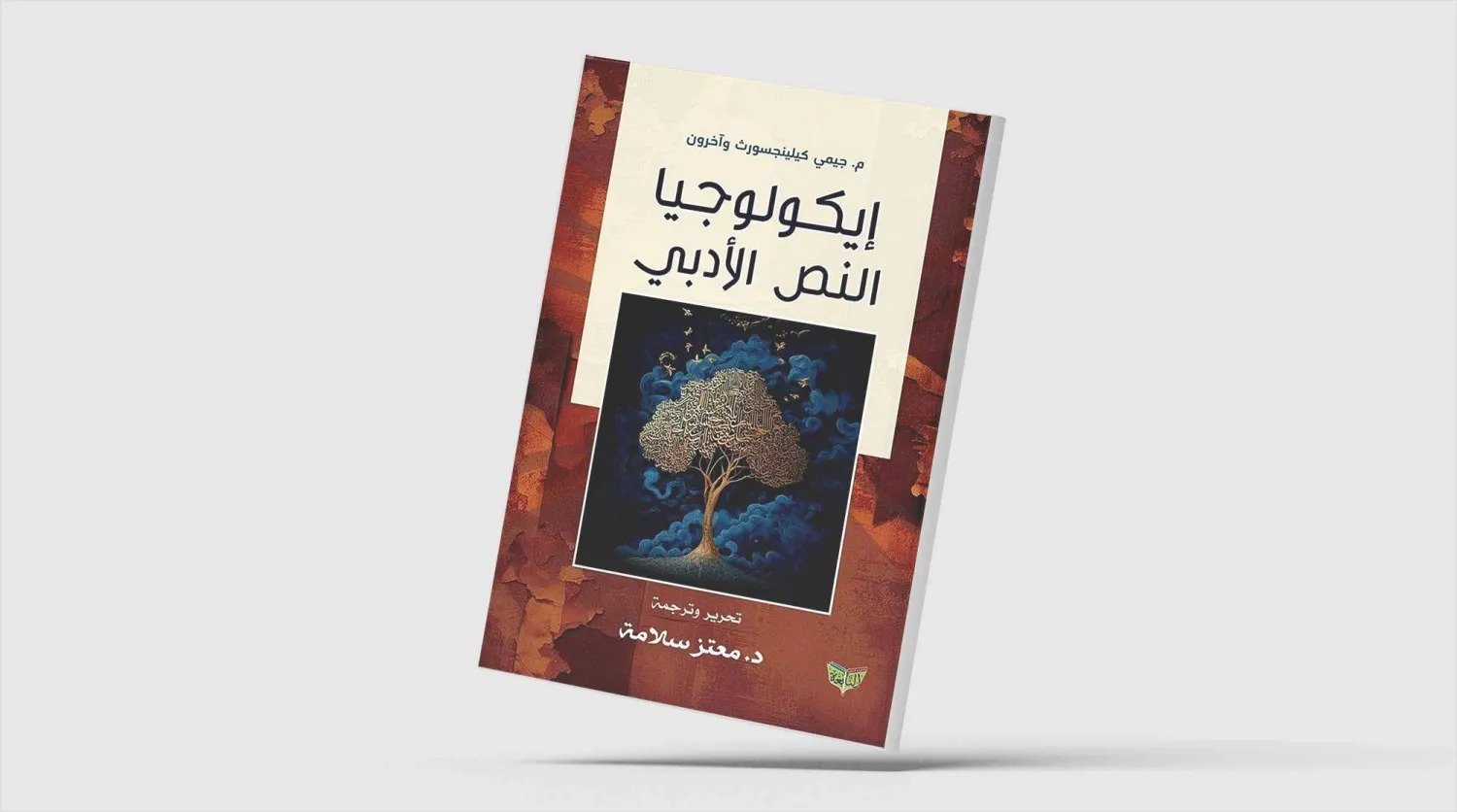
A new book titled “The Ecology of the Literary Text: Translated Theoretical and Applied Studies in Contemporary Ecocriticism” has recently been published by Al-Nabigha Publishing House in Cairo. Translated and edited by Egyptian academic and literary critic Dr. Moataz Salama, the volume seeks to provide a broader introduction to one of the contemporary critical approaches that has reshaped the way literature, nature, humanity, and the environment are understood in relation to one another.
The book brings together a selection of studies by prominent Western scholars who have contributed to the development of ecocritical concepts and the expansion of its analytical tools. It moves from theoretical foundations to practical applications in the study of poetry, fiction, and drama, while also questioning the traditional boundaries separating literary genres.
Ecocriticism does not regard nature simply as an aesthetic backdrop or a neutral space in which literary events unfold. Instead, it approaches the environment as an active element in the production of meaning and as a means of revealing relationships between people, place, resources, and power. From this perspective, literary texts become spaces through which societies’ perceptions of nature, patterns of exploitation, forms of adaptation, and tensions surrounding ownership, domination, and environmental justice can be examined.
From Arab Literary Heritage to Modern Ecocriticism
In his introduction, Moataz Salama points out that the relationship between literature and nature is by no means entirely foreign to Arab culture. It has deep roots in the Arab literary heritage, particularly in travel literature and narratives in which the desert, oasis, sea, and city function as central spaces carrying multiple layers of meaning.
The significance of the modern ecological approach, however, lies in its ability to reread this heritage from a different perspective. Rather than viewing the presence of nature in classical texts merely as aesthetic description or landscape representation, it can be approached as a record of human relationships with place, patterns of ownership and exploitation, forms of adaptation to the environment, and responses to environmental change.
Introducing ecocriticism into Arab literary studies, therefore, does not necessarily mean importing a field of knowledge detached from the local cultural context. Rather, it can provide an opportunity to rediscover dimensions of both classical and modern Arabic literature through new questions concerning place, resources, power, humanity, and the environment.
Addressing a Gap in the Arabic Library
According to the translator, the book responds to a significant intellectual need in the Arabic library, where ecocriticism remains relatively limited in its presence and is often encountered through scattered articles or brief references within broader critical studies.
Salama argues that the challenge is not simply the scarcity of specialized research, but also the way this critical approach has been received and applied. Some Arabic writings on ecocriticism, in his assessment, have not sufficiently engaged with its philosophical and critical foundations, which has affected the quality and direction of some Arab applications of the approach.
The collection therefore seeks to provide a more comprehensive picture of ecocriticism by combining discussions of its theoretical foundations with applications to literary works belonging to different genres and cultural contexts.
Five Studies Between Theory and Practice
The book contains five critical studies originally published in English. According to the volume’s presentation, they represent contemporary approaches to ecocriticism that move beyond some of the field’s earlier phases and shift from theoretical questions toward literary applications.
The collection opens with Dutch scholar Astrid Bracke’s study, “Challenges Facing Ecocriticism,” a theoretical contribution that introduces readers to some of the principal questions and problems confronting the field.
It is followed by American scholar M. Jimmie Killingsworth’s “The Island Poet and the Sacred Shore,” an applied study that employs ecocritical tools to examine the literary work and its relationship with place and nature.
The third study, by Indian scholar Upamanyu Pablo Mukherjee, is titled “Postcolonial Environments: Nature, Culture and the Contemporary Indian English Novel: Water/Land: Amitav Ghosh as a Case Study.” It brings ecocriticism into a postcolonial context in which questions of nature, culture, history, and identity intersect.
Bracke returns with a fourth study, “Pastoral in the Contemporary British Novel,” examining the presence and representations of the pastoral tradition in modern British fiction.
The volume concludes with Canadian scholar Simon C. Estok’s “Shakespeare and Ecocriticism: An Analysis of the Home/Power Binary in King Lear,” which applies ecocritical perspectives to one of Shakespeare’s most prominent plays, focusing on the relationship between place, power, and homeland.
Expanding the Questions of Literary Criticism
Ultimately, the significance of the book lies in presenting ecocriticism not merely as a specialized approach concerned with representations of nature in literature, but as a framework capable of reformulating some of the traditional questions surrounding literary texts.
Within this approach, place is no longer simply a setting for events, nature is not merely a poetic image, and resources are not marginal elements in narrative. All of them can become analytical keys for understanding power relations, social inequality, economics, colonialism, identity, and the transformations in humanity’s relationship with the natural world.
This perspective has acquired increasing relevance as environmental issues have gained global prominence, from climate change and water scarcity to the degradation of ecosystems. Literature can therefore serve as an important field for examining how human perceptions of nature and the environment are formed and how people understand their position within the natural world.
The publication also continues the translator’s earlier efforts to make major works of contemporary critical theory available to Arabic readers. His previous translations include “From Cultural Poetics to Cultural Mobility: Translated Essays in Cultural Criticism,” “The New Historicism and Cultural Materialism” by Stephen Greenblatt, and “Approaches to Contemporary Literary Criticism: Selected Essays.”
In this sense, “The Ecology of the Literary Text” represents a further contribution to the translation of modern critical theories into Arabic. More importantly, it opens a wider space for Arab readers and researchers to engage with ecocriticism as a field in which literary, philosophical, social, and historical questions intersect, while reconsidering the relationship between humanity, place, and nature from within the literary text itself.
Most read