Syria and Russia: From a Wartime Partnership to a Redefinition of Influence

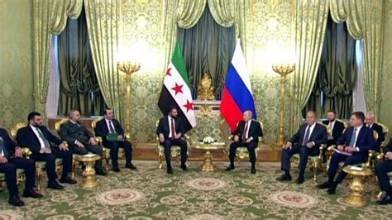
The Russian naval convoy that arrived at the port of Tartus on September 7 was more than another military resupply operation. Its significance extended beyond its cargo and maritime route. After months of negotiations following the fall of Bashar al-Assad’s regime, Damascus and Moscow reached an understanding on August 9 concerning the future of the Russian presence in Syria, opening a new phase in a relationship that had for years been defined primarily by Russian military support for the former regime.
From this perspective, the arrival of four Russian vessels in Tartus only weeks after the agreement represents an early test of the new framework the two sides are attempting to construct: Can Damascus regain greater sovereignty over its strategic facilities while Moscow retains the military and logistical capabilities it needs to preserve its regional influence?
The initial answer suggested by the convoy appears to be yes—but within a framework fundamentally different from that of the past.
An Agreement That Does Not End the Russian Presence but Redefines It
The memorandum of understanding signed in August brought to an end roughly 18 months of negotiations over the future of Russian bases and facilities in Syria. Under the new arrangements, the Syrian state assumes control of civilian-use facilities, including Hmeimim Air Base and the commercial pier at the port of Tartus, while military facilities are reorganized as joint training and rehabilitation centers, with a continued Russian military presence.
This arrangement reveals the core of the transformation taking place in the relationship.
Had the objective been to terminate the Russian presence, the agreement would likely have established a withdrawal timetable and the closure of Russian facilities. Instead, the conversion of military bases into joint centers, combined with the continued presence of Russian personnel, suggests that the negotiations were not fundamentally about whether Russia would remain or leave, but rather about the form of its continued presence and the limits of its influence.
This is where the political significance of the agreement lies. Damascus gains practical recognition of a greater role in managing infrastructure located on Syrian territory, while Moscow obtains a legal and political framework that allows it to retain a strategic military foothold.
The emerging relationship, therefore, is not based on ending Russian influence, but on renegotiating the terms under which that influence operates.
The Russian Convoy and the Test of the New Arrangements
Against this backdrop, the convoy that arrived in Tartus in September takes on particular significance. It included the cargo ship Sparta, the naval supply vessel Akademik Pashin, the oil tanker General Skobelev, and the destroyer Admiral Levchenko. Satellite imagery showed the Sparta and Akademik Pashin arriving at the port, while the oil tanker remained offshore. Sources cited by Reuters reported that the cargo vessel unloaded supplies, including ammunition intended for Russian facilities in Tartus and Hmeimim, although the agency was unable to independently verify the contents of the shipment.
The significance of the operation lies particularly in its timing.
It was the first major resupply mission reported since the August agreement, making it an early indication that the new arrangements do not imply an end to the military functions of Russian facilities. On the contrary, Moscow appears to be seeking to preserve the supply lines and logistical capabilities necessary to maintain its military presence.
The difference, however, is that this presence now operates within a different political framework.
Russia is no longer dealing with Syria as a state that provided it with broad freedom of military movement under a close alliance with the Assad regime. Instead, it is dealing with a new Syrian authority seeking to rebuild state institutions and reinforce its sovereignty over strategic facilities.
The convoy therefore tests not only Russia’s ability to maintain its supply network, but also the extent to which the new agreement can separate Syrian sovereignty from Russian military use.
Tartus: A Port Whose Importance Extends Beyond Syria
Russia’s determination to preserve its presence in Tartus cannot be understood solely through its bilateral relationship with Damascus. The port is an essential component of Moscow’s ability to maintain a military and logistical presence in the Mediterranean.
Tartus is particularly important because it has served as Russia’s principal naval repair and resupply facility in the Mediterranean, while Russian forces have used Syrian facilities to support a broader military presence in the Middle East and Africa.
Any interpretation of the agreement simply as a Syrian-Russian settlement over ownership or management of civilian facilities would therefore be incomplete.
At its core, the issue concerns Syria’s place within Russia’s broader geopolitical calculations. Moscow does not necessarily need complete control over every Syrian facility to retain influence. Access to selected strategic points, combined with a relatively limited military presence and the ability to maintain resupply and mobility, may be sufficient.
This is what makes the new arrangement potentially more flexible than the previous model.
Damascus: Restoring Sovereignty Without Severing Ties with Moscow
For Syria, the agreement provides an opportunity to redefine its relationship with Russia from a different position. After years in which Russian influence was closely associated with the previous regime, Damascus now seeks to transform the relationship into one between two states rather than between a supporting power and a dependent authority.
The importance of this shift is particularly evident in Syria’s assumption of responsibility for civilian facilities in Tartus and Hmeimim. Syria has already begun operating the fourth commercial pier at Tartus and receiving commercial shipments after its transfer to Syrian management, while Russian forces have reportedly been seen moving some equipment from buildings they had been using near the pier.
This development carries significance beyond administrative management. Restoring civilian facilities to Syrian control signals an effort by Damascus to reassert authority over functions associated with sovereignty, economic activity, and trade without turning that process into a rupture with Moscow.
This equation could become one of the defining features of Syria’s emerging foreign policy: diversifying external partnerships rather than becoming dependent on a single partner, while maintaining relationships that can contribute to the process of rebuilding the state.
From “Regime Ally” to “State Partner”
The most important transformation in the Russian-Syrian relationship may lie in the nature of the interests connecting the two sides.
Under Assad, the regime’s political security was a central pillar of the relationship. After his fall, Moscow no longer has the same political ally and must instead rebuild its relationship with the Syrian state and its new institutions.
This requires Russia to modify its instruments of influence.
Rather than relying primarily on direct military support for a particular regime, Moscow could evolve into a partner in several areas: military training, energy, infrastructure, trade, ports, and reconstruction, while maintaining a limited military presence serving its strategic interests.
Such a form of influence may prove more sustainable because it does not necessarily depend on a single political figure or a particular regime.
Balancing Moscow and Damascus
The success of the new framework, however, is not guaranteed. Each side enters it with different objectives.
Damascus seeks to restore as much control as possible over its territory and institutions while simultaneously maintaining external relationships that can help rebuild the state. Moscow, by contrast, wants to preserve a strategic foothold in Syria, maintain access to the Mediterranean, and retain an instrument through which it can influence developments in the Middle East and Africa.
This is where disagreements could emerge around three principal issues.
First: the limits of the Russian military presence.
The stronger Syria’s desire to consolidate its sovereignty becomes, the more important it will be to define precisely the nature, scale, and functions of the Russian presence.
Second: the management of strategic facilities.
The distinction between civilian and military use may appear clear in theory, but it could become more complicated in practice when military resupply requirements intersect with the functions of commercial ports and airports.
Third: the political nature of the relationship.
Russia wants to preserve a strategic relationship, while Damascus seeks to avoid replacing the previous form of Russian influence with a new form of dependency.
The future of the relationship will therefore depend heavily on the two sides’ ability to translate the agreement into clear and stable rules governing their overlapping interests.
The Regional Dimension
The restructuring of Russia’s presence in Syria should also be viewed against the backdrop of broader regional transformations. Damascus is operating within a multipolar regional environment in which Turkish, Israeli, American, Gulf, and Russian interests intersect.
Syria has already begun developing multiple security and diplomatic relationships, including contacts with Israel through U.S.-mediated discussions over security arrangements, while Damascus has emphasized its desire to preserve the independence of its decision-making regarding alliances and foreign relations.
Within this context, maintaining relations with Moscow could form part of a broader strategy aimed at diversifying external sources of support and preventing any single regional or international power from monopolizing influence over Syrian decision-making.
For Russia, maintaining a foothold in Syria provides an important strategic asset in a regional environment where multiple powers are competing for influence.
Toward a More Pragmatic Relationship
Ultimately, the September convoy reveals something more important than the details of its military cargo: the Russian-Syrian relationship did not end with Assad’s fall, but it has lost its previous form.
The wartime alliance that emerged in the context of the Syrian conflict is gradually being replaced by a more pragmatic relationship based on an exchange of interests rather than direct political dependence.
Current developments suggest that the two sides are attempting to construct an arrangement that allows Damascus to restore part of its institutional sovereignty while simultaneously providing Moscow with the military and logistical access it needs to preserve its regional influence.
The real test, however, will not be whether a Russian vessel can reach Tartus. It will be whether the two sides can answer a more fundamental question:
Can Russia maintain strategic influence in Syria without that influence being perceived as an infringement on Syrian state sovereignty?
If Damascus and Moscow succeed in managing this balance, the new relationship could evolve into a more stable model, less dependent on the power dynamics of wartime. If Russian military interests once again become deeply intertwined with the management of Syrian sovereign infrastructure, however, tensions could re-emerge—the very tensions that the recent agreements were intended to contain.
The Tartus convoy is therefore more than a resupply operation. It is the first practical test of a Russian-Syrian relationship being rebuilt on the remains of an entire political and military era.
What the coming months will reveal is not simply whether Russia will remain in Syria, but what kind of influence it will retain—and how much space Damascus will ultimately be willing to grant that influence within a sovereign Syrian state.
Most read



Read also