

Britain is currently undergoing one of its deepest political transformations since the end of the Second World War, amid the gradual erosion of the traditional party system that dominated British political life for nearly a century. The recent local elections, which are traditionally expected to revolve around municipal services, housing, and local taxation, evolved instead into a broader test of the future of the British political system itself, revealing a structural crisis that extends far beyond the conventional electoral competition between the Labour and Conservative parties.
The results reflected not merely a decline in support for the Labour Party or the rise of Reform UK, but a gradual collapse of the political formula that had long rested on the alternation of power between Labour and the Conservatives, while relegating smaller parties to the margins. What is emerging today is Britain’s transition from a “two-party system” toward a far more fragmented and complex political landscape, in which issues of identity, cultural belonging, and immigration increasingly overshadow the traditional class divisions that shaped British politics for decades.
This transformation appears most clearly in Wales, historically one of the principal strongholds of the modern British labour movement due to its association with coal mining, trade unions, and heavy industry. Labour’s sharp decline in Wales cannot be interpreted as an ordinary electoral setback, but rather as a profound shift in the social and political foundations upon which British labour identity itself was built. The rise of the nationalist Plaid Cymru, alongside the substantial gains made by Reform UK, points to a broader transition from class-based political loyalties toward national and cultural identities — a shift that reflects a wider crisis within Britain’s multi-national state structure.
In Scotland, although the Scottish National Party retained its position as the dominant political force, the continued rise of Reform UK and the Green Party likewise signals a reconfiguration of the political landscape around issues that transcend the traditional left-right divide. Nationalist parties in Scotland and Wales are no longer merely protest movements seeking leverage against Westminster; they have evolved into governing forces with durable social constituencies rooted in perceptions of political and cultural marginalization within the United Kingdom.
England, meanwhile, presented an even more complex picture. Reform UK achieved significant breakthroughs in areas that had long been considered safe strongholds for either Labour or the Conservatives. This advance reflects an important transformation in the nature of political protest within British society. Electoral dissatisfaction is no longer driven solely by economic grievances or austerity policies, but increasingly by concerns over immigration, national identity, institutional trust, globalization, and the social costs of environmental transition policies.
One of the most significant developments in contemporary British politics is therefore the declining relevance of traditional “left” and “right” classifications in explaining electoral behavior. Reform UK, often portrayed as a right-wing populist party, simultaneously adopts interventionist and economically populist positions, including calls for a greater state role in sectors such as energy and transportation. By contrast, the Green Party increasingly represents affluent urban constituencies whose political identity is shaped more by environmental concerns, cultural liberalism, and climate transition than by traditional class politics.
These developments indicate that British politics is moving away from an era of “economic polarization” toward one defined by “cultural and identity polarization.” Issues such as immigration, national belonging, Europe, net-zero policies, pro-Gaza activism, and trust in political elites have become more influential in shaping voting behavior than traditional debates over taxation or public versus private ownership.
The continuing erosion of the so-called “Red Wall” — the traditional Labour constituencies that backed Brexit and later shifted toward the Conservatives in the 2019 general election — further illustrates the widening gap between political elites in London and large segments of the working class and industrial regions. Many of these voters increasingly believe that the British political establishment ignored the message conveyed by the Brexit vote, particularly regarding immigration, national identity, and mounting economic pressures.
At the same time, Labour is gradually losing a substantial portion of its progressive urban base to the Green Party, particularly in university cities and affluent districts of London, where environmental and climate-transition issues have become embedded within the cultural identity of the new middle classes. Yet these same policies are viewed with growing suspicion in industrial areas and among working-class communities, where many perceive “green transition” policies as direct threats to jobs, energy security, and living standards.
Taken together, these trends suggest that what began with Brexit was not merely a temporary protest against the European Union, but rather the beginning of a deeper restructuring of the British political order itself. Parties once dismissed as temporary protest movements — such as UKIP and later Reform UK — are now increasingly discussed as forces capable of leading a future government or reshaping parliamentary politics in fundamental ways.
Yet this transformation also carries growing risks for Britain’s political stability. Continued fragmentation could push the country toward a political model resembling the fragile coalition systems common in parts of continental Europe — but without the institutional traditions and political culture necessary to manage such arrangements smoothly. In such a scenario, every major issue — from Europe and immigration to energy policy and defense spending — could generate shifting and unstable alliances, raising the prospect of chronic political paralysis.
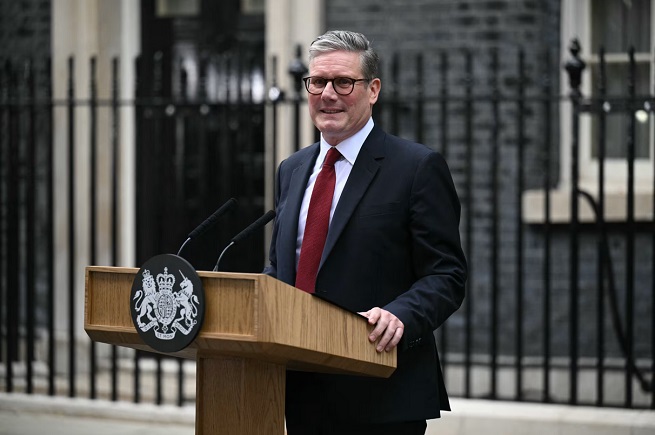
At the center of this turbulent transformation stands Keir Starmer, facing what increasingly appears to be an existential political crisis. The challenge is no longer simply declining popularity, but the fragmentation of the electoral coalition that brought Labour back to power. The party is losing traditional working-class constituencies to Reform UK, progressive urban voters to the Greens, and ground to nationalist parties in both Wales and Scotland. This no longer appears to be a temporary wave of electoral dissatisfaction, but rather evidence of a profound restructuring of Britain’s political map — one that could push the country into a fundamentally different political era from the one it has known for the past century.
Most read