Chinese Culture Between Heritage and Renewal: Models of Cultural Presence in Europe

Chinese culture represents one of the world’s most enduring civilizational traditions. Over thousands of years, it has preserved a broad range of arts, symbols, customs, and traditional crafts while developing new ways of presenting them to successive generations and different cultural environments. This balance is particularly evident in the experiences through which elements of Chinese heritage have been introduced into European societies.
These experiences indicate that the appeal of Chinese culture is linked not only to its historical depth and diversity, but also to its capacity for renewal, adaptation, and interaction with other cultures. Peking Opera, the Chinese zodiac, and Chinese New Year celebrations, for example, have evolved from traditional cultural forms into platforms for participation, creativity, and cross-cultural engagement.
The European experience therefore provides important indications of several positive characteristics of contemporary Chinese culture, most notably its ability to combine authenticity with innovation, transform heritage into a living practice, and remain open to the reinterpretation of Chinese cultural symbols by creators from different cultural backgrounds.
First: A Culture Rooted in History and Capable of Continuity
One of the most notable characteristics of Chinese culture is its ability to preserve its essential elements over time while presenting them in forms that respond to social and technological change.
Peking Opera provides a clear example. It combines singing, recitation, acting, martial arts, stylized physical movements, and traditional costumes, making it a complex expression of the history and accumulated experience of Chinese theater. Yet introducing this art form to foreign audiences is no longer limited to conventional stage performances. Instead, new formats have emerged that make its elements more accessible to contemporary audiences.
This experience suggests that preserving heritage does not necessarily mean freezing it in its traditional form. Heritage can retain its essential character while the methods used to present it continue to evolve.
Second: The Ability to Combine Heritage and Technology
Chinese cultural adaptability is particularly evident in the use of modern technology to present traditional arts in new ways.
At an exhibition in 2025, extended-reality technologies were used to immerse visitors in a virtual environment inspired by Peking Opera, allowing them to experience traditional costumes, movements, and visual elements. Some features of the opera were also incorporated into physical fitness activities, while food products drew on its visual symbolism.
The significance of this experience lies not simply in the use of technology itself, but in how it is employed: technology becomes a means of bringing heritage closer to audiences rather than a substitute for heritage.
This reflects the ability of Chinese culture to embrace modern tools without abandoning its traditional foundations.
Third: Transforming Culture from a Display into a Participatory Experience
A notable feature of Chinese cultural initiatives in Europe is the shift away from a model based on a strict separation between performer and audience toward a more interactive approach.
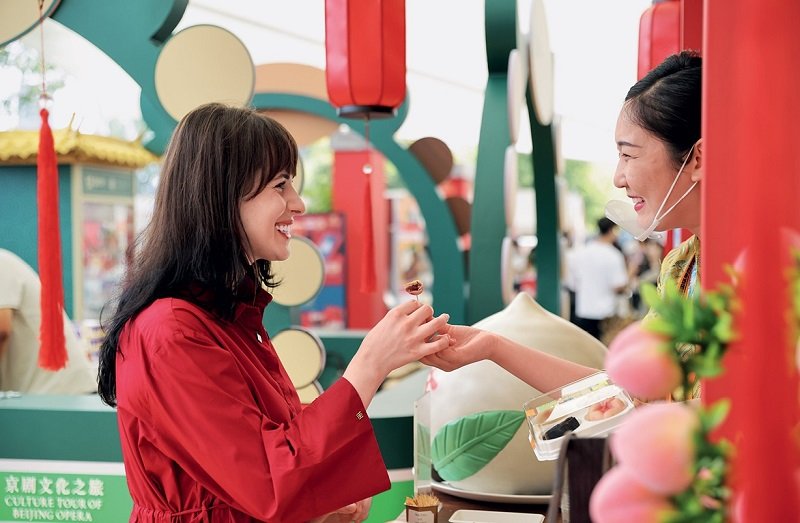
Instead of simply watching Peking Opera or viewing a traditional exhibition, visitors can wear traditional costumes, try some of the movements, participate in craft workshops, and interact with products and designs inspired by Chinese culture.
This approach gives culture greater potential to move beyond elite cultural settings and become part of everyday life, increasing the opportunities for audiences outside China to understand and engage with it.
Fourth: A Culture Open to Dialogue and Reinterpretation
The Chinese zodiac provides an important example of the ability of Chinese culture to engage with different creative traditions.
The Global Zodiac Design Competition, launched in 2014, has developed over twelve editions into an international platform that has attracted more than 40,000 entries from 28 countries and generated dozens of international exhibitions.
The significance of this experience lies in the fact that foreign artists and designers have not merely reproduced Chinese symbols; they have reinterpreted them through their own artistic languages. One Russian designer, for example, drew on the concept of the “Fire Horse” associated with the Five Elements philosophy, while Spanish designers incorporated elements of Chinese New Year customs into their creative work.
This demonstrates that certain Chinese cultural symbols possess a high degree of cross-cultural adaptability, allowing them to be reinterpreted while retaining their underlying symbolic meaning.
Fifth: The Human Dimension of Chinese Culture
Many elements of Chinese culture embody values with broad human relevance, including reunion, optimism, celebration of life, and aspirations for a better future.
These values are particularly visible in the symbolism of the zodiac and Chinese New Year celebrations, which are not presented solely as traditions belonging to the Chinese community, but also as occasions through which others can participate and discover aspects of Chinese culture.
Such shared values can help reduce cultural distance between societies. Cultural communication does not always need to begin with differences; it can also start from common human values and aspirations.
Sixth: Culture as a Means of Connecting People
Chinese New Year celebrations in Europe provide an example of culture moving from the official sphere into the realm of popular participation.
In Helsinki, for instance, cultural events have developed into occasions in which local residents participate in traditional craft workshops and intangible cultural heritage activities. Local Finnish groups interested in dragon and lion dances have also emerged and later performed alongside Chinese and Estonian teams.
This phenomenon is particularly significant because it reflects a transition from introducing a culture to engaging with it. When members of a host society begin practicing elements of another culture themselves, cultural exchange becomes deeper and potentially more sustainable.
Seventh: Openness to Reciprocal Cultural Exchange
The experience is not limited to presenting Chinese culture to European audiences. It also includes incorporating elements of European cultures into Chinese-organized cultural events and creating opportunities for mutual artistic expression.
In Germany and Greece, for example, Chinese musical groups have performed European works, while European musicians have interpreted Chinese compositions. Joint performances have also brought together Chinese and European choirs and musicians.
This dimension highlights an important characteristic: cultural exchange is treated as a two-way process, rather than simply a means of transferring the culture of one side to another.
Eighth: Intangible Cultural Heritage as Part of Everyday Life
The Chinese experience places considerable emphasis on traditional crafts and folk arts as living forms of heritage that can be practiced, rather than merely preserved in museums.
Workshops in traditional joinery, Peking Opera mask painting, velvet flower making, and traditional New Year printing, among other activities, give audiences opportunities to discover Chinese heritage through direct participation.
This approach contributes to heritage preservation by reintegrating traditional practices into contemporary experience.
Ninth: Transforming Cultural Symbols into Creative Products
Chinese culture in these initiatives extends beyond arts and celebrations into design and the creative industries.
Some zodiac-inspired designs have been transformed into toys, collectibles, tableware, stationery, and accessories, allowing cultural symbols to move from exhibition spaces into everyday use.
This highlights the potential to combine cultural value, creative value, and practical function, thereby expanding the reach of traditional cultural elements and giving them new forms of contemporary expression.
Tenth: Chinese Culture as a Platform for Civilizational Exchange
Exhibitions, festivals, and joint performances demonstrate that culture can perform a role extending beyond entertainment and the arts to become a means of communication between societies.
Works inspired by the Chinese zodiac have been displayed at international institutions and events, while cultural partnerships have been established with a number of European countries. In London, the 2024 Chinese New Year celebration attracted more than 700,000 visitors in a single day, with extensive participation in cultural performances and activities.
These indicators demonstrate that Chinese culture can function as a platform for civilizational interaction, particularly when it is presented in ways that encourage participation and understanding rather than passive observation.
Conclusion
The experience of Chinese cultural engagement in Europe reveals a set of characteristics that give Chinese culture a significant capacity to establish a presence beyond its original environment.
These characteristics include deep historical roots, the ability to preserve cultural identity, flexibility in renewing heritage, openness to technology, readiness to interact with other cultures, transforming audiences into participants, and connecting culture with everyday life and the creative industries.
What is particularly notable is that the success of these experiences does not depend solely on presenting Chinese culture in its original form. Instead, it also depends on creating spaces in which European audiences can interact with it and reinterpret certain elements within their own cultural contexts.
One of the fundamental strengths of contemporary Chinese culture, therefore, lies in its ability to achieve a balance between authenticity and renewal. It draws on a deep historical heritage but does not treat that heritage as something static. Rather, it seeks new forms through which traditional culture can maintain a presence in contemporary life.
In this sense, the Chinese experience offers not only a model for preserving heritage, but also a model for transforming heritage into a means of dialogue, interaction, and greater understanding among cultures.
Most read