
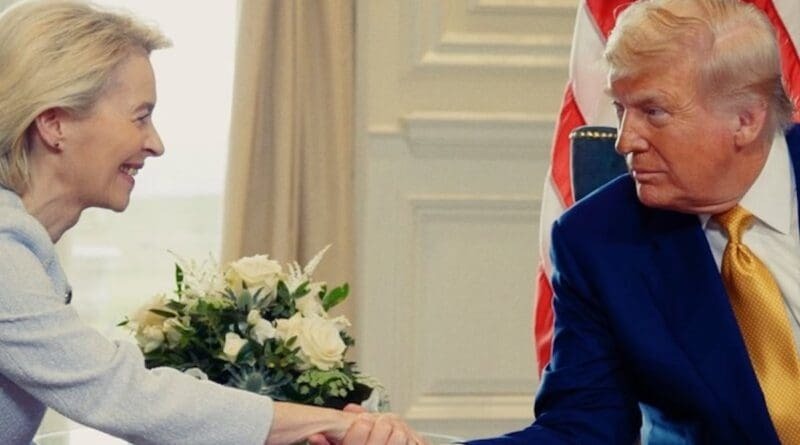
Transatlantic relations are undergoing rapid transformations that reflect a growing structural tension between the United States and Europe, driven by diverging perspectives on international security and crisis management. Remarks by U.S. President Donald Trump, in which he described NATO as a “paper tiger,” underscore a deeper shift in Washington’s perception of traditional alliances. These statements, however, cannot be separated from the broader context of disagreement over how to address the Iranian crisis, as European states declined to participate in military operations against Iran aimed at reopening the Strait of Hormuz, while some also refused to grant the United States access to key military bases. These decisions signal a gradual transformation in European strategic behavior.
Rather than indicating a rupture with the transatlantic alliance, the European position reflects an ongoing redefinition of that partnership. A series of developments has contributed to the erosion of trust between the two sides, including protectionist trade policies imposed by the Trump administration, unprecedented geopolitical threats such as the suggestion of annexing Greenland, and support for political movements within Europe that challenge established liberal norms. The U.S. decision to launch military operations against Iran without prior consultation further reinforced European perceptions that the partnership is no longer based on mutual coordination, but increasingly on unilateral decision-making.
Within this context, the closure of the Strait of Hormuz emerged as a critical turning point, exposing the structural vulnerabilities of Europe’s energy security. The disruption triggered immediate spikes in fuel prices across European markets, prompting governments to implement emergency measures to mitigate economic and social impacts. These developments were not merely temporary disruptions but revealed a deeper structural dependence on specific supply routes, bringing renewed urgency to efforts aimed at diversifying energy sources and reducing reliance on geopolitical chokepoints.
With the ceasefire now in place—despite its inherent fragility—Europe finds itself at a rare strategic moment that allows for reassessment and recalibration. Rather than marking the end of the crisis, the ceasefire creates a limited window for strategic repositioning. Should ongoing negotiations in Pakistan succeed in stabilizing the truce and producing a workable framework, Europe will inevitably face the question of its role in the post-ceasefire phase. This may include contributing to the implementation of agreements or ensuring maritime security, potentially requiring a more active and operational engagement than previously assumed.
The European Union’s launch of EUNAVFOR ASPIDES in 2024 illustrates a precedent for limited but meaningful independent action aimed at protecting economic interests. However, the effectiveness of such efforts ultimately depends on Europe’s ability to overcome internal divisions. Europe’s strength lies not only in its economic weight or its status as the world’s largest single market, but in its capacity to act collectively. In the absence of unity, it risks fragmentation into smaller actors with competing interests and diminished influence.
The current crisis thus serves as a critical test of the concept of European strategic autonomy. Europe must decide whether to leverage this moment to advance more independent policies in energy and security, or to continue operating reactively within a framework shaped by external actors. This choice hinges on political will and the ability to translate short-term opportunities into long-term strategic shifts that redefine Europe’s position within the international system.
Ultimately, the ceasefire should not be viewed merely as a temporary pause in hostilities, but as a pivotal moment revealing deeper transformations in global power dynamics. As the international system moves toward greater competition and multipolarity, Europe faces a decisive strategic choice: to remain a reactive actor shaped by external pressures, or to emerge as an autonomous force capable of shaping and defending its own interests.
Most read