
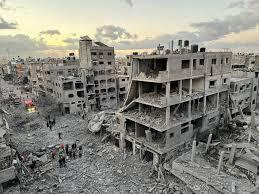
A new round of diplomatic activity is emerging around the stalled Gaza ceasefire negotiations, driven by mediators seeking to revive the agreement after months of paralysis. The renewed efforts come at a time when regional tensions—particularly the escalating conflict involving Iran—have overshadowed the Gaza file and contributed to the current political and military stalemate.
Over the past few days, Cairo hosted a new round of meetings involving regional and international mediators, as well as the High Representative of the International Peace Council, Nikolay Mladenov. The discussions are part of ongoing efforts to revive the ceasefire framework and address unresolved provisions that have hindered its implementation.
Cairo’s Efforts to Break the Deadlock
According to media sources, the recent meetings were marked by a generally positive atmosphere, with all parties expressing commitment to continue working toward implementing the proposed ceasefire framework. Participants also agreed to resume discussions in Cairo next week in an attempt to address the remaining issues and move the agreement forward.
Observers say Egypt is keen to prevent the Gaza file from slipping into political stagnation amid the broader regional turmoil. With international attention increasingly focused on the Iranian conflict, there are concerns that Israel could use the current moment to consolidate a new political and security reality in Gaza.
In this context, political science professor and analyst of Palestinian and Israeli affairs Dr. Tarek Fahmy argues that Cairo is determined to keep the Gaza ceasefire agreement alive on the diplomatic agenda to prevent Israel from entrenching a long-term status quo in the enclave. According to Fahmy, mediators are currently attempting to revive the agreement by addressing unresolved issues, particularly the launch of the proposed “technocrats committee,” which would oversee civilian administration in Gaza during the transitional phase.
Hamas Between Commitment and Political Pressure
For its part, Hamas has reiterated its commitment to implementing the ceasefire agreement in all its phases, signaling readiness to resume negotiations in Cairo in the coming days. A Hamas delegation recently met Egyptian officials, representatives of Palestinian factions, and Nikolay Mladenov, alongside mediators from Egypt, Qatar, and Turkey.
However, the movement insists that the first phase of the agreement must be fully implemented before any new arrangements are introduced. This stance reflects Hamas’s attempt to maintain political pressure on Israel while presenting itself as committed to the terms of the agreement.
Palestinian political analyst Nizar Nazzal believes Hamas understands that Israel may not be willing to proceed with the second phase of the deal due to political and security concerns—particularly those related to the issue of weapons. Consequently, Hamas appears to be shifting the burden onto Israel by publicly declaring its readiness to implement the agreement in full, thereby placing Tel Aviv under international scrutiny.
The Weapons Issue: The Core Dispute
The question of Hamas’s weapons remains the central obstacle in the negotiations. According to the proposed framework reportedly discussed by Mladenov, the plan would involve a gradual disarmament of Hamas over several months, including dismantling the group’s extensive tunnel network in Gaza.
Hamas, however, has made clear that any discussion of weapons must come only after Israeli forces withdraw from the Gaza Strip and “stabilization forces” are deployed, along with the formation of a local police force to maintain order. The movement argues that addressing the weapons issue before establishing security structures could create a dangerous security vacuum in the enclave.
Israel, meanwhile, maintains that it will not agree to withdraw from Gaza unless Hamas is first disarmed, making this issue the most difficult point of contention in the negotiations.
A Delayed Phase Amid Regional Uncertainty
Many analysts believe that the current talks may not produce an immediate breakthrough. Instead, they are aimed primarily at keeping communication channels open and preparing the groundwork for the second phase of the agreement.
Nazzal suggests that Mladenov’s role at this stage is less about direct mediation and more about conveying messages between the various parties. According to him, the transition to the next stage of the agreement may remain on hold until the broader regional crisis—particularly the Iran-related conflict—begins to ease.
A New Test for Egyptian Mediation
Despite the challenges, observers believe the upcoming meetings in Cairo could produce practical steps, especially regarding the activation of the proposed technocrats committee, which is widely seen as a key mechanism for managing Gaza during the post-war transitional period.
If Egypt succeeds in advancing this track, it could mark an initial step toward reviving the ceasefire agreement and alleviating the severe humanitarian crisis in Gaza. If not, the deal may remain frozen, awaiting broader shifts in the regional and international landscape.
Most read