The United Nations Between Its Founding Legacy and a Crisis of Influence

Since its establishment, the United Nations has been associated with an ambitious idea that goes beyond its role as an international organization: to create an institutional framework capable of managing conflicts, preserving international peace, and providing both large and small states with a forum in which to articulate their interests within a system theoretically based on shared rules. Yet the organization’s trajectory over the decades reveals a widening gap between this idealized image and the realities of the international system in which it operates.
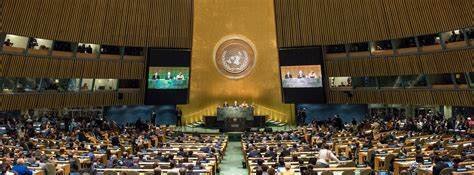
This gap is particularly evident in the political discourse within the organization, where UN sessions often become arenas for exchanging accusations and criticizing the United States, as the power with perhaps the most visible presence in the international system. US policies face strong criticism from a range of countries, while calls for respect for the sovereignty of peoples and their right to self-determination are repeatedly voiced. The paradox, however, is that opposition to American dominance does not necessarily mean overcoming the structures of power within the international system itself. The major powers remain the actors with the greatest capacity to shape the organization’s decisions and political direction.
This reveals one of the UN’s fundamental structural dilemmas. An organization founded on the principle of the legal equality of states simultaneously grants five permanent members of the Security Council an exceptional privilege: the veto. The United States, Russia, China, France, and the United Kingdom can each block a Security Council resolution even when it enjoys the support of a majority of its members.
The issue, however, is not merely the legal structure of the veto, but its broader political consequences. The mechanism has made the Security Council, to a considerable extent, a reflection of the balance of power that emerged at the end of the Second World War rather than a reflection of the transformations that the world has undergone since then. The distribution of economic and political power has changed, new regional powers have emerged, and the number of UN member states has increased dramatically. Yet the basic structure of decision-making in the Security Council remains fundamentally tied to arrangements created in a very different historical era.
The 1996 crisis surrounding the selection of the UN secretary-general, when the United States used its veto to block the reappointment of Boutros Boutros-Ghali despite broad support for him within the Security Council, offers a clear illustration of the influence wielded by the major powers over the organization’s future. The episode demonstrated that procedural legitimacy within an international institution is not necessarily sufficient when it conflicts with the wishes of a state possessing veto power.
Yet the UN’s crisis cannot be reduced to the veto alone. The broader problem concerns the organization’s declining ability to translate its principles and resolutions into effective instruments for managing international crises. As conflicts have multiplied and international polarization has intensified, the United Nations has faced growing difficulties in building the consensus required to act on the most sensitive issues.
The organization’s symbolic and political standing was different in its early years. The United Nations emerged from the devastation of a global war, at a moment when the international community was searching for a new system capable of preventing a recurrence of such a catastrophe. Political figures such as Harry Truman, Winston Churchill, Charles de Gaulle, and Joseph Stalin represented a world in which the power of states was closely intertwined with the stature of the individuals who led them. International diplomacy was likewise associated with figures possessing considerable political and strategic weight, giving international institutions a stronger aura of authority and influence.
The international system, however, subsequently underwent profound transformations. Traditional empires disappeared, colonialism receded, new states emerged, and the world entered the Cold War before moving, following the collapse of the Soviet Union, into a more complex international order. Throughout these transformations, the United Nations did not fully succeed in adapting its institutional structure to the changing distribution of global power.
There is a striking paradox here. The organization that was supposed to reflect the plurality of the international system has itself increasingly faced both a crisis of representation and a crisis of effectiveness. Developing countries have called for greater representation in decision-making institutions, while emerging powers have demanded a role commensurate with their economic and political weight. At the same time, the five permanent members have maintained their exceptional position within the Security Council.
The United Nations therefore faces a dual dilemma. On the one hand, it cannot ignore the balance of power on which the international system rests. On the other, it cannot continue to present itself as a genuinely global framework reflecting the aspirations of all states if its core decision-making mechanisms remain largely shaped by a balance of power established in 1945.
This does not mean that the United Nations has lost its importance or become an institution without a meaningful role. Despite its limitations, it remains a diplomatic platform with no comparable global alternative in terms of universal membership and its ability to bring adversarial states together around the same table. Its agencies and programs also remain essential components of international efforts in humanitarian assistance, development, health, refugees, and human rights.
The distinction between the existence of an institution and its capacity to exercise influence, however, has become increasingly clear. The problem is not that the United Nations has disappeared, but that its ability to produce and enforce international consensus is limited when the interests of major powers collide. It is precisely here that the organization’s crisis of influence becomes most apparent.
Restoring a more effective international role for the United Nations may therefore require more than administrative reforms. It may require reconsidering the relationship between the organization’s institutional structure and the distribution of power in the international system. Reforming the Security Council, expanding representation, reconsidering the mechanisms governing the use of the veto, and strengthening the General Assembly’s ability to generate broader political consensus are all elements of a larger question: Can the United Nations adapt to a world that is no longer the world in which it was founded?
The post-Second World War international order sought to create an institution capable of preventing a return to the chaos produced by global conflict. Today’s world faces a different set of challenges: multidimensional conflicts, protracted crises, rising international and regional powers, geopolitical competition, and wars that increasingly transcend traditional boundaries.
Stefan Zweig’s notion of the “world of yesterday” is therefore useful as a point of reflection—not as a judgment on the present or an expression of nostalgia for the past, but as a reminder that international institutions, like the societies that created them, change over time. The United Nations was born out of a world emerging from the Second World War. It does not necessarily follow that, in its current form, it is fully equipped to manage the complexities of the twenty-first century.
The real question, therefore, is not whether the United Nations has lost all of its influence, but whether the international system is prepared to rebuild and reform the organization in ways that reflect the current distribution of power and the challenges of a changing world—or whether states will continue to rely on an institution designed for a world that ended decades ago to manage crises emerging from a new international order whose rules have yet to be fully defined.
Ultimately, the UN’s crisis may be less a crisis of the organization itself than a crisis of the international system as a whole. When the institution expected to embody international consensus is unable to produce that consensus, the problem does not necessarily lie within the institution alone. It also reflects the absence of agreement among the very powers that are supposed to give it the capacity to act.
The future of the United Nations will therefore remain closely tied to the future of the international system itself: Will the world move toward reforming its rules and institutions, or toward greater competition, fragmentation, and the emergence of multiple centers of power?
Most read