“The Flower-Bearer”: A Stone Statue from the Palace of Hisham ibn Abd al-Malik

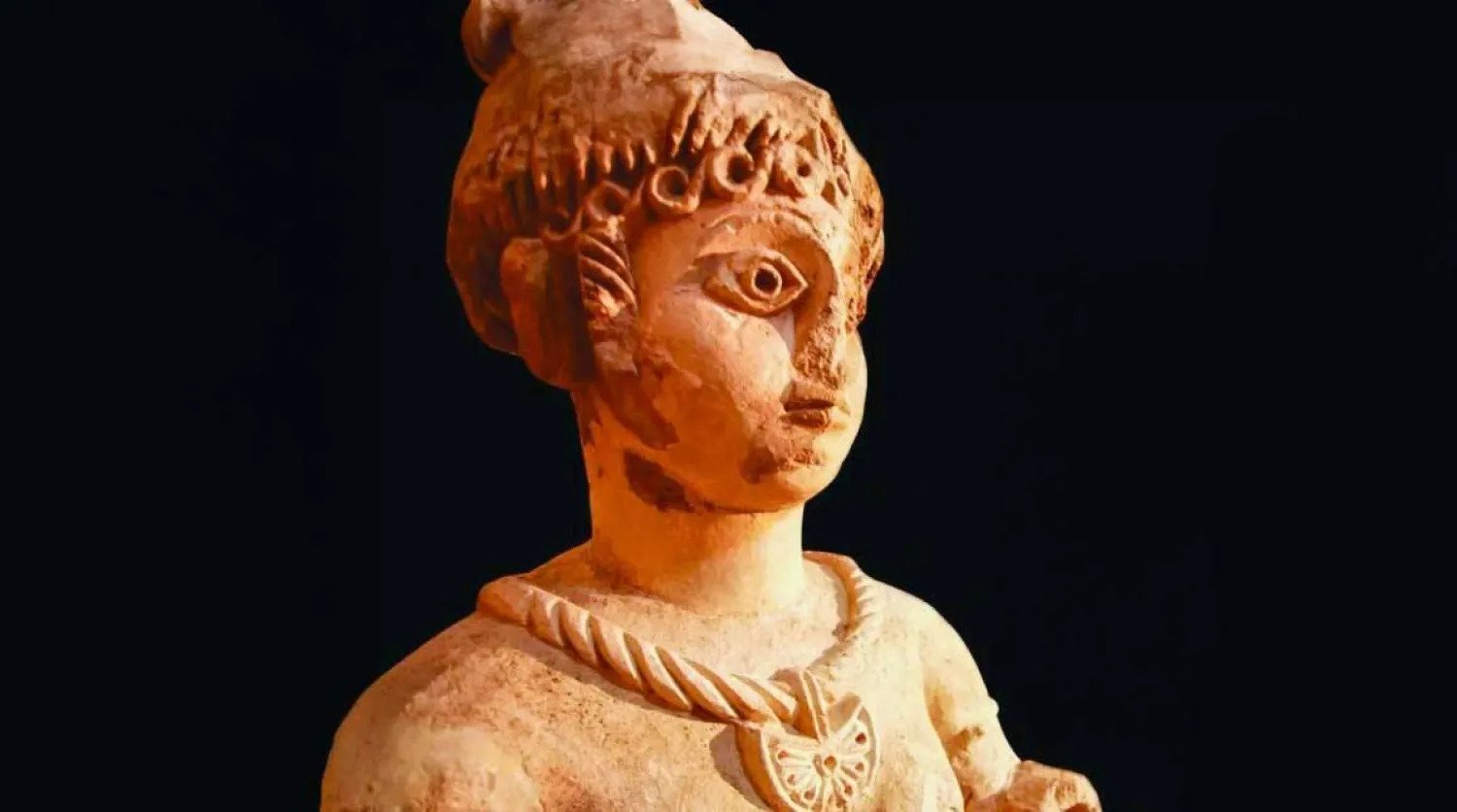
Sculpture and engraving flourished considerably during the Umayyad period, becoming organically integrated with secular architecture and constituting a fundamental component of its decorative embellishment. The characteristics of this art are evident in a group of statues recovered from a palace built by Caliph Hisham ibn Abd al-Malik in the Palestinian desert, north of Jericho. Among them is a statue depicting a woman standing upright, raising a bouquet of flowers in her right hand. This sculpture reflects the influence of Sasanian artistic traditions and attests to the continuity of local artistic styles that characterized the cities of the Syrian Desert in the centuries preceding the advent of Islam. At the same time, the artifact is distinguished by an innovative formal approach, evident in numerous elements of its composition. It encapsulates a distinctive feminine aesthetic that matured during the Umayyad era and left its mark on many of the period’s artistic works.
The sculpture stands approximately 1.5 meters tall, making it roughly equivalent to the natural height of a human being. It consists of a single carved mass, shaped in its various dimensions, and thus qualifies as a full-length statue according to established terminology in art dictionaries. The artistic style departs from classical principles and embraces a local tradition whose surviving examples can still be found in Palmyra’s artistic heritage. In this tradition, animated movement is absent and stillness prevails; frontal positioning dominates the composition, accompanied by fixed gazes, wide-open eyes, and hands that bend, rise, or extend according to a set of established gestures.
This unified compositional scheme is repeated in the Umayyad female statue. The head rests on broad shoulders and appears upright in a frontal position. The body likewise exhibits a pronounced rigidity, with movement largely confined to the raised arms. The left hand has broken off and disappeared, while the right hand survives in its entirety, forming a fist whose fingers grasp a bouquet of flowers.
The chest is full, the abdomen rounded, and the thighs similarly plump. The legs are held close together and wrapped in a long garment that falls to the feet. This simple attire is decorated with a network of parallel horizontal folds. A broad belt, tied around the waist, lies above it, bordered by a strip that extends vertically between the legs and continues horizontally to form a wide lining. The broad belt is embellished with a series of closely interwoven folds, while the lining features a sequence of evenly sized rectangular compartments, arranged in an elegant design that brings together engraving, sculpture, and ornamentation.
The same artistic treatment appears in a braided necklace tied around the shoulders, from whose center hangs a broad semicircular pendant. Above the pendant is a network of engraved patterns imitating the appearance of precious stones set into jewelry. Complementing this elaborate necklace are two broad, undecorated bracelets encircling the shoulder joints. The same stylistic approach is evident in the bouquet of flowers raised in the woman’s right hand. The bouquet takes the form of a tightly packed cone containing a cluster of flowers, each with carefully defined petals.
The facial features are unmistakably Palmyrene. The eyes are enormous, almond-shaped, and staring, with a recessed pupil at the center of each. The eyebrows form carved arches, from whose midpoint the straight line of the nose descends. The projecting mass of the nose has broken off and been damaged, although its original configuration remains discernible. The mouth is small, formed by closed lips separated by a deep incision. The chin is broad, as is the neck.
A mass of thick hair crowns the head, its locks transformed into a network of decorative engravings. The fringe takes the form of a wreath composed of interlocking circular loops. Two balanced locks descend from either side of the fringe, resting vertically against the cheeks. The remaining locks are arranged in three successive, evenly spaced layers over the crown, creating a distinctive hairstyle that appears to have characterized Umayyad female representations across different artistic media.
One example is a wall painting preserved in the Museum of Islamic Art in Berlin, originating from an Umayyad site in the Jordanian desert known as Qusayr Amra. It depicts a plump woman standing in a semi-profile position.
The woman tilts her head slightly, and her facial features are clearly visible. Her eyes are large and almond-shaped, surmounted by broad eyebrows forming two separate arches. The nose is long, with nostrils carefully delineated. The mouth is similarly well defined, with a central incision separating the lips. Her head rests above a full chest adorned with a necklace of tiny red spherical beads. A broad pendant hangs from its center, decorated with three white stones.
Her arms are visible, as are the ornaments adorning them. Each arm bears a double bracelet rendered in black, while each hand is decorated with a bracelet executed in a similar style. At the upper part of the pelvis, a chain encircles the waist, forming a slender belt. The legs are plump and held close together, and the right foot reveals an additional ornament in the form of a simple anklet.
The head is crowned with thick black hair, arranged into a large, tightly packed mass and topped by an oval black element. Above the hair is a network composed of chains of white, pearl-like stones.
This female representation recurs in the wall paintings of Qusayr Amra and appears in sculptural works from the Palace of Hisham. It can also be identified in several isolated artifacts originating from other Umayyad sites, where variations of the same model have been preserved.
In conclusion, these diverse artifacts constitute a body of evidence for the emergence of a distinctive feminine ideal during the Umayyad period, an aesthetic model that developed creatively in close association with the artistic culture of the era.
Most read