
By M. J. Franklin
The market for Homer’s Odyssey has become intensely crowded—rather like a certain famous palace on the island of Ithaca—prompting publishers to devise clever ways to draw readers to their editions.
It is the climactic moment of The Odyssey: Odysseus finally returns home to Ithaca, only to find his palace overrun by suitors competing for the hand of his wife, Penelope, and seeking to claim his throne. He must now drive out these intruders and reclaim his rightful place. The question is: How?
In their own way, book publishers are fighting a similar battle.
Public interest in The Odyssey surged in the run-up to last week’s release of Christopher Nolan’s star-studded film adaptation of Homer’s epic. So far this year, sales of The Odyssey have risen by 76 percent compared with the same period last year, according to Circana BookScan, which tracks sales across the publishing industry.
For publishers reprinting the dozens of translations of The Odyssey currently available, this moment presents both a challenge and an opportunity. Here is how some of them are responding.
The most straightforward way publishers are trying to elevate their editions of The Odyssey above the competition is by giving them striking new makeovers.
Picador is among those doing just that. In May, the publisher—which operates in the United States as an imprint of Farrar, Straus and Giroux—released a new edition of Robert Fitzgerald’s translation of The Odyssey, first published in 1961. Nolan’s film directly influenced the strategy behind the reissue.
“We had originally planned to publish a new deluxe edition of The Odyssey in fall 2025, but moved it to spring 2026 to capitalize on the excitement surrounding Christopher Nolan’s film adaptation,” Sheila O’Shea, director of publicity and marketing at Farrar, Straus and Giroux and Picador, said in an email.
Along with adjusting the timing, Picador gave the new edition an eye-catching visual overhaul, featuring a vibrant green cover, raised metallic-foil embellishments, French flaps, and deckled page edges.
Picador is not alone in giving the ancient epic a fresh look. In June, Penguin Classics reissued Robert Fagles’s acclaimed 1996 translation in a hardcover volume wrapped in a colorful dust jacket featuring characters from the poem.
The timing of Nolan’s film proved particularly fortuitous for Penguin Classics, which was already preparing to celebrate the 30th anniversary of Fagles’s translation as well as the 80th anniversary of the imprint itself. Penguin Classics was launched in 1946 with E. V. Rieu’s translation of The Odyssey.
“It was wonderful timing, really,” Elda Rotor, publisher of Penguin Classics, said in a statement. “While moviegoers were eagerly anticipating seeing Homer’s epic brought to the screen, we were preparing to celebrate Fagles’s translation.”
The Celebrity Factor
Rather than relying solely on reissues and redesigned editions, some publishers are turning to another powerful tool: celebrity appeal.
Although many of the most widely read English translations of The Odyssey are decades old, two recent versions have acquired particular cultural prominence.
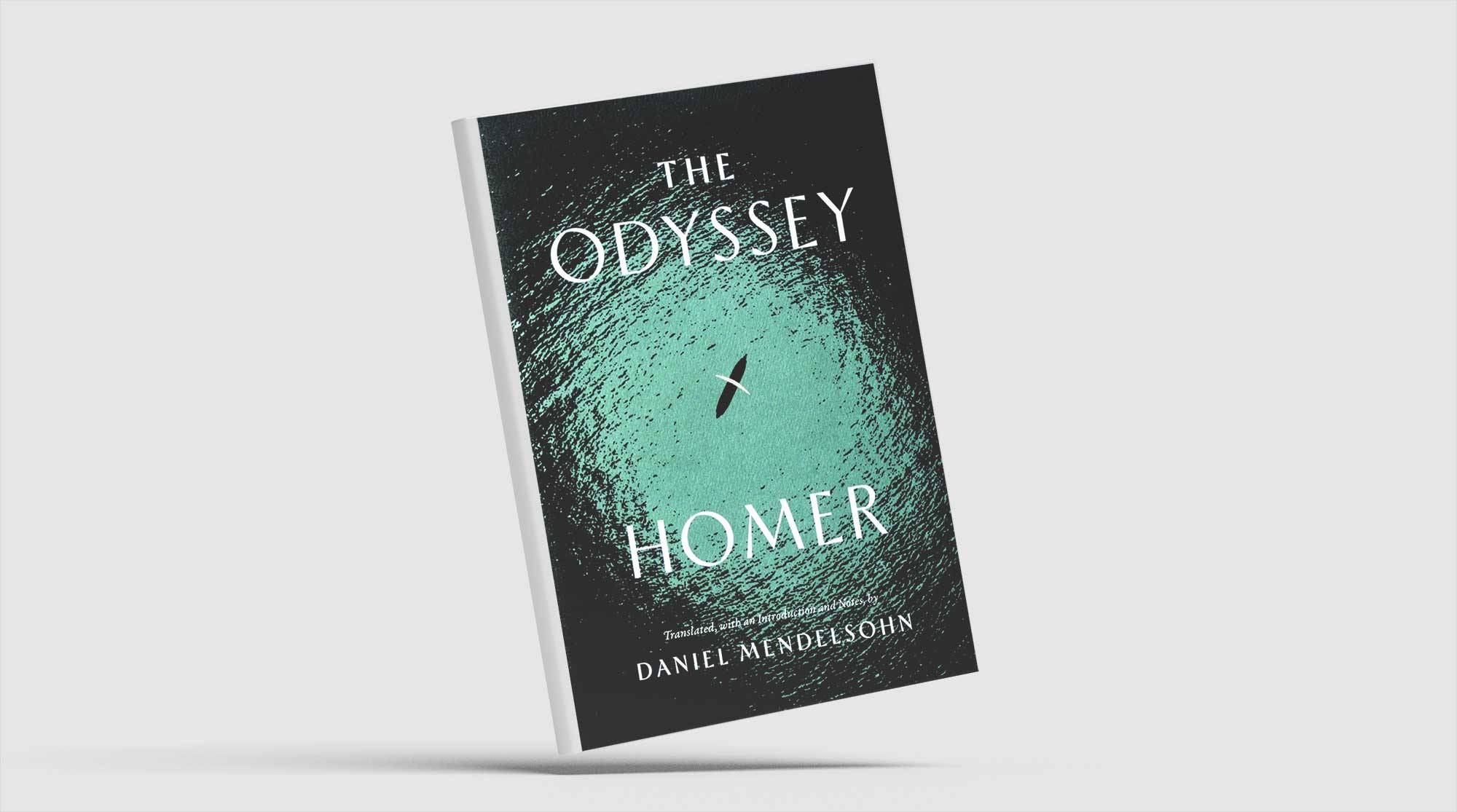
In 2017, W. W. Norton & Company published a translation by Emily Wilson, a professor at the University of Pennsylvania. Last year, the University of Chicago Press released a translation by Daniel Mendelsohn, a professor at Bard College.
Classicists are often stereotyped as monk-like scholars secluded in academia’s ivory tower. Wilson and Mendelsohn, however, are striking exceptions. Both have developed compelling and highly visible public profiles.
Mendelsohn’s cultural criticism is as highly regarded as his scholarly and academic work. He has written for prominent publications including The New York Times, The New Yorker, and The New York Review of Books.
Wilson, meanwhile—the first woman to translate The Odyssey into English—has attracted considerable attention and controversy for two reasons. First, her strikingly direct translation sparked an intense debate over the best way to render Homer’s works into modern English. Second, her work found itself caught up in the “culture wars,” as she herself described the phenomenon in a recent interview with New York magazine.
“After I published my translation of The Odyssey, the work was praised—somewhat simplistically—as an expression of ‘girl power,’ but it also faced backlash and criticism,” Wilson told the magazine last month.
The considerable public profiles of both translators have proved a major advantage amid the widespread interest—or “Odyssey fever”—currently sweeping the literary world.
“It may not be surprising that we are promoting Emily Wilson’s translation,” Louise Brockett, communications director at Norton, said in an email. “What is more surprising is the amount of interest that is growing organically. Group readings of Emily Wilson’s translation have been organized, and book clubs devoted specifically to discussing The Odyssey have been formed.”
Like Wilson, Mendelsohn has become “an authoritative voice for journalists covering the work and for those seeking to learn more about the epic and the world of Homer,” Levi Stahl, marketing director at the University of Chicago Press, said in an email.
Originally published in Asharq Al-Awsat.
Most read