Israel’s Election: A Struggle for Power Amid Political Uncertainty and Limited Prospects for the Palestinians

A close contest between rival blocs, the prospect of prolonged coalition negotiations, and limited differences between Netanyahu and Eisenkot on the Palestinian issue make the election a test of Israel’s political system rather than a guaranteed turning point in existing policies.
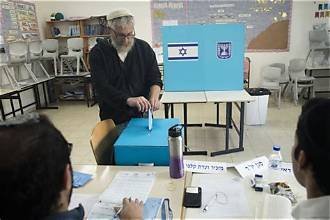
Israel is approaching its parliamentary election amid deep political polarisation, with party calculations intersecting with the consequences of the war in Gaza, the security failures associated with the attacks of 7 October 2023, and disagreements over the future of relations with the Palestinians. The significance of the election extends beyond the choice of the next government. It also tests the political system’s ability to produce a stable majority at a time when the competing blocs are closely matched and the interests of smaller parties may determine the formation of the next governing coalition.
The extensive security preparations, including the deployment of approximately 22,000 police officers in anticipation of possible unrest following the release of exit polls, reflect concerns about the potential consequences of the result. According to The Jerusalem Post, the scenarios under consideration included the possibility that one of the two rival blocs might refuse to accept the results, allege electoral fraud and attempt to undermine public order. The scenario evoked comparisons with the attack on the US Capitol on 6 January 2021.
The possibility carries political implications beyond security planning. It suggests that, under conditions of intense polarisation, electoral competition could develop into a crisis of confidence in public institutions and the democratic process itself. However, preparations for such a scenario do not necessarily mean that it will occur; they reflect an assessment of potential risks in an election expected to produce a closely contested outcome.
Netanyahu and Eisenkot: A close contest and a struggle to form a government
This is Israel’s first parliamentary election since the attacks of 7 October 2023, which returned security to the centre of public debate and placed Benjamin Netanyahu’s government under considerable political pressure. Nevertheless, pre-election polling did not indicate a decisive lead for either of the two main blocs, reflecting continuing divisions within Israeli society and the difficulty of translating opposition to the government into an alternative parliamentary majority.
According to the projections cited in the report, Netanyahu’s bloc, comprising six parties, was expected to win 51 of the Knesset’s 120 seats. The rival anti-Netanyahu bloc, led by Gadi Eisenkot and his centrist Yashar party, was projected to secure the same number. Such a close contest would leave neither side able to form a government independently, making the outcome dependent on smaller parties and their willingness to enter coalitions that might conflict with positions declared during the election campaign.
One of Netanyahu’s principal vulnerabilities lies in his relationships with far-right coalition partners. Continued support from Itamar Ben-Gvir, leader of Otzma Yehudit and national security minister, cannot be taken for granted given his repeated disagreements with the prime minister. Bezalel Smotrich, leader of Religious Zionism, is similarly likely to condition his support on the next government’s willingness to pursue policies consistent with his ideological agenda, particularly regarding settlements and Palestinian territory.
Eisenkot’s bloc faces constraints of its own. Even if it succeeds in attracting voters opposed to Netanyahu’s continued leadership, that would not necessarily provide it with a cohesive parliamentary base or guarantee its ability to reconcile the competing interests of potential coalition partners. The challenge is therefore not simply the number of seats each bloc secures, but whether either can build a sustainable coalition capable of surviving its first significant political or ideological dispute.
Arab parties: A pivotal position constrained by political red lines
With the two main blocs closely matched, Arab-led parties could emerge as decisive players in determining the next government. The projections cited in the report suggested that the Joint List, comprising Hadash, Ta’al and Balad, could win nine seats, while the United Arab List, led by Mansour Abbas, could secure five.
If these projections were borne out, the 14 seats could give Arab-led parties the potential to tip the balance in favour of either bloc. However, this possibility faces significant political and ideological obstacles. The Joint List’s leadership has indicated that its willingness to support an anti-Netanyahu government would depend on certain conditions, including the establishment of a pathway towards Palestinian statehood. Netanyahu rejects Palestinian statehood and has repeatedly ruled out forming a governing coalition with Arab parties.
Eisenkot, despite presenting himself as a political alternative to Netanyahu, has also rejected the proposed two-state solution. He has stated that participation in his government would require acceptance of Israel as a Jewish and democratic state, as well as agreement with his position on Hamas. He has expressed doubts that any Arab party would accept these conditions.
These positions reveal a central paradox in Israel’s political system: Arab parties may possess considerable parliamentary weight, yet their ability to translate that influence into effective participation in government remains constrained by the declared positions of the main Jewish political blocs. They also demonstrate that the red lines parties draw during election campaigns may become subjects of negotiation once coalition talks begin. Campaign statements are therefore important indicators, but not necessarily definitive predictors of the eventual political arrangements.
If both blocs rule out cooperation with Arab parties, each may be forced to attract members or parties from the opposing camp or accept a fragile political arrangement. In either case, government formation will depend on balancing parliamentary arithmetic with ideological interests, rather than on the initial election results alone.
Coalition deadlock: A test of the political system’s flexibility
Israel’s electoral system makes post-election negotiations particularly important. Under nationwide proportional representation, voters cast ballots for party lists, and seats are allocated according to each party’s share of the vote. Since no single party has won enough seats to govern independently, coalition governments have become the norm, making post-election bargaining a decisive stage in determining government policy.
A government requires at least 61 seats in the 120-member Knesset. Under the procedure described in the report, President Isaac Herzog would ask the candidate considered most likely to form a government to assemble a coalition within 42 days. If that attempt failed, another candidate would receive 28 days. The opportunity could then pass to a candidate proposed by members of the Knesset. If these efforts also failed, a new election could follow.
This process means that the announcement of election results does not mark the end of the political struggle, but rather the beginning of another, potentially more complicated phase. Every additional seat can become a bargaining asset, while each prospective coalition partner may attach conditions involving ministerial portfolios, budgets, security policy or settlement expansion. With the two blocs expected to remain closely matched, such demands could prolong negotiations or produce a government dependent on a narrow majority that would be difficult to maintain.
One of the election’s central tests will therefore be whether the political system can translate party competition into a stable government rather than another cycle of political deadlock. Numerical victory may prove less decisive than the ability to manage internal coalition contradictions.
The Palestinians: Differences in approach, continuity in core policies
From a Palestinian perspective, the contest between Netanyahu and Eisenkot does not necessarily signal a major strategic shift in Israeli policy, even if the election produces a change in prime minister. Based on the positions outlined in the report, the differences between the two men over settlements, the future of Gaza and the possibility of Palestinian statehood appear less pronounced than their disagreements over government management and coalition formation.
Under Netanyahu’s government, settlement expansion in the occupied West Bank has accelerated alongside an increase in violence against Palestinian communities. Netanyahu has also rejected the establishment of a Palestinian state and supported advancing the controversial E1 settlement project, which has drawn opposition because of its potential to undermine territorial continuity between parts of the West Bank.
Eisenkot, by contrast, has opposed approval of the E1 project but supports settlements that comply with Israeli law, even though settlements in the occupied Palestinian territories are considered illegal under international law. This distinction reflects disagreement over a specific settlement project, but does not necessarily indicate a fundamentally different approach to the future of settlements or Palestinian national rights.
On Gaza, Eisenkot has endorsed the US-led peace framework but, like Netanyahu, has linked an Israeli withdrawal from the territory to Hamas’s disarmament. He has pledged to end Hamas’s rule in Gaza within 18 months of taking office, either through implementation of President Donald Trump’s plan or through military action.
This pledge raises questions about the means by which Eisenkot intends to achieve an objective that Netanyahu’s government has failed to accomplish during years of war. Linking withdrawal to disarmament also leaves the future of Israel’s military presence in Gaza dependent on security and political conditions whose implementation mechanisms and prospects for agreement remain unclear.
Palestinians may therefore conclude that replacing the prime minister, in itself, would be insufficient to bring about a meaningful change in policies concerning occupation, settlements and Gaza. The real test lies not simply in who leads the government, but in whether the next coalition is prepared to change existing policies and support a political process that allows Palestinians to determine their national future.
Beyond the vote: Political change or continued deadlock?
Israel’s election exposes a dilemma that goes beyond competition between two political figures: the gap between the desire for a change in leadership and the ability to change policy. A close result could prolong negotiations, reproduce coalitions built on mutual concessions or lead to another election if the parties fail to agree on a government.
At the same time, a new leadership would not necessarily transform Israeli policy towards the Palestinians as long as key positions on Palestinian statehood, settlements and the future of Gaza remain broadly shared among competing political forces. This does not mean that political differences are insignificant or that change is impossible. It means that a change at the top of government does not automatically produce a change in the state’s underlying policy direction.
The outcome of coalition negotiations, the positions adopted by Arab-led parties, and the arrangements reached between right-wing and centrist forces will all be decisive in determining the shape of the next government. For Palestinians, however, the central question remains whether Israel’s internal political contest will open the way to a different political trajectory or merely rearrange the balance of power within a system that remains deadlocked over Palestinian national rights.
Ultimately, the election represents a dual test: whether Israel’s political system can produce a stable parliamentary majority, and whether a change of government can lead to substantive policy change. The interaction between these two questions will determine the significance of the vote, not only for Israel’s political future but also for the prospects of a political settlement with the Palestinians.
Most read


Read also